
ABIA PENSION DEBATE: LET US NOT TURN OTTI’S ATTEMPT TO SOLVE AN INHERITED CRISIS INTO THE ORIGIN OF THE CRISIS
The latest intervention by the Abia Pensioners Forum deserves attention because pensioners are entitled to ask questions about money earned through years of public service. But the presentation of the controversy also requires historical balance. Anyone reading the headline that Governor Alex Otti is being asked to clear “over 60 months” of pension arrears could easily come away believing that these arrears accumulated under the present administration. They did not.
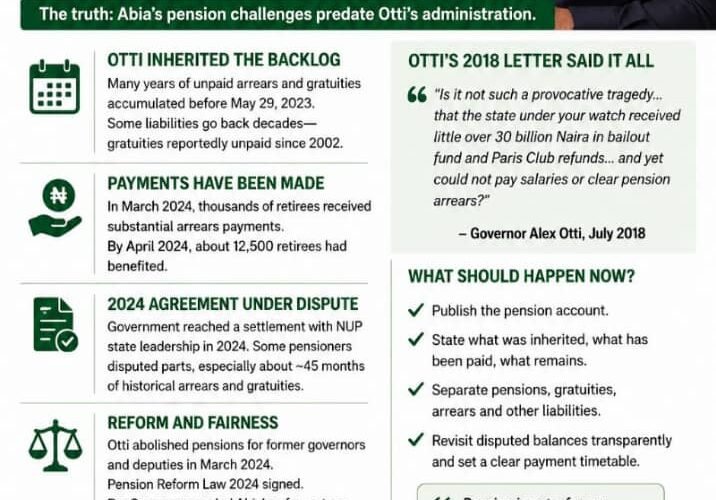
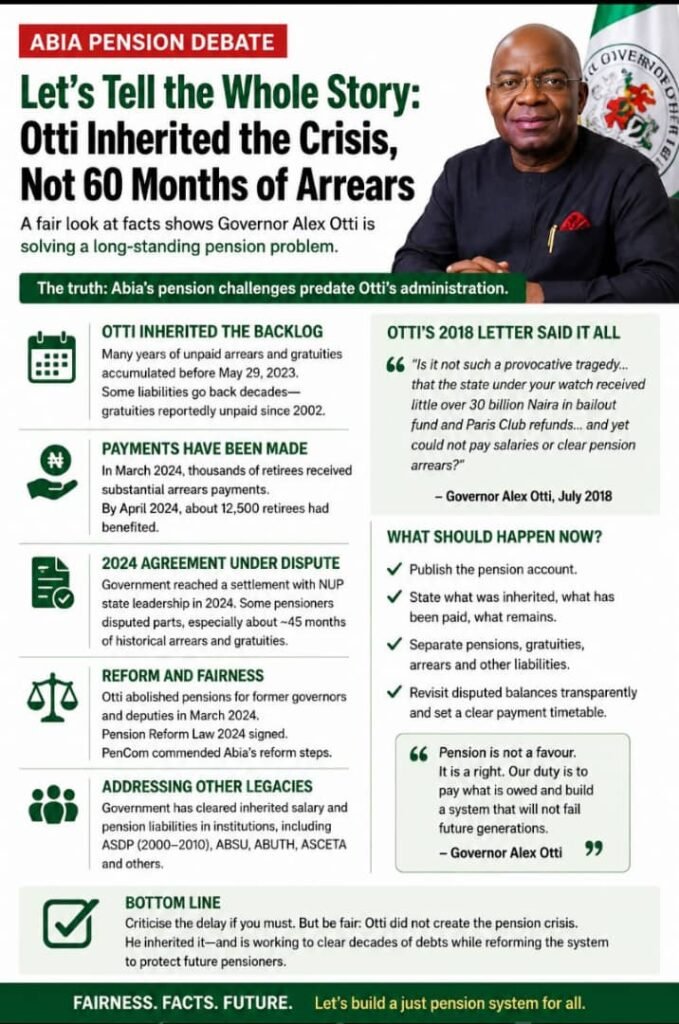
Otti Inherited the Pension Crisis; He Did Not Create It
Governor Alex Otti assumed office on 29 May 2023. Long before then, Abia pensioners had endured years of irregular payment, percentage payment, accumulated arrears and unpaid gratuities. Indeed, the present controversy itself acknowledges that some of the liabilities stretch many years backwards.
That distinction is fundamental.
If a government inherits arrears accumulated from 2014, 2015, 2016 and subsequent years, it is legitimate to demand that the new government resolve them. But it is historically misleading to discuss those liabilities as though they represent 60 months in which the Otti administration refused to pay pensioners.
They are substantially legacy liabilities inherited by Otti.
What Changed After May 2023?
One useful test of any administration is whether it is adding new arrears to the inherited stock or stopping the accumulation.
Governor Otti declared at his inauguration that from June 2023, salaries and pensions should be paid regularly by the 28th of each month. The administration subsequently began addressing the inherited pension problem. Independent accounts recorded substantial payments to thousands of pensioners in March 2024, with some retirees receiving payments running into more than ₦1 million.
By April 2024, about 12,500 retirees had reportedly received payments under the pension settlement exercise.
So the proposition that the Otti government “has not fulfilled any promise to Abia pensioners” is too sweeping to survive scrutiny.
There is an unresolved argument over how much of the historical liability was legally and finally extinguished, but that is quite different from claiming that nothing was done.
The Real Controversy Is the 2024 Settlement
This is where the debate should properly be located.
The Abia Government reached an agreement with the state leadership of the Nigeria Union of Pensioners in 2024 as part of the effort to resolve inherited pension liabilities. Subsequently, sections of the pensioners rejected aspects of the agreement, particularly the treatment of approximately 45 months of historical arrears and gratuities.
Even the national leadership of the NUP later appealed to Governor Otti to reconsider the agreement, saying the state union officials had entered it in error.
That means there is a genuine dispute.
But a disputed settlement is not the same thing as a government simply refusing to pay pensions for 60 months.
The more accurate question is therefore:
What historical liabilities were covered by the 2024 settlement, what amounts were actually paid, what balances were waived or considered settled, and should those balances now be reopened?
That is a much more serious conversation than a politically convenient headline.
The Gratuity Question Must Also Be Separated From Monthly Pension
The article also mixes pension arrears with gratuity.
They are related retirement obligations, but they are not the same accounting item.
Indeed, the Forum itself reportedly stated that gratuities had effectively not been paid regularly in Abia since about 2002. If that is accurate, it tells us something important: Governor Otti inherited a gratuity problem approximately two decades old.
That does not absolve his government of the responsibility to deal with it. It does, however, completely change the context.
The fair criticism is:
“Governor Otti inherited a massive gratuity backlog and should accelerate its liquidation.”
The unfair version is:
“Otti has refused to pay gratuities for decades.”
He obviously could not have created liabilities dating from 2002 when he became governor in 2023.
There Is Evidence of a Broader Attempt to Clear Inherited Labour Liabilities
The pension issue should also be viewed against the wider pattern of legacy obligations being addressed by the administration.
In March 2026, Governor Otti approved payment of pension arrears to surviving retirees of the Abia State Agricultural Development Programme covering the period 2000–2010—workers whose problem preceded his administration by more than a decade.
Reports have also documented payments or interventions concerning inherited salary arrears involving workers of the former Abia State Polytechnic, Abia State University Teaching Hospital, Abia State University, ASCETA and other public institutions.
This is relevant because it suggests that the administration’s approach has generally been to identify inherited liabilities, verify them and progressively liquidate them rather than simply disclaim responsibility because another government created them.
Otti Also Abolished Political Pensions
There is another fact that should not disappear from a discussion about pension justice.
In March 2024, Governor Otti signed legislation repealing the law that provided pensions and other benefits for former governors and deputy governors of Abia State.
SERAP publicly commended the action and urged other governments to emulate Abia.
The symbolism is difficult to dismiss: while dealing with liabilities owed ordinary retired workers, the administration abolished the extraordinary pension privileges enjoyed by former political office holders.
That does not settle every outstanding pensioner’s claim, but it is relevant evidence when assessing whether the government is philosophically indifferent to pension justice.
The Pension System Is Also Being Reformed
Beyond paying old debts, there is the question of preventing another generation of pensioners from facing the same nightmare.
Abia enacted the Pension Reform Law in 2024 and began moving towards a more sustainable contributory pension framework. The National Pension Commission subsequently commended the state for the reform steps and its attempt to establish a pension arrangement capable of surviving beyond the tenure of one governor.
That may ultimately be the bigger achievement.
Paying yesterday’s arrears without reforming the system that produced them merely postpones the next crisis.
So What Should Otti Do Now?
The government should not become defensive about the pensioners raising these questions. In fact, the cleanest way of ending the controversy is radical transparency.
Publish the pension account.
State clearly how much liability was inherited on 29 May 2023.
State how many months constituted that liability.
State how much has been paid since then.
Separate pension arrears, current pensions, gratuities, percentage-payment balances, and special institutional liabilities.
Publish the 2024 agreement with the NUP.
Then show exactly which liabilities government regards as extinguished under the agreement and which remain outstanding.
If genuine verified balances remain, establish a transparent timetable for paying them.
Governor Otti would lose little politically by doing this and could gain considerably.
The Historical Record Matters
There is an irony in invoking Alex Otti’s 2018 letter attacking the previous government over unpaid pensions.
That letter should not embarrass him. It should actually be used as the standard against which his government is measured.
But the comparison must be like-for-like.
In 2018, Otti was criticising a government under whose watch pension liabilities were accumulating.
In 2026, the legitimate question is whether the Otti administration is creating new arrears or trying—successfully or imperfectly—to liquidate inherited ones while keeping current obligations running.
Those are two very different propositions.
Conclusion: Criticise the Delay, But Tell the Whole Story
Abia pensioners have every right to demand every legitimate entitlement due to them. Gratuity is not charity. Pension is not a favour. Any unresolved balance deserves transparent reconciliation and, where valid, payment.
But fairness equally requires acknowledging what has changed.
Alex Otti did not inherit a functioning pension system. He inherited a pension crisis.
He inherited arrears running backwards for years.
He inherited gratuity liabilities stretching back decades.
His government made substantial payments in 2024.
Monthly pension payment was restored on a more regular footing.
His government has continued addressing extraordinary historical liabilities, including some originating as far back as 2000.
He abolished pensions for former governors and deputy governors.
And his administration enacted reforms intended to prevent the pension system from returning to the very condition he inherited.
So the proper headline is not:
“Otti Owes Pensioners Over 60 Months.”
A more historically accurate formulation would be:
“Abia Pensioners Ask Otti to Complete the Resolution of Decades-Old Liabilities His Government Inherited.”
That formulation does not silence the pensioners.
It simply places responsibility, achievement and unfinished business where they actually belong.