


NNPCL REMITTANCE CLAIMS: WHEN BIG NUMBERS BECOME BIG DECEPTION
The recent claim that NNPCL remitted about $15.33 billion to the Federation under President Bola Tinubu in roughly three years, compared with only about $13 billion allegedly remitted between 1999 and 2023, deserves far more scrutiny than the celebratory graphics circulating on social media suggest. The issue is not merely whether the figures quoted are numerically correct. The deeper question is whether the figures are conceptually comparable, historically consistent and economically meaningful. Once those questions are asked, the apparent simplicity of the claim begins to collapse.
THE $13 BILLION HISTORICAL CLAIM IS THE FIRST PROBLEM
The assertion that NNPC remitted only about $13 billion to the Federal Government over the entire period from 1999 to 2023 is difficult to accept at face value without a clearly stated primary source and accounting definition. Nigeria earned substantial petroleum revenues throughout those years, and official records from institutions such as NEITI show significant remittances to the Federation Account within much shorter periods.
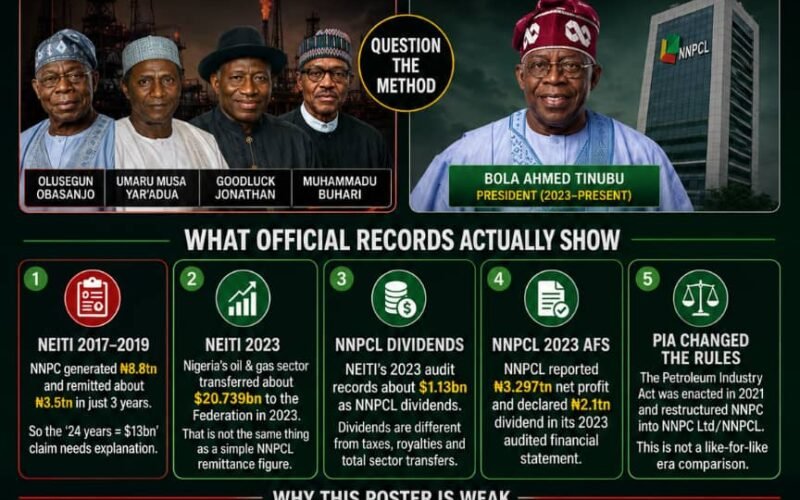
For example, NEITI’s fiscal allocation report covering 2017 to 2019 recorded roughly ₦3.5 trillion in NNPC remittances to the Federation Account during those three years alone. That does not automatically disprove every possible interpretation of the $13 billion figure, because the two numbers could represent different accounting categories. But that is precisely the problem. If the author of the claim is using a very narrow definition of “remittance,” that definition must be disclosed before comparing it with a modern figure.
A statistic without its accounting definition is not evidence. It is merely a number.
NNPC OF 1999 IS NOT THE SAME INSTITUTION AS NNPC LIMITED TODAY
A central weakness in the comparison is that it treats the old Nigerian National Petroleum Corporation and the present Nigerian National Petroleum Company Limited as though nothing changed institutionally.
Something very important changed.
The Petroleum Industry Act 2021 fundamentally altered Nigeria’s petroleum governance structure and provided for the incorporation of NNPC Limited as a commercially oriented company. Consequently, the mechanisms through which petroleum revenues now reach government are not necessarily identical to those that operated twenty years ago.
Under different regimes, government petroleum receipts may appear as crude oil sales, royalties, petroleum taxes, dividends, production-sharing revenues, Federation Account transfers and other fiscal flows.
Therefore, simply taking a figure labelled “NNPC remittance” from one institutional period and putting it beside another figure from a post-PIA period can produce a completely misleading comparison.
The elementary rule of economic statistics is simple: compare like with like.
THE GOVERNMENT ITSELF HAS RECENTLY CHANGED THE REMITTANCE SYSTEM
The difficulty becomes even more obvious when recent reforms are considered. In February 2026, the Federal Government directed that oil and gas revenues owed to government should be paid directly into the Federation Account, changing earlier arrangements under which significant deductions and retentions occurred within the petroleum revenue system.
That reform alone should warn analysts against pretending that a remittance number from 2026 is automatically comparable with one from 2006 or 2016.
If the rules governing what is retained, deducted, transferred or classified as revenue have changed, the headline figures will change even when underlying petroleum-sector performance has not changed by the same magnitude.
Accounting architecture matters.
NNPCL’S OWN ACCOUNTS SHOW WHY SIMPLE POLITICAL COMPARISONS ARE DANGEROUS
NNPC Limited reported a ₦3.297 trillion net profit for 2023, representing a substantial increase from the previous year’s figure. It also declared a dividend of approximately ₦2.1 trillion.
These are important numbers.
But profits and dividends are not the same as Federation oil revenue. Taxes are not dividends. Royalties are not crude-sale proceeds. Gross revenues are not net remittances.
Combining these concepts selectively can create almost any political narrative one wants.
That is precisely why serious fiscal analysis must identify the components of every number before drawing conclusions from it.
WHERE IS THE DENOMINATOR?
Perhaps the biggest analytical omission in the viral claim is the absence of a denominator.
If NNPCL remitted $15.33 billion, the immediate economic question should be: out of how much total petroleum revenue?
Suppose one administration generated $20 billion and remitted $13 billion. Suppose another generated $60 billion and remitted $15 billion. Merely looking at $13 billion against $15 billion would make the second administration appear superior, even though the first may have transferred a much larger proportion of available revenue.
Absolute values alone therefore reveal very little about efficiency.
A more meaningful indicator would examine the percentage of petroleum revenue ultimately transferred to government, the cost of producing each barrel, operating expenditure, subsidy obligations, debt deductions, joint-venture expenditure, crude losses and other legitimate or questionable deductions.
Without the denominator, the public is being shown the numerator and asked to applaud.
That is not analysis.
THE EXCHANGE-RATE PROBLEM CANNOT BE IGNORED
There is another major methodological weakness.
The comparison stretches across nearly three decades during which Nigeria operated vastly different exchange-rate regimes.
The naira traded at dramatically different values against the dollar under Obasanjo, Yar’Adua, Jonathan, Buhari and Tinubu. Therefore, if historical remittances originally recorded in naira are converted into dollars, the exchange rate chosen can radically alter the final dollar value.
Was each year’s naira remittance converted using the exchange rate prevailing in that particular year?
Was an average annual rate used?
Was the official rate used?
Was the parallel-market rate used?
Were only dollar-denominated receipts counted?
Nobody can properly evaluate the $13 billion historical claim until these methodological questions are answered.
When somebody gives you a twenty-four-year dollar total without explaining the exchange-rate methodology, scepticism is not cynicism. It is elementary economics.
NOMINAL DOLLARS ACROSS TWENTY-SEVEN YEARS ARE NOT ECONOMICALLY IDENTICAL
There is also the question of inflation.
A dollar in 1999 had considerably greater purchasing power than a dollar today. Comparing nominal dollar values spanning almost three decades without adjusting for inflation gives an exaggerated impression of the superiority of recent nominal figures.
This is why serious economists distinguish between nominal and real values.
A political graphic may ignore this distinction because large contemporary numbers look impressive. Economic analysis cannot.
OIL PRICES WERE NOT CONSTANT
Nigeria does not determine the international price of crude oil.
Different presidents governed during radically different global oil-market conditions. Crude prices have ranged from extraordinarily low levels to well above $100 per barrel over the period being compared.
Consequently, an administration operating during a high-price oil environment may naturally collect more revenue than one operating during a low-price period, even if their administrative efficiency is identical.
To determine whether NNPCL’s performance actually improved, analysts should control for the international oil price environment.
Without doing so, a government may effectively be taking political credit for movements in global commodity markets.
PRODUCTION VOLUME ALSO MATTERS
Revenue depends not only on price but also on quantity.
Nigeria has experienced substantial fluctuations in crude oil production because of OPEC quotas, pipeline vandalism, crude theft, militant activity, ageing infrastructure, investment shortfalls and operational shutdowns.
A meaningful comparison must therefore examine how many barrels were produced and sold during each period.
If one administration produced significantly more crude than another, the expected petroleum revenues would naturally differ.
The proper analytical question is consequently not merely how many dollars were remitted. It is how effectively each barrel of Nigeria’s petroleum resources was converted into public revenue.
That is a completely different question from the one presented by the political graphic.
THE CLAIM THAT HIGHER REMITTANCE PROVES CORRUPTION WAS FOUGHT IS LOGICALLY UNSOUND
Perhaps the most extraordinary part of the circulating message is the suggestion that the alleged $15.33 billion remittance proves that President Tinubu has fought corruption within NNPCL.
Even if the $15.33 billion figure were perfectly accurate, the conclusion still would not logically follow.
Higher government remittances can result from higher oil prices, increased production, lower deductions, exchange-rate changes, changes in subsidy arrangements, new fiscal rules, dividend declarations, changes in tax treatment or altered accounting structures.
None of those automatically proves that corruption declined.
Evidence of reduced corruption would require something entirely different. It would require improved procurement transparency, credible independently audited accounts, reconciliation of crude production and lifting, reduced unexplained losses, transparent contracts, lower revenue leakages and effective institutional accountability.
A larger remittance number cannot substitute for that evidence.
THE PIA ITSELF PREDATES THE PRESENT ADMINISTRATION
There is also an important historical point that any fair assessment should recognise.
The Petroleum Industry Act was enacted in 2021 under President Muhammadu Buhari, not President Tinubu.
The transition from the old NNPC structure to the commercially oriented NNPC Limited emerged from that legislation.
Therefore, if improved commercial discipline, dividend structures or fiscal separation under NNPCL have contributed to higher government receipts in recent years, part of the institutional explanation lies in a reform enacted before the current administration assumed office.
A government is entitled to take credit for successfully implementing inherited reforms.
It is not entitled to erase the history of those reforms.
THERE ARE ALSO LARGE UNRESOLVED PETROLEUM ACCOUNTING QUESTIONS
The deeper one searches into Nigeria’s petroleum accounts, the less convincing simplistic political graphics become.
There have been long-running disputes involving alleged under-remittances, liabilities, deductions and reconciliation differences between NNPC, regulators and government institutions. Recent reporting has referenced a longstanding dispute concerning tens of billions of dollars in alleged historical under-remittances, while NNPC has maintained that its revenues were properly accounted for.
That alone demonstrates how technically complicated petroleum revenue accounting is.
If government institutions themselves have spent years reconciling what was earned, owed, deducted and remitted, it is intellectually unserious for a social-media graphic to compress twenty-four years of petroleum fiscal history into one unqualified “$13 billion” number.
REMITTANCE IS NOT THE SAME THING AS PERFORMANCE
There is another deeper economic issue.
Even if NNPCL genuinely remits significantly more money today, Nigerians are entitled to ask what those higher remittances are achieving.
Public enterprises do not exist merely to produce impressive figures for government press releases.
Petroleum revenue should ultimately translate into public welfare.
If more money is entering government coffers while public debt remains extremely high, infrastructure deficiencies persist, poverty remains widespread, electricity remains unreliable, unemployment and underemployment remain serious and household purchasing power remains under intense pressure, Nigerians have every right to ask where the transmission mechanism has broken down.
Higher remittance is useful.
But higher remittance without visible development raises another set of accountability questions.
THE REAL QUESTION SHOULD BE REVENUE PER BARREL
A more sophisticated comparison would calculate government petroleum revenue relative to the volume and value of petroleum produced.
How much did government receive per barrel?
What percentage of gross petroleum revenue reached the Federation?
What were operating costs per barrel?
How much was lost through theft?
How much was deducted for commercial or quasi-fiscal obligations?
How much went into joint-venture expenditure?
How much was retained by NNPCL?
These measures would provide genuine evidence of whether petroleum-sector efficiency has improved.
Merely comparing two absolute dollar amounts does not.
NIGERIANS SHOULD DEMAND THE AUDITED WORKING
The answer to questionable statistics is not another questionable statistic.
Government and its supporters should publish the underlying calculations.
Let Nigerians see the annual remittance series from 1999 to the present. Let the accounting definition remain identical throughout the series. Let crude production volumes be shown beside revenues. Let average international oil prices be included. Let exchange rates used in currency conversion be disclosed. Let royalties, taxes, dividends, crude-sale proceeds and other revenue categories be separated.
Once that information is available, Nigerians can judge the performance objectively.
Until then, presenting $13 billion against $15.33 billion as incontrovertible proof of extraordinary performance is not serious economic analysis.
It is political advertising disguised as arithmetic.
DON’T GIVE NIGERIANS A POSTER — GIVE THEM THE ACCOUNTS
Nigeria’s petroleum industry is too important to be reduced to partisan graphics.
NNPCL controls assets that ultimately belong to the Nigerian people. The standard required should therefore be far higher than viral claims, selective figures and celebratory captions.
Nobody should be afraid of good performance. If NNPCL has genuinely become dramatically more efficient, Nigerians should celebrate it.
But extraordinary claims require transparent evidence.
Show the gross revenues.
Show the production.
Show the costs.
Show the deductions.
Show the taxes.
Show the royalties.
Show the dividends.
Show the exchange-rate methodology.
Show the audited annual remittances.
Then let the numbers speak.
Until that is done, Nigerians should treat the viral comparison for what it presently appears to be: an incomplete statistical comparison attempting to carry a much larger political conclusion than the available evidence can support.
The issue is therefore not whether one supports or opposes President Tinubu.
The issue is whether public economic claims can survive elementary scrutiny.
Nigeria deserves better than selective statistics.
Don’t give Nigerians propaganda with a dollar sign attached to it. Give Nigerians the audited accounts.