
Nigeria’s 148% FDI Jump Is Not Yet Development: FG Should Stop Celebrating Headlines, Roll Up Its Sleeves and Get to Work
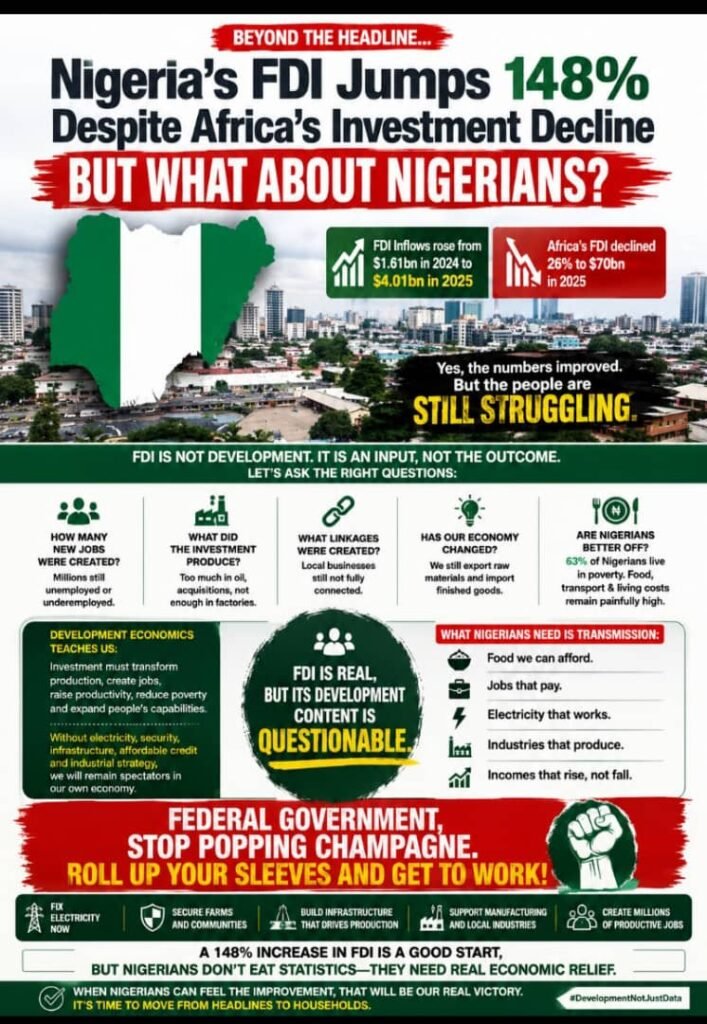
Nigeria’s reported 148 per cent increase in Foreign Direct Investment, from approximately $1.61 billion in 2024 to $4.01 billion in 2025, is undoubtedly a positive development. At a time when total FDI inflows into Africa reportedly declined by about 26 per cent, Nigeria’s ability to attract significantly more foreign capital deserves acknowledgement. It suggests that some degree of international investor confidence may be returning following reforms in the foreign exchange market, fiscal administration, petroleum sector and broader macroeconomic environment. But there is a danger in converting an improvement in one macroeconomic indicator into evidence that the Nigerian economy has fundamentally turned the corner. It has not. The visible economic reality confronting millions of Nigerians remains far more complicated than the headline FDI figure suggests.
The Federal Government must therefore resist the temptation to celebrate the percentage increase without interrogating what lies beneath it. Development economics has never regarded capital inflow as an end in itself. Investment becomes meaningful when it transforms production, raises productivity, expands employment, improves household income and ultimately reduces poverty. The relevant question is consequently not simply whether Nigeria attracted $4.01 billion in FDI. The important questions are what kind of investment entered Nigeria, which sectors received it, how many new productive assets were created, how many sustainable jobs emerged, what domestic industries benefited from the investment and, ultimately, whether ordinary Nigerians experienced any measurable improvement in their standard of living.
FDI Is an Input, Not Development
One of the fundamental weaknesses in public discussion of foreign investment in Nigeria is the tendency to confuse the arrival of foreign capital with economic development itself. They are not the same thing. Foreign Direct Investment can contribute powerfully to development, but its developmental effect depends largely on its structure. A foreign investor who establishes a new automobile plant, pharmaceutical factory, semiconductor facility, agricultural processing complex or industrial machinery plant creates an entirely different economic footprint from an investor who purchases an already existing Nigerian asset.
This distinction becomes especially important when examining Nigeria’s recent FDI performance. A significant part of the reported increase appears connected with major transactions in oil, gas, cement and energy-related assets. Renaissance Africa Energy’s acquisition of Shell’s Nigerian onshore assets and Huaxin Cement’s acquisition of Lafarge Africa are substantial transactions and should not be dismissed. They demonstrate investor interest and involve the movement of substantial capital. Nevertheless, the developmental implications of an acquisition must be distinguished from those of greenfield investment. The transfer of ownership of an existing productive asset may increase the recorded value of foreign investment without necessarily producing a corresponding increase in new factories, new industrial capacity or new employment.
A country therefore cannot measure the quality of its development merely by counting the dollars that crossed its borders. It must ask what those dollars actually created.
The Poverty Numbers Puncture the Celebration
The strongest challenge to excessive celebration of Nigeria’s FDI numbers is the poverty visible across the country. Millions of Nigerians continue to experience severe pressure from food prices, transportation costs, rents, school fees, electricity charges and healthcare expenses. Households that previously considered themselves comfortably middle class increasingly struggle to maintain basic consumption patterns. Workers routinely supplement their salaries with additional businesses. Young graduates remain unemployed or underemployed. Small enterprises struggle with electricity, financing and logistics costs. Rural communities face insecurity that disrupts agricultural production, while urban households confront continually rising living costs.
This creates one of the central contradictions of the present Nigerian economy. Macroeconomic indicators may be gradually improving while microeconomic welfare remains severely stressed. Government revenue can rise while household purchasing power declines. Foreign reserves can improve while families reduce the quantity and quality of food they consume. FDI can rise by 148 per cent while poverty remains widespread. GDP can expand while millions of citizens feel economically poorer.
There is nothing unusual about such a divergence in the short run. Economic reforms frequently produce delayed benefits. But the existence of that delay should encourage humility from policymakers rather than triumphalism. The appropriate message should therefore be that some foundations for recovery may be emerging, but enormous work remains before those gains become visible in ordinary households.
Arthur Lewis Would Ask: Where Are the Jobs?
The celebrated development economist Arthur Lewis provides an important framework for analysing Nigeria’s predicament. Lewis argued that economic transformation occurs when surplus labour moves from low-productivity traditional activities into a modern, higher-productivity sector. Industrial expansion absorbs labour, increases productivity and raises incomes. Economic transformation, therefore, cannot be separated from employment creation.
Applied to Nigeria, the important question becomes straightforward: how many productive jobs accompanied the $4.01 billion investment inflow?
Nigeria has a youthful population and millions of young people entering the labour market. This demographic structure can become an extraordinary economic advantage if productive employment expands sufficiently. It can equally become a severe social problem if economic growth continuously fails to create opportunities. Consequently, every major FDI announcement should be accompanied by employment statistics. Government should tell Nigerians how many permanent jobs were created, how many skilled Nigerian workers were employed, how many apprentices were trained and how many local businesses became suppliers to the investing companies.
An investment figure without an employment multiplier is incomplete development information.
If billions of dollars enter an economy while millions of economically active citizens remain trapped in informal, precarious and extremely low-productivity employment, the Lewisian transformation has not occurred. Capital may have entered, but structural economic development remains unfinished.
Hirschman Would Ask: Where Are the Economic Linkages?
Albert Hirschman’s theory of economic development provides another useful lens. Hirschman emphasised the importance of backward and forward linkages between industries. Investment generates development when activity in one sector creates demand and opportunities in several other sectors.
Imagine, for instance, a large automobile manufacturing plant established in Nigeria. Such a plant could create demand for tyres, batteries, plastics, glass, electronics, steel, transportation, insurance, logistics, engineering, maintenance, banking, information technology and professional services. Thousands of businesses could potentially become connected to the productive ecosystem created by one major industrial investment.
This is fundamentally different from an investment whose operations remain largely isolated from the domestic economy.
Nigeria must therefore stop evaluating foreign investment merely according to its dollar value and begin measuring its linkage effects. For every billion dollars entering the economy, policymakers should ask how much domestic value is being created. How many Nigerian suppliers are participating? How much technology is being transferred? How much local manufacturing is being stimulated? How much of the investment translates into exports? How many Nigerian companies become stronger because the foreign investor arrived?
A smaller investment producing deep domestic linkages can sometimes contribute more to long-term development than a much larger transaction that operates as an economic enclave.
The Structuralist Question: What Exactly Is Nigeria Producing Differently?
Structuralist development economists such as Raúl Prebisch warned developing countries about dependence on primary commodities and the long-term dangers of exporting raw materials while importing manufactured and technologically sophisticated goods. Nigeria’s economic history illustrates this problem almost perfectly.
For decades, Nigeria has exported crude petroleum while importing refined products, industrial machinery, pharmaceuticals, electronics and numerous manufactured consumer goods. Oil prices rise and government revenue expands. Oil prices fall and fiscal pressures return. Foreign exchange becomes scarce, the currency weakens, inflation accelerates and another cycle of economic adjustment begins.
That cycle is not structural transformation.
True transformation occurs when the productive structure of the economy itself changes. Nigeria must increasingly become a country that manufactures, processes, designs and exports sophisticated products. The future of Nigerian FDI therefore cannot remain disproportionately concentrated in extractive industries and acquisitions of established assets. The country needs investment in petrochemicals, agro-processing, pharmaceuticals, machinery, renewable energy equipment, digital infrastructure, electronics, transportation equipment, industrial agriculture and export-oriented manufacturing.
The crucial question is therefore not simply whether foreign capital is returning. It is whether foreign capital is helping Nigeria become a fundamentally different type of economy.
Amartya Sen Would Ask Whether Nigerians Are Actually Better Off
Amartya Sen broadened development analysis beyond GDP growth and capital accumulation. His capability approach essentially argues that development should be assessed by improvements in the real freedoms and capabilities available to people.
This provides perhaps the simplest test of Nigeria’s present economic condition.
Can the average household purchase adequate food more easily than before? Can parents educate their children without severe financial distress? Can families obtain healthcare when they need it? Can young Nigerians find productive employment? Can businesses obtain reliable electricity at competitive prices? Can citizens travel safely? Can farmers reach their farms without insecurity? Can productive enterprises borrow money at interest rates compatible with long-term investment?
These questions may sound less sophisticated than FDI ratios, GDP projections or reserve statistics, but they are actually closer to the purpose of development.
An economy ultimately exists to improve human welfare.
If citizens continuously hear that the economy is recovering while their personal economic circumstances deteriorate, a dangerous credibility gap emerges between official statistics and lived experience. Government should not dismiss that gap as ignorance or political hostility. It should investigate it.
The Streets Are Also Economic Evidence
Economic analysis must never become so obsessed with aggregate statistics that it becomes blind to observable social reality. Anyone travelling through Nigerian cities and communities can observe the economic pressure confronting households.
The increasing number of people requesting financial assistance, the growing reliance on informal borrowing, reduced household food consumption, the migration of professionals, weakening purchasing power among salaried workers and the growing number of small businesses operating at extremely thin margins all contain economic information.
These observations do not replace official statistics, but neither should official statistics invalidate them.
Economists understand the difference between aggregate performance and distributional outcomes. An economy may grow while particular groups become poorer. Investment may rise while income distribution worsens. Government revenue may increase while real wages fall. Inflation can overwhelm nominal salary increases. GDP per capita may perform differently from aggregate GDP when population growth remains rapid.
Therefore, the Nigerian on the street who says, “I am poorer today,” is not necessarily contradicting an economist who says, “GDP increased.” Both statements can simultaneously be true.
That distinction should discipline economic communication from government.
A 148% Increase Can Still Be Very Small
Percentages can also create optical illusions.
An increase from $1.61 billion to $4.01 billion is indeed approximately 148 per cent and represents a major improvement relative to the previous year. But the percentage sounds considerably more dramatic because the starting point was low.
Nigeria is a country of more than 200 million people with enormous infrastructure requirements, a massive labour force and substantial industrial ambitions. An annual FDI inflow of approximately $4 billion must therefore be viewed within that scale.
The Vanguard report itself provides useful perspective. Brazil reportedly attracted approximately $77 billion, while India attracted about $39 billion. Nigeria’s $4.01 billion consequently remains modest compared with major emerging economies competing for global capital.
Nigeria accounted for only a tiny fraction of global FDI.
The appropriate policy response should therefore not be self-congratulation. It should be competitiveness.
Government should ask why vastly larger amounts of international productive capital still choose other countries. Why should a multinational manufacturer choose Morocco instead of Nigeria? Why should an international technology company establish its African manufacturing hub elsewhere? Why should a pharmaceutical company prefer another emerging market? Why should Nigerian companies themselves sometimes find foreign locations more commercially attractive?
Those are the uncomfortable questions capable of generating serious reforms.
Electricity Remains the Elephant in the Factory
No serious discussion about industrialisation in Nigeria can avoid electricity.
Manufacturing competitiveness depends enormously on reliable and reasonably priced energy. When firms must generate a substantial proportion of their electricity independently using diesel, gas or other alternatives, their production costs rise. Those additional costs eventually appear in consumer prices or reduce profitability.
For decades, Nigeria has attempted industrial expansion while simultaneously operating with severe electricity constraints. This contradiction has restricted manufacturing, weakened competitiveness and discouraged investment.
Government therefore cannot merely celebrate investors already willing to tolerate Nigeria’s difficult production environment. It must create an environment capable of attracting thousands more.
Industrial clusters require reliable power. Export manufacturers require reliable power. Cold-chain agriculture requires reliable power. Digital infrastructure requires reliable power. Hospitals require reliable power. Modern transportation requires reliable energy systems.
Without solving electricity at scale, Nigeria will continue fighting industrialisation with one hand tied behind its back.
Insecurity Is an Economic Variable
The discussion must also move beyond conventional financial indicators. Security is increasingly one of Nigeria’s most important economic variables.
Farmers who cannot safely access farmland reduce production. Transporters facing kidnapping risks increase charges. Businesses operating in insecure environments increase security expenditure. Investors discount future returns because of uncertainty. Insurance costs rise. Supply chains become unreliable.
Eventually, these costs appear in food prices, transportation charges and lower investment.
Agricultural insecurity is particularly dangerous because food inflation affects poorer households disproportionately. A government genuinely committed to poverty reduction must therefore regard agricultural security as economic policy, not merely policing.
Every hectare of farmland abandoned because of insecurity is lost output. Every farmer displaced represents reduced supply. Every transport route made dangerous increases distribution costs.
A serious economic recovery strategy must therefore place security alongside monetary, fiscal and industrial policy.
The Cost of Money Can Suffocate the Productive Economy
Nigeria must also confront the financing environment faced by productive businesses. High interest rates may sometimes be necessary for controlling inflation and stabilising the currency, but they create significant difficulties for manufacturers and other long-term investors.
An economy cannot sustainably industrialise when productive businesses cannot afford long-term capital.
Trading businesses can sometimes survive expensive credit because inventories turn over relatively quickly. Manufacturing is different. Factories require years of investment in equipment, buildings, technology, research, workforce development and market penetration.
Nigeria therefore needs a financial system capable of supporting productive capital formation.
Otherwise, the country risks creating a strange economy in which financial institutions remain profitable while manufacturers struggle to expand productive capacity.
Macroeconomic Stability Is Necessary, But It Is Only the Foundation
None of this means the economic reforms undertaken by the Federal Government are irrelevant. Exchange-rate reforms, fiscal adjustments, petroleum-sector reforms and efforts to improve government revenue can create the macroeconomic stability necessary for long-term recovery.
No economy develops sustainably under permanent macroeconomic instability.
But stability is the foundation of the building. It is not the completed building.
Once macroeconomic stability begins to emerge, policymakers must move aggressively toward the second stage: production.
The question must change from “How do we stabilise Nigeria?” to “What will Nigeria produce?”
The next phase of reform should therefore focus overwhelmingly on electricity, manufacturing, agriculture, logistics, export competitiveness, industrial credit, technological capability and human capital.
Nigeria cannot adjust its way into prosperity.
It must produce its way into prosperity.
Government Should Measure the Quality of FDI
Nigeria should consequently begin publishing a more sophisticated FDI scorecard.
Rather than announcing only the headline dollar amount, policymakers should explain how much represents greenfield investment, how much represents acquisitions, what proportion entered manufacturing, how much went into extractive industries, how much generated new productive capacity and what level of Nigerian employment resulted.
Government should further evaluate technology transfer, domestic procurement, export generation and local value addition.
Such information would distinguish investment that merely changes ownership from investment that actually transforms the productive structure of the economy.
Nigeria needs foreign investors, but Nigeria particularly needs the right foreign investors.
What Nigerians Need Is Transmission
The most important economic challenge confronting the Federal Government today may therefore be described as a transmission problem.
Macroeconomic reforms have been implemented. Some international indicators are showing improvement. Foreign capital appears more interested. Government revenues have increased. The foreign-exchange market has undergone substantial restructuring.
But the benefits must now transmit to households.
That transmission will occur when inflation falls faster than nominal incomes, when food becomes more affordable, when wages regain purchasing power, when businesses expand employment, when electricity becomes more reliable and when domestic production reduces dependence on expensive imports.
Until that happens, political leaders should understand why Nigerians remain sceptical when confronted with impressive macroeconomic numbers.
People do not live inside spreadsheets.
They live inside households.
Let the Government Celebrate When Nigerians Can Feel It
Nigeria should acknowledge the improvement in FDI. A country that attracts rising investment is better positioned than one experiencing sustained capital flight. But the Federal Government should treat the 148 per cent increase as encouragement to work harder rather than evidence that the work has been completed.
The real celebration should come when millions of Nigerians move out of poverty, manufacturing employment expands substantially, food inflation falls, electricity becomes reliable, exports diversify beyond crude oil and Nigerian industries begin competing successfully across Africa and the world.
That is the stage at which economic reform becomes economic development.
For now, the Federal Government should receive the FDI numbers with cautious satisfaction, put away the champagne and roll up its sleeves.
The factories still need electricity. The farmers still need security. The roads and ports still need improvement. Businesses still need affordable financing. Young Nigerians still need productive jobs. Families still need food they can afford. Nigeria still needs an industrial strategy capable of converting its enormous population into a productive economic force.
A 148 per cent increase in FDI is a good headline.
But headlines do not feed households.
Investment is not automatically development. Growth is not automatically prosperity. Macroeconomic recovery is not automatically household recovery.
The ultimate success of economic reform will not be determined by how many favourable statistics government officials can announce.
It will be determined by the day ordinary Nigerians no longer need government to tell them that the economy is improving.
They will know because they can feel it.