
From Good to Great: The Discipline of Merit in Abia’s Leadership Model
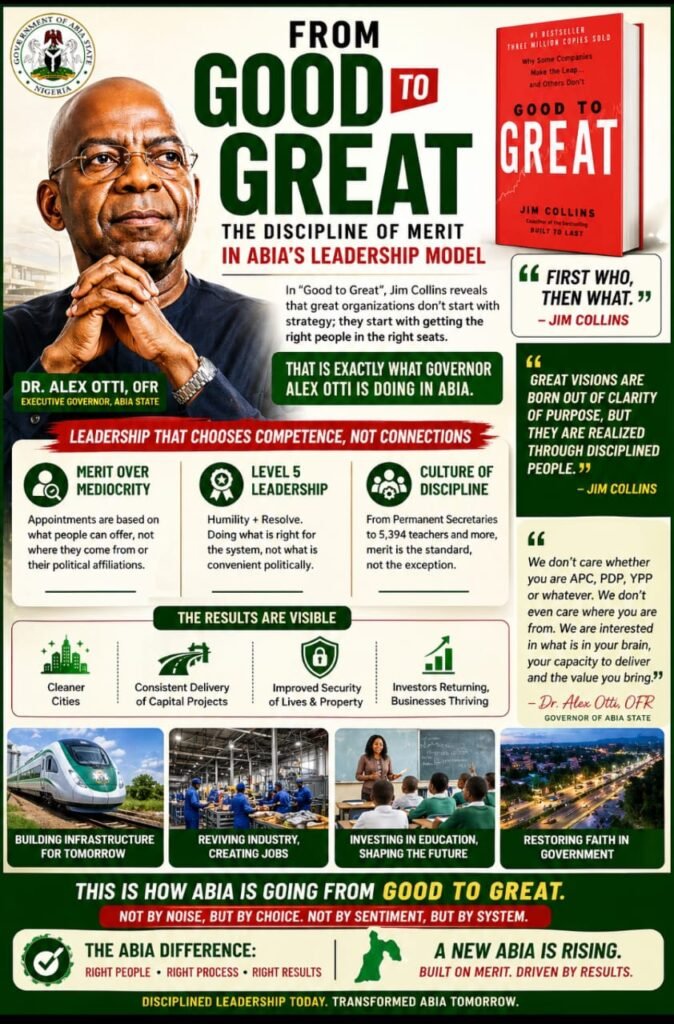
Jim Collins’ Good to Great begins with a simple but profound principle: “First who, then what.” Great institutions do not start with strategy—they start with putting the right people in the right seats. In that light, Governor Alex Otti’s insistence on merit—over origin, party, or sentiment—fits squarely within the architecture of enduring transformation.
Collins argues that great leaders are not driven by noise or popularity, but by discipline, clarity, and an uncompromising commitment to competence. When Governor Otti states that appointments are based on “what is in your brain… your capacity to deliver… your network and value,” he is effectively applying this principle in real governance. This is not politics as usual; it is institution-building through human capital selection.
Another core idea in Good to Great is the concept of Level 5 Leadership—leaders who combine humility with fierce resolve to do what is right for the system, not what is convenient politically. Choosing a candidate because she outperformed others—despite external noise—reflects that discipline. It signals a shift from patronage to performance culture, which is the bedrock of sustainable governance.
Collins also emphasizes the importance of culture of discipline. When an administration consistently applies merit—from Permanent Secretaries to thousands of teachers—it creates a system where competence becomes the standard, not the exception. Over time, this reshapes institutions: agencies become responsive, processes become efficient, and public trust begins to recover.
This is how transformation happens—not through slogans, but through structured, repeatable decisions that prioritize results. Investors respond to this. Businesses return not because everything is perfect, but because they see predictability, seriousness, and leadership intent. That is the “flywheel effect” Collins describes—small, consistent decisions building momentum into visible change.
Ultimately, Good to Great teaches that greatness is not an event; it is a process of disciplined choices. In Abia’s case, merit-based appointments are not just administrative decisions—they are signals of a deeper shift toward competence, accountability, and long-term state-building.
And in governance, as in business, one truth remains constant:
When you get the people right, the results will follow.