


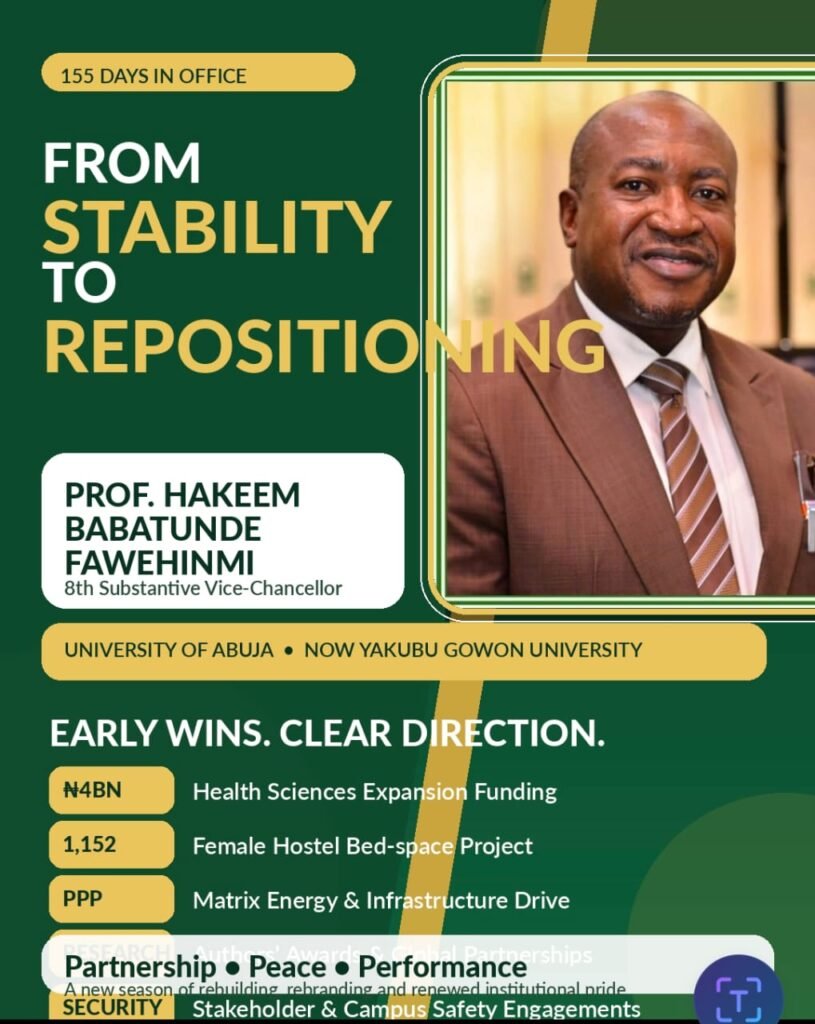
155 Days of Motion: How Professor Hakeem Babatunde Fawehinmi Is Rebranding the University of Abuja
There are leaders who enter office with noise. There are leaders who enter with ceremony. And there are leaders who enter with work.
Professor Hakeem Babatunde Fawehinmi, Vice-Chancellor of the University of Abuja, now Yakubu Gowon University, belongs to the third class. In only 155 completed days in office, counting from 11 December 2025 to 15 May 2026, he has begun to write a fresh administrative signature across the institution: a signature of stability, infrastructure, partnership, research, welfare, security, and institutional dignity.
For a university that had passed through seasons of tension, transition, uncertainty and leadership turbulence, the arrival of Professor Fawehinmi was not merely another appointment. It was a reset button. It was a call to order. It was the beginning of a deliberate attempt to return the University of Abuja to the seriousness of its mandate as Nigeria’s capital-city university.
He is a Professor of Clinical Anatomy and Biomedical Anthropology with deep experience in institutional administration, including service as Head of Department, Dean and two-term Deputy Vice-Chancellor Academic at the University of Port Harcourt. That background matters. It means he did not arrive as an experimental administrator. He came as a tested university manager with academic depth, administrative memory and reform experience. �
University of Abuja
From uncertainty to stability
Every great administration begins first by calming the ground on which it must build. Professor Fawehinmi’s first achievement is not only found in concrete and ceremonies; it is found in the restoration of confidence.
The University of Abuja had needed a steady hand, a voice of moderation, a leader who could bring the Senate, Council, management, staff unions, faculties, students and external stakeholders back into a common institutional conversation. His early consultative style signalled that the new administration would not be one of distance and command alone, but one of listening, bridge-building and structured engagement.
That is why his administration must be understood first as a stabilising administration. Before buildings rise, trust must rise. Before programmes expand, confidence must expand. Before a university becomes world-class, it must first become internally peaceful, administratively focused and morally persuaded that a new direction is possible.
A Vice-Chancellor of infrastructure, not excuses
In 155 days, one of the clearest marks of the Fawehinmi administration is its visible embrace of infrastructure through partnerships.
The groundbreaking of a 1,152-bed female hostel through a Public-Private Partnership with Royal Dynasty Homes Ltd is not a small matter. Hostel accommodation is not decoration; it is student welfare. It is security. It is academic concentration. It is dignity. A female hostel of that scale speaks directly to the lived experience of students who struggle with accommodation, transport costs, safety concerns and the emotional burden of studying from unstable living conditions. Public reports describe the project as a major step toward addressing accommodation challenges on campus. �
Nigeria Education News +1
This is the kind of project that tells students: the university sees you.
The inauguration of the Matrix Energy filling station at the University Gate/Iddo axis also fits into the same development logic. It may look like a commercial facility, but in a university ecosystem, such infrastructure expands convenience, improves campus services and strengthens the university’s capacity to attract responsible private-sector investment. The project was constructed under a PPP arrangement and commissioned as part of the university’s infrastructure and development agenda. �
Facebook +1
The point is simple: Professor Fawehinmi is not waiting for government subvention alone. He is opening the gates of the university to structured partnerships that can solve real problems.
The ₦4 billion health sciences breakthrough
Perhaps one of the biggest early wins of the administration is the University’s selection as one of the beneficiaries of the 2026 Special Intervention for Health Professions programme, with ₦4 billion FMOE/TETFund funding for health sciences expansion.
This is not ordinary funding. It is strategic funding. It targets infrastructure and equipment expansion in health-related programmes such as medicine, dentistry, pharmacy and nursing. Professor Fawehinmi described the selection as a significant achievement and noted that it would strengthen the University’s capacity to train health professionals and contribute to national development. �
University of Abuja
For a professor of medical and biomedical background, this breakthrough carries administrative symbolism. It shows alignment between his professional strength and the University’s developmental opportunity. It says that the University of Abuja can become a stronger national centre for health sciences, professional training and medical manpower development.
In a country where healthcare gaps remain wide, a capital-city university that strengthens health education is not merely helping itself; it is helping Nigeria.
Research is returning to the centre
A university is not a glorified secondary school. It is not only a place where lectures are delivered and examinations are marked. A university lives by research, publication, grants, innovation and intellectual visibility.
That is why the 2024–2025 UniAbuja Researchers and Authors Recognition Awards, hosted by the Centre for Sponsored Projects, deserves attention. At the event, 21 academics were recognised across medal categories for 2024, while 14 researchers were distinguished in 2025 for grants secured from international donor agencies. Professor Fawehinmi commended the awardees for their scholarly contributions and impact on knowledge advancement. �
University of Abuja
This is how research culture is rebuilt: by recognising those who publish, those who attract grants, those who mentor, and those who place the university on the global academic map.
It is important that the Fawehinmi administration is not only chasing buildings. It is also elevating scholarship. Buildings give a university a body; research gives it a soul.
The BPP partnership: putting UniAbuja at the centre of governance excellence
Another major marker of the administration is the partnership between the University and the Bureau of Public Procurement to establish an International Centre for Procurement, Governance, Integrity and Assurance.
This is a serious institutional move. The Federal Ministry of Information reported that the Bureau of Public Procurement and Yakubu Gowon University announced the partnership to position Nigeria as a premier hub for procurement expertise within ECOWAS and beyond. � The News Agency of Nigeria also reported that the centre is intended to make Nigeria a leading hub for procurement expertise within the ECOWAS region and beyond. �
Federal Ministry of Info
News Agency of Nigeria
This is exactly the kind of initiative a capital-city university should champion. Abuja is the seat of government. Public procurement is at the heart of governance, development, transparency and anti-corruption. A university located in Abuja should not be absent from national conversations on governance, integrity and public-sector capacity.
Under Professor Fawehinmi, the University is beginning to behave like the intellectual capital of the Federal Capital Territory.
A university that is looking outward
One of the notable features of the administration is its outward-facing posture. The Vice-Chancellor has not locked the University within its gates. He has opened conversations with government agencies, diplomatic actors, development institutions and professional bodies.
This matters because modern universities do not grow by isolation. They grow by networks. They grow by partnerships. They grow by memoranda that become programmes, visits that become grants, conversations that become centres, and collaborations that become international visibility.
The administration’s emerging direction is clear: UniAbuja must not be a passive university sitting in the capital; it must become a convening university, a policy university, a research university, a partnership university, and a development university.
Student welfare as development policy
The female hostel project shows that student welfare is not being treated as an afterthought. Accommodation is one of the silent crises in many Nigerian universities. When students live far from campus, they lose time, money and energy. When female students are exposed to unsafe housing arrangements, their academic experience becomes more stressful than it should be.
A 1,152-bed hostel is therefore not just a building project. It is a welfare intervention. It is a security intervention. It is a gender-sensitive intervention. It is an academic productivity intervention.
This is the kind of project that parents understand immediately. It tells parents that the university is thinking about the safety and dignity of their daughters. It tells students that management is not blind to their struggles. It tells investors that UniAbuja is ready for serious development partnerships.
The Fawehinmi method: partnership, peace and performance
So far, the emerging Fawehinmi method can be summarised in three words: partnership, peace and performance.
Partnership, because the administration is using PPPs, government agencies and institutional collaboration to attract resources and visibility.
Peace, because the first requirement of university progress is internal stability.
Performance, because within 155 days, the administration already has visible items that can be named: health sciences funding, hostel groundbreaking, Matrix Energy commissioning, research recognition, BPP partnership, external engagements and management consolidation.
This is how institutions are repositioned. Not by slogans alone. Not by press statements alone. Not by ceremonies alone. But by connecting vision to action.
Why this administration deserves institutional support
No Vice-Chancellor can transform a university alone. A university is a living organism. It needs the cooperation of Council, Senate, management, unions, faculties, departments, students, alumni, government, industry and the host community.
Professor Fawehinmi has started with motion. The duty of the university community is to turn that motion into momentum.
Those who love the University of Abuja must not reduce every development to politics. They must not allow old wounds to swallow new possibilities. They must not confuse constructive criticism with destructive cynicism. A university that has suffered instability must learn to protect stability when it comes.
The early signs are encouraging. The administration is working. The projects are visible. The partnerships are strategic. The research direction is promising. The welfare agenda is emerging. The external reputation of the university is being rebuilt.
A new story is possible
The University of Abuja was created to be more than another federal university. It was created to carry the symbolic weight of the nation’s capital. It should be a meeting point for scholarship, governance, diplomacy, innovation, policy, enterprise and national development.
Professor Hakeem Babatunde Fawehinmi appears to understand this burden.
In 155 days, he has not solved every problem. No honest person would claim that. But he has started well. He has brought calm where there was anxiety. He has brought movement where there was hesitation. He has brought partnerships where there were gaps. He has brought projects where there were promises. He has brought administrative seriousness where the institution needed direction.
The message is therefore clear:
Professor Hakeem Babatunde Fawehinmi is not merely occupying the office of Vice-Chancellor; he is beginning to activate it.
And if the first 155 days are a signal of what is coming, then the University of Abuja may be standing at the entrance of a new season — a season of rebuilding, rebranding, repositioning and renewed institutional pride.
AProf Chukwuemeka Ifegwu Eke
Department of Economics
Deputy Director,
University of Abuja Business School