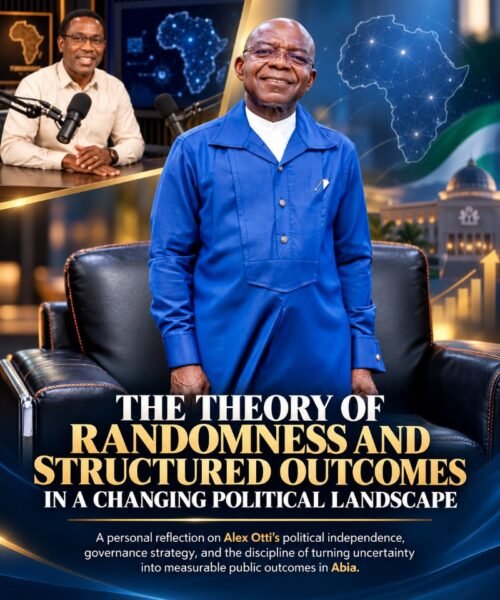



The Chartered Politicians of Abia vs The People: THE LAST HERO STANDING IN ABIA
There is an old woman in Abia.
She does not wear gold.
She does not travel with siren.
She does not answer “Your Excellency” with the arrogance of borrowed thunder.
She is older than every campaign poster, wiser than every stomach-infrastructure slogan, and more patient than every unpaid pensioner who has prayed under the sun until prayer itself began to sweat.
Her name is Governorship.
Not Governor.
Not Government House.
Not “power must return.”
Not “our turn.”
Not “equity.”
Not “structure.”
Not “stakeholders.”
Not “leaders of thought” who never think beyond ballot boxes.
Her name is Governorship—
the sacred stool they turned into a dining table,
the public trust they converted into family inheritance,
the altar of service they dressed like a bride and dragged into the marketplace of ambition.
For twenty-four years, she watched them come.
First came Orji Uzor Kalu, with the confidence of a man who knew that Abia was young, soft, and available for political baptism. He mounted the saddle in 1999 and rode through eight years, while Abia learned the difference between a state and a private estate. Then came Theodore Ahamefule Orji, first as political heir, then as political landlord, then as the man who discovered that succession can be more profitable than salvation. After him came Okezie Victor Ikpeazu, the scholar-governor of endless grammar, the man under whose watch Abia became a place where excuses wore academic gowns and Aba roads sometimes looked like practical courses in erosion management.
And all through those seasons, Governorship stood in the corner, insulted but not dead.
She saw the roads swallow tyres.
She saw workers count salary arrears like rosary beads.
She saw pensioners speak to their bank accounts like widows speaking to graves.
She saw Aba, the city of enterprise, cough through dust, flood, neglect, and promise.
She saw Umuahia, the capital, dressed in ceremonial speeches while ordinary people searched for ordinary governance.
Yet the men called themselves leaders.
Leaders?
No.
Some were undertakers with campaign offices.
Some were landlords of delay.
Some were professional mourners who caused the funeral and still arrived first at the condolence register.
They said they had “structures.”
Of course, they had structures.
Every cemetery has structures.
Every abandoned project has pillars.
Every broken promise has a foundation stone.
Every unpaid salary has a file number.
Every failed administration has a spokesman.
Their structure was simple:
capture the party, capture the treasury, capture the ballot, capture the courts, capture the narrative, then capture the people’s memory before the next election.
But in 2023, something happened.
Governorship woke up.
She removed the wrapper of compromise.
She washed her face in the morning river of public anger.
She looked at Abians and said: “Enough. I was not created to be a trophy in the sitting room of retired political emperors. I was not created to be inherited like farmland. I was not created to be rotated among men who mistake Abia for ancestral property.”
Then came Alex Otti.
Whether one loves him, doubts him, praises him, criticises him, or watches him with the caution of a people long deceived, one thing became clear: the old choir lost its monopoly over the hymnbook. The old landlords suddenly discovered democracy again. The same men who had eaten at the long table of power began to complain that the kitchen was being renovated without their permission.
Now 2027 is approaching, and see them gathering again.
The old masquerades are dusting their costumes.
The retired drummers are testing their drums.
The village criers of yesterday are oiling their throats.
The same political hands that cooked yesterday’s soup are back in the kitchen, promising that this time, the pepper will be different.
They call meetings in Umuahia.
They whisper about alliances.
They summon “stakeholders.”
They say Abia must be “rescued.”
Rescued?
By whom?
By the same fishermen who drained the pond?
By the same doctors who misdiagnosed the patient for twenty-four years?
By the same architects whose buildings became potholes?
By the same watchmen under whose watch the compound was looted by termites wearing agbada?
Abia people are not fools.
They know Orji Uzor Kalu was there.
They know Theodore Orji was there.
They know Okezie Ikpeazu was there.
They know the years.
They know the roads.
They know the salary stories.
They know the pension cries.
They know the contractors who became philosophers.
They know the political sons, political fathers, political godsons, political godfathers, and political grandchildren who fed from the same ancestral pot of state capture.
And now the combative spirit for 2027 has entered them.
How poetic.
When Abia needed combat against decay, where were the warriors?
When Aba traders needed roads, where were the liberators?
When pensioners needed dignity, where were the defenders?
When hospitals needed breath, when schools needed chalk, when civil servants needed salaries, when communities needed water, when youths needed hope—where were these newly anointed combatants?
Now that power has left their dining table, they have discovered courage.
Their courage is not for Abia.
Their courage is for access.
Their anger is not moral.
Their anger is logistical.
Their pain is not that Abia suffered.
Their pain is that Abia may recover without their permission.
That is the satire of our democracy:
those who misplaced the key now want to lead the search party.
But Governorship is no longer sleeping.
She now walks through Aba with one eye open.
She passes through Umuahia with memory in her handbag.
She visits Ohafia, Bende, Isiala Ngwa, Ugwunagbo, Ukwa, Arochukwu, Obingwa, and every tired community that has heard campaign poetry before.
She listens, but she no longer claps cheaply.
When they say “we are coming back,” she asks:
“To do what you forgot to do when you had the seat, the seal, the convoy, the budget, the siren, the House of Assembly, the commissioners, the boards, the contracts, the praise-singers, and the entire machinery of government?”
When they say “Abia must be rescued,” she asks:
“From whom did Abia first need rescue?”
When they say “we have experience,” she replies:
“Yes, experience in what exactly—governance, excuses, succession games, or the advanced mathematics of public disappointment?”
When they say “2027 is our turn,” she laughs:
“Your turn again? Did Abia become a family chair at a funeral meeting?”
This is why Governorship must be the hero of the Abia story.
Not any one man.
Not any party.
Not Labour Party, PDP, APC, APGA, or any alphabet soup cooked in Abuja and served cold in Umuahia.
The hero must be the office itself, rescued from the hands of professional occupiers and returned to its rightful owner: the people.
Governorship must stand at the gate in 2027 with a broom, a ledger, and a mirror.
The broom to sweep away entitlement.
The ledger to count the years.
The mirror to show every aspirant his own record before he opens his mouth.
Let every man who wants Abia in 2027 first answer the roll call of history.
Orji Uzor Kalu, what did Abia become after your eight years?
Theodore Orji, what did Abia inherit after your eight years?
Okezie Ikpeazu, what did Abia endure after your eight years?
And to the new men beating drums around old camps, what exactly are you bringing: fresh vision or recycled appetite?
Let no one hide behind “stakeholders.”
A stakeholder is not a man who only appears when power is being shared.
A stakeholder is the woman in Ariaria whose shop floods when rain falls.
A stakeholder is the pensioner whose file became a ghost.
A stakeholder is the young graduate who left Abia not because he hated home, but because home could not hold him.
A stakeholder is the civil servant who learned patience by force.
A stakeholder is the child whose school needed repair while politicians repaired their alliances.
So when the old order gathers and calls it strategy, Abians should call it rehearsal.
When they call it rescue mission, Abians should call it audition.
When they call it coalition, Abians should ask whether it is coalition for development or coalition for restoration of appetite.
The ballot in 2027 must not be a funeral invitation for common sense.
Let the old chartered politicians come.
Let them wear white.
Let them quote equity.
Let them invoke zones.
Let them embrace one another for camera.
Let them declare that Abia is too important to be left in one man’s hand.
But Abia people should answer:
“True. That is why it must not return to the hands of those who treated it like inheritance.”
Governorship, the old woman, is now standing.
She is tired of being kidnapped every four years.
She is tired of being renamed “structure.”
She is tired of being dragged to hotel meetings by men who remember Abia only when elections are pregnant.
She is tired of being used as collateral for ambition.
In 2027, let Governorship speak.
Let her say:
“I am not a retirement benefit.
I am not compensation.
I am not a family title.
I am not a political pension.
I am not the property of yesterday’s men.
I am the people’s sacred instrument.”
And if the old undertakers return with new flowers, let Abia ask them one question:
Are you coming to govern the living, or are you coming back to complete the burial?