

MEASURING THE NEW ABIA: THE PRACTICAL METRICS BEHIND ABIA’S RISE AS NIGERIA’S THIRD FASTEST-IMPROVING STATE
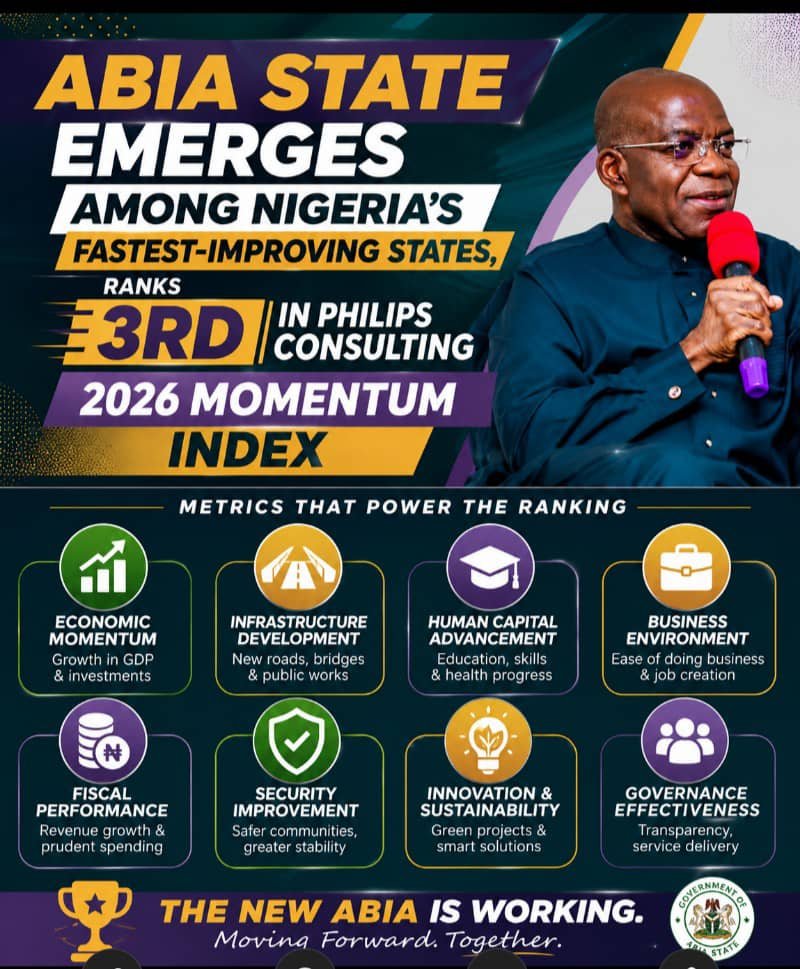
Abia State’s emergence as Nigeria’s third fastest-improving state in the 2026 Phillips Consulting State Performance Momentum Index was not founded merely on political publicity or isolated project announcements. The state reportedly recorded a positive momentum score of +0.67, placing behind Enugu at +1.15 and Jigawa at +0.77. The score indicates that Abia’s rate of improvement was above the national average during the period assessed. It does not suggest that every developmental challenge has disappeared; rather, it shows that the state is moving measurably from years of infrastructure decay and institutional weakness towards stronger public services, improved infrastructure and better economic management.
Infrastructure and Urban Renewal
Infrastructure represents one of the clearest indicators of Abia’s transformation. By May 2026, the state government reported the completion of approximately 414 road projects across urban and rural communities. These interventions have improved access to markets, residential areas, agricultural communities and industrial clusters. The reconstruction of Port Harcourt Road in Aba is particularly important because the corridor connects major manufacturing, commercial and residential locations. Better roads reduce transportation time, lower vehicle-maintenance costs and improve the movement of goods and people.
Beyond the roads already completed, a $263.8 million urban infrastructure programme supported by development partners is expected to facilitate the rehabilitation of more than 248 kilometres of roads in Aba and Umuahia. The programme is also expected to address two major erosion sites and strengthen drainage, waste management and urban mobility. These figures reveal that Abia’s infrastructure momentum is not limited to isolated projects but forms part of a broader attempt to reconnect markets, industrial zones and residential communities.
Education and Human-Capital Development
Education reform has become another measurable pillar of Abia’s development momentum. The state reportedly recruited approximately 5,394 teachers, with plans to engage an additional 4,000 teachers to meet the growing demand in public schools. This means that the full recruitment programme could eventually add more than 9,000 teachers to the state’s education system.
Public-school enrolment reportedly increased by about 150 per cent, with more than 300,000 pupils said to have enrolled under the expanding free and compulsory basic education programme. The longer-term target is approximately 500,000 pupils. These figures suggest that the education reforms are moving beyond the renovation of school buildings to increasing access, strengthening teacher availability and rebuilding public confidence in government-owned schools.
The development of Smart Schools and technology-supported learning environments is also important to Abia’s human-capital strategy. The real value of these initiatives will eventually be measured through improved school attendance, reduced dropout rates, better teacher performance, stronger examination results and increased digital competence among pupils.
Healthcare Renewal
Healthcare represents another important area in which measurable progress has been reported. Approximately 277 healthcare facilities were said to have been retrofitted across the state. This includes interventions in primary healthcare centres, general hospitals and other public medical institutions.
The government also reported the recruitment or deployment of nearly 1,000 healthcare professionals, including doctors, nurses, pharmacists and other medical personnel. These workers are expected to support service delivery across primary, secondary and tertiary health institutions. Major institutions receiving attention include the Abia State University Teaching Hospital, Amachara General Hospital and several general hospitals across the state.
Approximately 15 per cent of the state’s annual budget has also been associated with healthcare expenditure. The significance of these figures must ultimately be reflected in the availability of medical personnel, medicines, diagnostic equipment and emergency services. The final test will be shorter waiting periods, reduced maternal and infant mortality, improved rural healthcare coverage and greater confidence in public hospitals.
Fiscal Discipline and Capital Investment
Abia’s fiscal structure provides another major explanation for its development momentum. The state’s 2025 approved budget stood at approximately ₦750.28 billion. Of this amount, about ₦611.7 billion, representing approximately 82 per cent, was allocated to capital expenditure. About ₦138.6 billion, representing approximately 18 per cent, was provided for recurrent expenditure.
In practical terms, this means that for every ₦100 contained in the budget, approximately ₦82 was directed towards roads, schools, hospitals, water facilities and other development projects, while about ₦18 was allocated to salaries, administration and other recurrent obligations. The budget also represented an increase of approximately 30 per cent over the preceding year.
The high capital-to-recurrent ratio of 82:18 demonstrates an attempt to use public expenditure as an instrument of infrastructure expansion and economic renewal. The credibility of this approach will depend on actual budget implementation, transparent procurement, responsible borrowing, sustainable debt management and the publication of audited financial statements.
Improved Revenue Administration
The restructuring and digitalisation of revenue collection have also contributed to Abia’s fiscal momentum. A more transparent revenue system can reduce leakages, eliminate unofficial payment channels and ensure that legitimate government revenue enters public accounts.
Growth in internally generated revenue gives the state greater capacity to finance development projects without depending entirely on federal allocations. However, the success of revenue reform must not be measured by collections alone. It must also be assessed by the fairness of the system, the reduction of multiple taxation and the protection of small traders, transport workers and emerging businesses from arbitrary levies.
A credible revenue structure should therefore increase government income while making payments transparent, predictable and convenient for citizens. The relationship between taxes collected and public services delivered must also remain visible.
Economic Revival and the Aba Productive Ecosystem
Aba remains the commercial and industrial heartbeat of Abia State. Government interventions in roads, electricity, drainage, sanitation and market infrastructure directly affect thousands of shoemakers, garment producers, leather workers, fabricators, traders and transport operators.
The rehabilitation of strategic commercial corridors can reduce the cost of moving raw materials and finished products. It can also shorten travel time, expand production hours and improve access to domestic and international markets. The impact should eventually be seen in the number of formally registered businesses, the growth of Aba’s footwear and garment clusters, increased private investment and higher employment.
The economic value of infrastructure is therefore not limited to the number of roads completed. It must be assessed through lower transportation costs, increased industrial output, stronger business profitability and improved household incomes.
Electricity and Productive Capacity
Electricity reform is essential to the sustainability of Abia’s manufacturing economy. Small-scale producers in Aba have historically depended heavily on petrol and diesel generators, significantly increasing their operating costs.
State-level electricity regulation, private-sector collaboration and investment in alternative energy can support markets, industrial clusters, hospitals, schools and transport terminals. The practical indicators should include average daily hours of electricity supply, the number of businesses connected to reliable power, the reduction in generator dependence and the increase in productive working hours.
An illustrative reduction of between 20 and 30 per cent in generator expenses could significantly improve the profit margins of Aba’s small manufacturers. This percentage should be understood as an analytical projection rather than an officially reported outcome. The actual success of the reforms must be determined through verified energy-cost reductions, improved supply hours and measurable increases in industrial production.
Water, Sanitation and Environmental Improvement
Abia’s development momentum also includes investment in potable water, drainage, erosion control, waste management and urban sanitation. The wider urban infrastructure programme targeting more than 248 kilometres of roads and two major erosion sites is expected to improve both environmental safety and economic mobility in Aba and Umuahia.
The relevant performance indicators should include the number of households connected to potable water, the number of functional water schemes, the reduction in flood-prone locations, the volume of solid waste collected and the number of erosion sites successfully restored.
These environmental interventions are important because poor drainage, flooding and unmanaged waste damage roads, threaten public health and disrupt commercial activities. Sustainable urban development therefore requires that road construction, drainage, sanitation and waste management be treated as interconnected responsibilities.
Land Administration and Investment Confidence
The government reportedly signed approximately 4,000 Certificates of Occupancy during its first three years. This represents an important but less visible dimension of institutional reform.
Efficient land documentation strengthens property rights, reduces uncertainty and makes it easier for individuals and businesses to use property as collateral. It can also shorten the time required to acquire land for housing, agriculture, commerce and industrial investment.
The significance of the 4,000 Certificates of Occupancy should therefore be measured through reduced processing time, increased formalisation of property ownership, improved access to credit and stronger investor confidence in the state’s land-administration system.
Governance and Institutional Effectiveness
Governance performance is ultimately determined by the ability of public institutions to plan, implement and account for government programmes. Abia’s positive momentum score of +0.67 reflects the combined movement recorded across infrastructure, education, health, fiscal management, economic development and public administration.
The practical governance indicators include the proportion of the budget devoted to capital development, the rate of project completion, the publication of audited accounts, the reduction of revenue leakages and the responsiveness of ministries and public agencies.
Institutional effectiveness must also be reflected in transparent procurement, professional appointments, accessible public information and improved treatment of citizens by government officials. Good governance is not merely the announcement of ambitious policies; it is the consistent conversion of plans and public resources into measurable outcomes.
Citizen Experience as the Final Metric
The strongest evidence of Abia’s progress must be found in the experience of ordinary residents. A trader should experience easier access to markets. A manufacturer should record lower transportation and energy costs. A pupil should have access to a qualified teacher and a functional classroom. A patient should receive treatment in a properly equipped health facility. A property owner should obtain land documentation without years of delay.
The citizen-centred indicators should therefore include reduced travel time, increased school enrolment, improved patient-to-health-worker ratios, lower business operating costs, greater access to potable water and higher satisfaction with government services.
Government expenditure becomes meaningful only when it changes daily life. The figures must therefore move beyond official reports and become visible in safer roads, stronger schools, functional hospitals, cleaner communities, improved electricity and expanding economic opportunities.
What the Ranking Truly Means
Abia’s third-place position does not mean that it has already become Nigeria’s third-best state in every absolute development measure. It means that Abia recorded the third-fastest rate of improvement among the states assessed.
The evidence associated with that momentum includes a performance score of +0.67, approximately 414 completed road projects, about 277 retrofitted healthcare facilities, nearly 1,000 healthcare professionals recruited or deployed, approximately 5,394 teachers recruited, about 150 per cent growth in public-school enrolment, more than 300,000 pupils enrolled, approximately ₦611.7 billion allocated to capital expenditure, an 82 per cent capital expenditure ratio, approximately 4,000 Certificates of Occupancy signed and more than 248 kilometres of roads targeted under the urban infrastructure programme.
These figures do not suggest that Abia has attained perfection. They indicate the direction, scale and speed of the reforms taking place. They show that the state’s development story can increasingly be discussed through measurable outputs rather than political claims alone.
ABIA’S RANKING IS NOT BUILT ON CLAIMS ALONE.
IT IS SUPPORTED BY ROADS, SCHOOLS, HEALTH FACILITIES, CAPITAL INVESTMENT AND MEASURABLE INSTITUTIONAL REFORMS.
THE NEW ABIA IS NOT ONLY MOVING — ITS MOMENTUM CAN BE COUNTED.
Published by Prof. Chukwuemeka Ifegwu Eke