
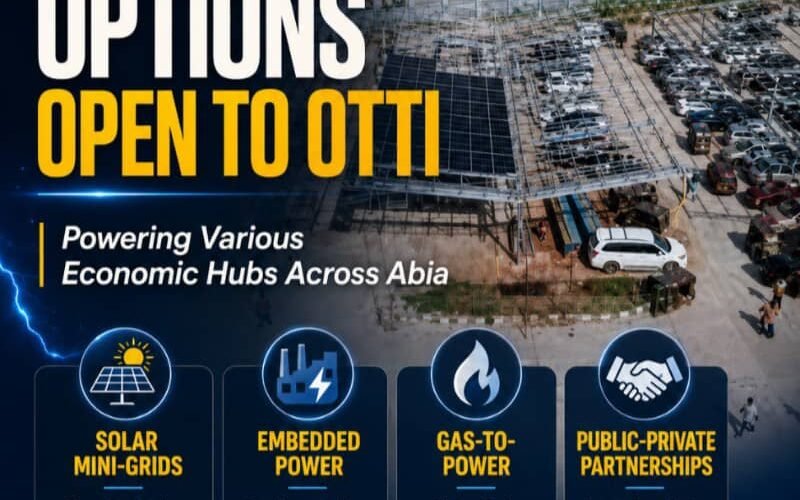
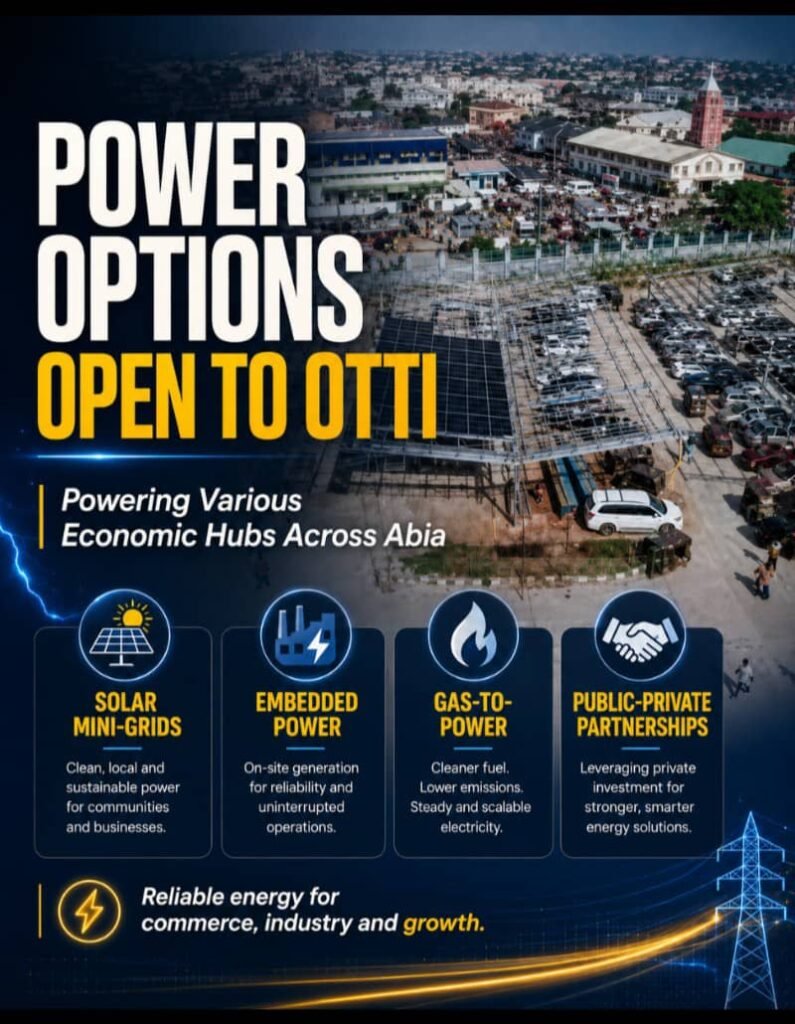
POWER OPTIONS OPEN TO OTTI: POWERING ABIA’S ECONOMIC HUBS
By Pastor AProf. Chukwuemeka Ifegwu Eke
Reliable electricity is no longer merely a public utility. It is the foundation of production, commerce, investment, employment and sustainable economic growth.
Across Abia State, major commercial and industrial centres require dependable power to operate efficiently. Markets, industrial clusters, technology centres, transport hubs, hospitals, schools and small businesses cannot achieve their full potential under an unstable electricity supply.
Governor Alex Otti therefore has several practical power options available for strengthening Abia’s emerging economic hubs.
SOLAR MINI-GRIDS
Solar mini-grids can provide clean and decentralised electricity to markets, rural enterprises and communities that are poorly served by the national grid.
They can power shops, cold rooms, processing equipment, security systems and digital services while reducing dependence on petrol and diesel generators.
EMBEDDED POWER
Embedded generation allows electricity to be produced close to the businesses and industrial clusters where it is needed.
This model can provide dedicated and more reliable power to major economic locations such as Aba’s industrial and commercial centres. It can also reduce transmission losses and protect businesses from repeated national-grid disruptions.
GAS-TO-POWER
Abia’s proximity to gas resources creates an important opportunity for gas-powered electricity projects.
Gas-to-power plants can provide steady and scalable electricity for manufacturing, large markets, hospitals and other energy-intensive facilities. With appropriate environmental safeguards, this option can support industrial expansion and employment creation.
PUBLIC-PRIVATE PARTNERSHIPS
The financial demands of modern power infrastructure require cooperation between government, private investors, electricity companies, development institutions and local businesses.
Through transparent public-private partnerships, the Abia State Government can attract investment, share project risks and accelerate the delivery of sustainable energy solutions.
A HUB-BASED POWER STRATEGY
Rather than waiting for one central solution, the government can adopt a hub-by-hub electricity strategy.
Each economic location should be assessed according to its population, business concentration, energy demand, available fuel source and capacity to pay for reliable power.
A large industrial cluster may require embedded gas-powered generation. A rural agricultural community may be better served by a solar mini-grid. A major market may benefit from a hybrid system combining solar power, battery storage and grid electricity.
The central objective should remain clear: the right power solution for each economic hub.
Reliable electricity would lower production costs, extend business hours, improve public safety, preserve goods, support digital transactions and attract new investment.
The development of Abia cannot be separated from the development of its energy infrastructure.
By combining solar mini-grids, embedded generation, gas-to-power projects and credible private-sector partnerships, the Otti administration can build an electricity framework that responds directly to the needs of Abia’s communities and businesses.
Reliable energy for commerce, industry and growth is not merely an option. It is an economic necessity.