
WHEN A RANKING BECOMES A POLITICAL RACKET: THE ECONOMICS ORACLE FORGOT
BudgIT, Abia’s Fiscal Renaissance and the Intellectual Hazard of Selective Statistics
By AProf Chukwuemeka Ifegwu Eke
5 November 2026
I have read with considerable amusement the commentary circulated under the pseudonym ORACLE, purporting to expose Governor Alex Otti’s administration through BudgIT’s 2026 State of States Fiscal Performance Ranking.
The author celebrates Abia’s 16th position with the unmistakable enthusiasm of someone who has discovered political salvation in a spreadsheet.
Unfortunately, the excitement appears to have outrun the economics.
I recognise BudgIT as a credible institution. I accept its latest ranking. What I reject is the rather adventurous interpretation that a composite fiscal index, extracted from its historical and methodological context, constitutes definitive proof that Governor Otti has failed.
There is a considerable difference between reading a statistical table and understanding what the numbers represent.
A ranking is an analytical instrument, not a political obituary.
THE HISTORY THAT REFUSES TO DISAPPEAR
Let me begin where serious economic analysis ought to begin: with the historical trajectory.
When Alex Otti assumed office on 29 May 2023, Abia was confronting substantial fiscal obligations, accumulated arrears, infrastructural deterioration and significant dependence on federally distributed revenue.
The subsequent BudgIT assessments provide an instructive chronology.
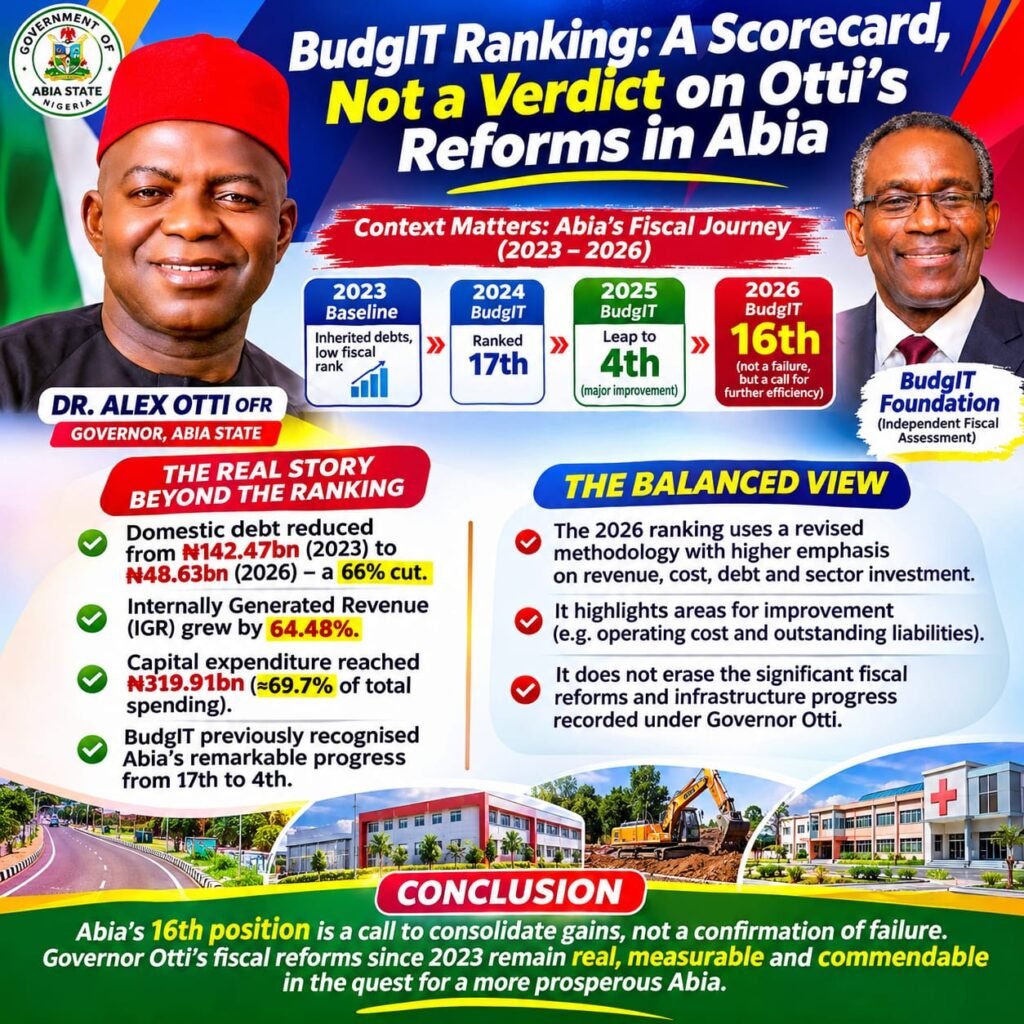
In the 2024 State of States assessment, Abia occupied the 17th position.
In the 2025 edition, it rose spectacularly to 4th.
Indeed, BudgIT itself identified Abia as an especially remarkable performer because the state had never previously featured among the first ten.
On 12 May 2026, Governor Otti received a BudgIT delegation, whose representatives acknowledged this improvement.
That acknowledgment did not originate from the governor’s publicity department.
It came from the institution whose credibility the opposition now invokes.
Today, the 2026 edition places Abia 16th, with an index score of 51.25.
I accept the figure without hesitation.
But I also insist that intellectual consistency requires us to acknowledge the entire sequence.
A credible institution does not become credible only when its findings appear politically convenient.
If BudgIT was right to identify Abia’s remarkable improvement in 2025, its earlier findings cannot suddenly become irrelevant because a subsequent edition supplies ammunition for partisan criticism.
THE METHODOLOGICAL ELEPHANT IN THE ROOM
There is something even more consequential that the circulating commentary conspicuously neglects.
BudgIT’s 2026 report introduces a revised methodology.
Its assessment gives greater attention to revenue performance, fiscal viability, debt sustainability and expenditure in critical development sectors.
This matters enormously.
An economist understands that when the composition and weights of a composite index change, movements in rankings cannot automatically be attributed entirely to deterioration in underlying performance.
To establish that conclusion rigorously, one would need to examine the component scores and, ideally, reconstruct comparable rankings under an unchanged methodology.
Consequently, Abia’s movement from 4th to 16th deserves examination, but it cannot, by itself, establish the sweeping allegation that the administration has become fiscally incompetent.
The distinction is elementary.
Unfortunately, elementary distinctions occasionally become endangered species during political campaigns.
THE DEBT QUESTION: WHERE THE CRITICISM BECOMES PARTICULARLY FRAGILE
Now to what I consider one of the most important developments in Abia’s recent fiscal history.
Debt management.
During his October 2026 media engagement, Governor Otti explained that Abia’s reported domestic debt had fallen dramatically from the level recorded around the beginning of his administration.
The Debt Management Office provides an important independent reference.
Its records indicate that Abia’s domestic debt stood at approximately ₦142.47 billion on 30 June 2023.
By 30 June 2026, the corresponding figure was approximately ₦48.63 billion.
That represents a reduction of approximately ₦93.85 billion, or nearly 66%.
These are not figures manufactured for social-media entertainment.
They are drawn from Nigeria’s official debt-reporting framework.
But I must introduce an important qualification.
Domestic debt is not the same as total public debt.
Abia also carries external obligations, and the naira valuation of foreign-denominated liabilities can change substantially with exchange-rate movements.
Indeed, the governor has acknowledged increases in foreign loan balances associated with disbursements under existing multilateral development-financing arrangements.
Therefore, the economically defensible conclusion is not that Abia has become debt-free.
It is that the state has achieved a substantial reduction in its reported domestic debt stock while continuing to manage external liabilities and inherited obligations.
That is a meaningful fiscal development.
I would be interested to know precisely how reducing a domestic debt burden by nearly ₦94 billion constitutes evidence of financial recklessness.
Perhaps ORACLE has discovered a new school of public finance in which paying down debt is considered an economic offence.
If so, I eagerly await the textbook.
REVENUE MOBILISATION: ANOTHER INCONVENIENT FACT
The 2026 BudgIT assessment also records a 64.48% increase in Abia’s internally generated revenue.
Let that figure receive the attention it deserves.
An increase of nearly two-thirds is hardly the defining characteristic of a government incapable of revenue mobilisation.
Furthermore, the 2025 BudgIT assessment identified Abia among the relatively small group of states whose internally generated revenue could cover at least half of their operating expenses.
This is not evidence of complete fiscal independence.
It is evidence of progress towards stronger revenue capacity.
The distinction matters.
I have never argued that Abia has reached the summit of economic development.
I argue that fiscal transformation should be evaluated through measurable changes in revenue capacity, expenditure composition, debt obligations and developmental outcomes—not through a single ordinal position.
CAPITAL EXPENDITURE: FOLLOW THE MONEY, NOT THE NOISE
The latest BudgIT findings provide another dimension conspicuously absent from the circulating criticism.
Abia’s capital expenditure reached approximately ₦319.91 billion in 2025.
Its total expenditure stood at approximately ₦458.95 billion.
Capital expenditure therefore represented roughly 69.7% of total expenditure, using the reported figures.
This is a substantial capital-spending orientation.
It does not automatically prove that every project was efficiently executed.
Nor does it establish that all expenditures produced their intended outcomes.
Those questions require project verification, procurement scrutiny and independent assessment of service delivery.
Nevertheless, it would be intellectually dishonest to discuss Abia’s expenditure performance while completely ignoring the magnitude of its reported capital investment.
A government investing heavily in capital formation must be assessed on both the quality of that investment and its eventual economic returns.
Road connectivity, electricity infrastructure, healthcare facilities, educational investment and urban renewal can generate benefits extending beyond the financial year in which the expenditure occurs.
The economist must therefore distinguish between immediate expenditure and the longer-term productivity of public capital.
Development is not always contemporaneous with expenditure.
A road completed today may continue reducing transportation costs for decades.
A rehabilitated school may enhance human capital formation over an entire generation.
A strengthened electricity network may stimulate enterprise productivity long after the commissioning photographs have disappeared from social media.
These are matters for empirical evaluation, not political caricature.
YES, ENUGU PERFORMED IMPRESSIVELY. AND SO?
I congratulate Governor Peter Mbah and the people of Enugu State on their impressive second-place position.
Enugu’s fiscal performance deserves recognition.
Its substantial increase in internally generated revenue is particularly noteworthy.
But I find it curious that some commentators imagine that praising Enugu necessarily requires denigrating Abia.
Economic progress is not a football derby.
The prosperity of Enugu does not require the impoverishment of Abia.
Both states can improve simultaneously, and both administrations can learn from each other.
In fact, meaningful regional development requires stronger economic cooperation among the South-East states.
Reducing such a serious discussion to an Otti-versus-Mbah popularity contest does neither state any intellectual service.
THE FAAC ARGUMENT: A HALF-TRUTH MASQUERADING AS ECONOMICS
The author also contends that increased Federation Account allocations following fuel-subsidy removal should automatically have translated into proportionately greater development outcomes.
The expectation of accountability is legitimate.
The implied arithmetic is simplistic.
An increase in nominal revenue does not necessarily represent an equivalent increase in real purchasing power.
Nigeria has experienced substantial inflation, exchange-rate depreciation and sharp increases in construction, energy, transportation and imported-input costs.
Consequently, the real value of public revenue must be examined alongside the cost of delivering public services and infrastructure.
The relevant questions are therefore not merely how much more money entered the treasury, but how much purchasing power that money retained, what inherited obligations required settlement, how expenditure was allocated and what measurable outcomes followed.
I welcome scrutiny of those outcomes.
What I reject is the assumption that nominal revenue increases can be treated as identical to real fiscal expansion.
That is the kind of arithmetic that makes inflation laugh.
WHAT THE NEW REPORT ACTUALLY CHALLENGES ABIA TO DO
There is no intellectual virtue in pretending that every indicator is favourable.
The latest assessment identifies substantial increases in Abia’s operating expenses, alongside outstanding pension, gratuity and contractor liabilities.
Those figures deserve serious attention.
They raise legitimate questions about expenditure efficiency, the management of fiscal commitments and the sustainability of future budgets.
Governor Otti’s administration should provide clear explanations, maintain transparent reporting and demonstrate that its capital investments generate measurable public benefits.
I consider these obligations entirely consistent with defending the administration’s broader reform record.
Indeed, the most convincing defence of good governance is not the denial of weaknesses but the capacity to identify and correct them.
Nevertheless, criticism must respect the distinction between fiscal challenges and comprehensive administrative failure.
The existence of outstanding liabilities does not, without further investigation, establish that they were all newly incurred by the present administration.
Likewise, rising expenditure cannot automatically be classified as waste without examining its composition, purpose and outcomes.
Context is not an excuse for poor performance. It is a prerequisite for evaluating performance intelligently.
MY FINAL WORD TO ORACLE
I have no quarrel with robust opposition.
Democracy benefits from intelligent scrutiny.
What democracy does not benefit from is the transformation of complex fiscal evidence into conveniently abbreviated political slogans.
The BudgIT report is not a declaration that Alex Otti has failed.
Neither is it a certificate that every fiscal decision taken by his administration has been flawless.
It is an assessment containing strengths, weaknesses, risks and opportunities for improvement.
To isolate Abia’s 16th position while overlooking its earlier progress, domestic debt reduction, revenue growth and substantial capital expenditure is to substitute selective interpretation for comprehensive analysis.
It is particularly revealing when the same institution’s favourable findings were previously available for public examination.
I would therefore encourage ORACLE to consult the complete report rather than merely admire the highlighted row on a colourful infographic.
After all, the purpose of an oracle is presumably to illuminate the future, not to misinterpret the past.
My position remains unequivocal: Alex Otti’s administration has recorded meaningful, independently verifiable fiscal improvements since 2023. The 2026 ranking identifies areas requiring further progress, but it does not extinguish those achievements.
Abia deserves rigorous evaluation.
Governor Otti deserves accountability.
And the public deserves an analysis sophisticated enough to recognise both achievement and unfinished work.
One ranking cannot erase a reform trajectory.
One difficult indicator cannot invalidate every favourable indicator.
And no amount of political excitement can repeal the elementary principles of public finance.
I shall continue to defend measurable progress, acknowledge legitimate shortcomings and insist that the development of Abia State be judged by evidence rather than partisan enthusiasm.
Because in economics, as in governance, the complete balance sheet matters more than the loudest headline.
AProf Chukwuemeka Ifegwu Eke
Economist | Public Affairs Commentator
5 November 2026