

MEDIA NARRATIVES, POLITICAL MESSAGING AND THE OTTI–EMETU 2027 PROJECT
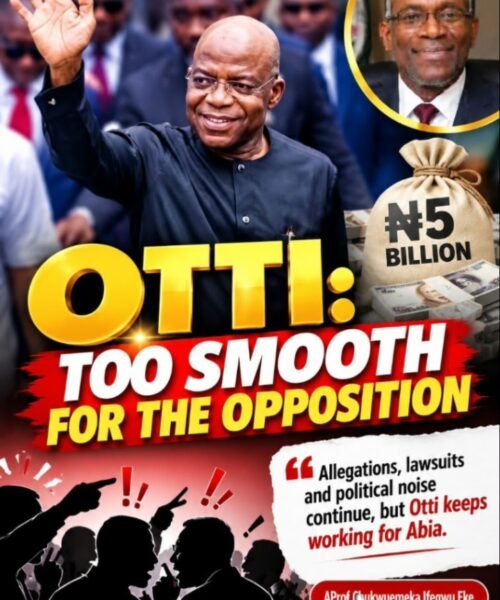
There comes a point when political criticism ceases to be a contest of ideas and begins to resemble an organised attempt to rewrite observable reality. Abia appears to be approaching that point.
On 23 September 2026, The Sun published an interview with PDP governorship candidate Kelechi Anosike under the headline, “2027: Otti weakest gov to defeat, thrives on social media.” In that interview, Anosike described Governor Alex Otti as a weak incumbent and argued that the administration’s reputation was largely a product of social-media promotion. He also made several claims about workers, industrial actions, government finances and the use of Signature Bank. These were political allegations made by an opposition candidate; the interview itself did not establish them as independently verified facts.
That distinction is important.
There is a vast difference between repeating an allegation and proving it.
It is convenient political theatre to dismiss visible governance as “social-media hype.” But roads do not exist on social media. Hospitals do not treat patients on social media. Public infrastructure does not become physical merely because somebody posted a photograph online.
The suggestion that communicating government activity somehow invalidates the activity itself is logically weak. Every serious government communicates. The real question is whether what is being communicated exists and can be independently inspected.
And in Abia, that is precisely the test that must be applied:
Go there. See it. Verify it.
The emerging pattern is not restricted to one interview.
On 8 July 2026, The Sun published Godwin Adindu’s article, “Abia opposition declares: Tear him for his bad verses; tear Otti for his bad grammar.” Adindu explicitly situated the growing attacks against Governor Otti within the activities of APC figures and remnants of the PDP in Abia.
When political opposition reaches the stage where even grammar, expressions and manner of speech become weapons, one begins to understand the depth of the contest surrounding public perception.
Then came another line of attack.
On 8 September 2026, The Sun reported that the Coalition of Concerned and Patriotic Ngwa Citizens, through Chukwuemeka Obinna and Joe Nkoro, rejected the endorsement of Governor Otti for a second term by the Ngwa National Association USA. The group accused the diaspora association of being detached from conditions at home and challenged it to undertake an independent assessment of Ngwa communities.
SOURCE:
https://thesun.ng/group-condemns-nnausas-endorsement-of-otti-for-second-term/
On 9 September 2026, Vanguard reported the same controversy, recording the coalition’s argument that the endorsement did not represent the position of all Ngwa people and that some communities still had development challenges.
SOURCE:
https://www.vanguardngr.com/2026/09/2027-group-rejects-ngwa-diaspora-endorsement-of-otti/
Nobody should be frightened by such criticism.
But let us also be clear: the existence of unfinished work does not amount to proof that nothing has been done.
No government completes every road, school, hospital, community project and development need simultaneously. The appropriate test is not whether problems remain. The proper test is whether there is measurable movement from where the state was to where it is today.
That is the argument the critics repeatedly avoid.
They point to what remains and pretend that what has been completed never happened.
They identify one unresolved problem and attempt to use it to erase a larger record.
That is not scrutiny. That is selective political narration.
Another controversy arose on 17 September 2026, when The Sun reported that APC chieftain Chief Charles Ogbonna had attributed a disparaging remark about Ngwa people to Governor Otti. The Governor’s Special Adviser on Media and Publicity, Ferdinand Ekeoma, publicly rejected the allegation and stated that the Governor had never made such a statement.
SOURCE:
https://thesun.ng/otti-lashes-back-at-apc-chieftain-over-alleged-malicious-statement/
This is precisely why accusations must be subjected to evidence.
If a statement is attributed to the Governor, produce the recording.
Produce the transcript.
State the venue.
State the date.
State the context.
Abia politics cannot be reduced to somebody saying that somebody said something.
The same distinction must be made concerning pensioners.
On 23 September 2026, Punch reported complaints by the Abia Pensioners’ Forum, signed by Coordinator Okey Kanu and Secretary Emma Onyenyiri. The Forum alleged short-payments, delays and inadequate transparency in the ongoing gratuity exercise.
Yet the same statement expressly acknowledged that the Otti administration had commenced gratuity payments.
SOURCE:
https://punchng.com/gratuity-pensioners-forum-alleges-payment-shortfall/
That fact should not disappear simply because it is inconvenient to a hostile narrative.
There are pensioners asking questions about outstanding entitlements.
There is also an ongoing payment process.
Both facts can exist at the same time.
Indeed, on 27 July 2026, Punch reported that retired permanent secretaries in Abia urged Governor Otti to settle outstanding gratuities while also acknowledging what they described as significant infrastructure achievements under the administration.
SOURCE:
https://punchng.com/abia-retired-permanent-secretaries-urge-otti-to-pay-outstanding-gratuities/
So let the entire picture be presented.
Where an individual pensioner believes there is a computation error, that complaint deserves reconciliation.
Where documentation needs clarification, it should be clarified.
But it is misleading to transform difficulties associated with resolving accumulated liabilities into the argument that nothing has been done, especially where the same stakeholders acknowledge that payments have commenced.
This is how political narratives are often constructed.
First, acknowledge an intervention quietly.
Then amplify every imperfection surrounding it.
Finally, present the imperfection as though the intervention never existed.
Abians are capable of seeing through that method.
And this is where the attacks on Governor Alex Otti and Deputy Governor Ikechukwu Emetu must be properly understood.
There is now an expanding political contest around ethnicity, geography, workers’ welfare, pension obligations, political structure, social media, public communication and even the language of the Governor.
The number of allegations does not make them true.
Each allegation must stand or fall on evidence.
If someone says a road does not exist, name the road and let citizens visit it.
If someone says a hospital has not been rehabilitated, identify the facility and inspect it.
If someone alleges that an entire region has been abandoned, place the projects within that region on the table and compare the claim with the physical record.
If someone makes allegations about state finances, let figures, audited records and legally verifiable documents replace insinuation.
That is where serious public discourse begins.
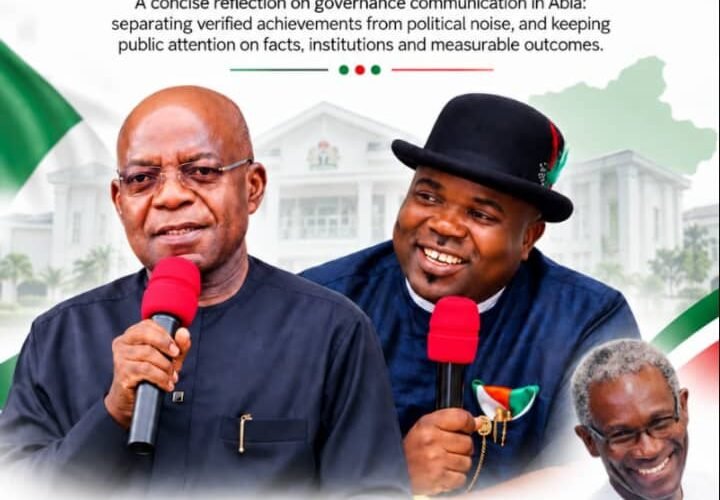
Governor Otti and Deputy Governor Emetu do not require the invention of achievements.
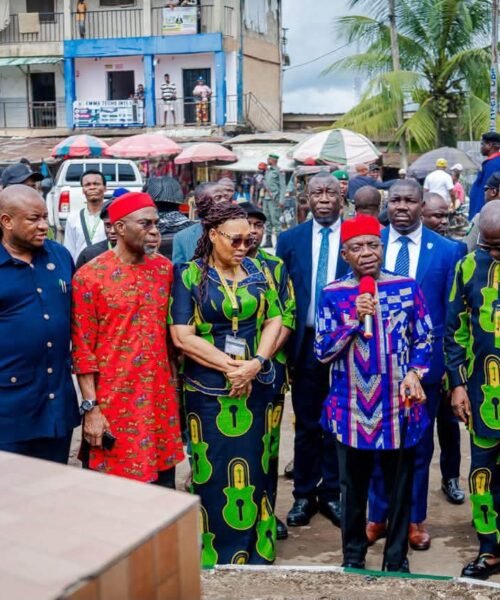
The administration must be judged by what is physically on the ground, by what citizens encounter in their communities and by records that can withstand verification.
The opposition is entitled to criticise.
It is not entitled to manufacture its own facts.
Political aspirants are entitled to campaign.
They are not entitled to convert allegations into evidence merely by repeating them often enough.
Groups are entitled to disagree with endorsements.
They are not entitled to erase existing projects because acknowledging them would complicate a preferred political narrative.
And newspapers are entitled to publish political interviews.
But an interview remains an interview.
The strength of an accusation depends on the evidence behind it, not the size of the headline carrying it.
The Otti–Emetu record should therefore be discussed exactly where its critics appear most uncomfortable discussing it:
ON THE GROUND.
Not in anonymous social-media exchanges.
Not through convenient political generalisations.
Not through ethnic insinuations.
Not through carefully constructed outrage.
But:
Road by road.
Hospital by hospital.
School by school.
Community by community.
Payment by payment.
Project by project.
Let every allegation meet a location.
Let every sweeping statement meet a record.
Let every claim of abandonment meet the list of interventions.
Let every accusation meet documentary evidence.
And after that, let Abians themselves judge.
That is the fundamental weakness in the emerging anti-Otti narrative:
REALITY REMAINS AVAILABLE FOR INSPECTION.
A headline may trend for twenty-four hours.
A political interview may dominate conversation for a week.
A carefully crafted allegation may circulate across WhatsApp groups.
But a functioning road remains after the headline disappears.
A rehabilitated public facility remains after the interview has been forgotten.
A completed project cannot be wished away by rhetoric.
So, let the attacks come.
Let every claim be placed beside the record.
Let every accusation be tested against evidence.
And let those who insist that Abia’s transformation exists only on social media explain how citizens are driving on social-media roads, entering social-media facilities and experiencing social-media infrastructure in real communities.
The political season may have begun.
But facts do not campaign.
FACTS SIMPLY REMAIN STANDING.