
OTTI, TINUBU AND 2027: BETWEEN GOVERNANCE, PARTY LOYALTY AND ECONOMIC CONVICTION
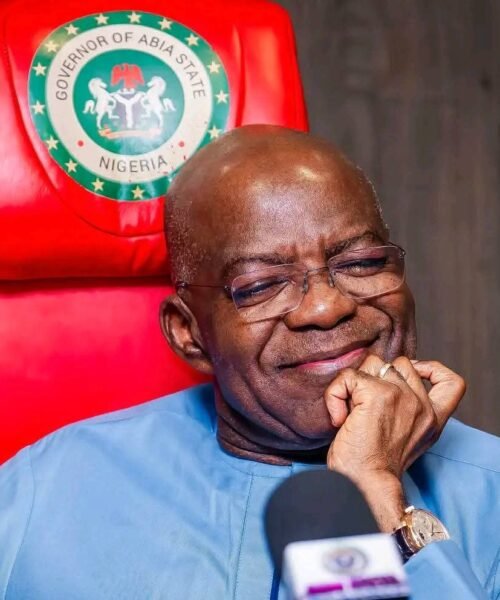
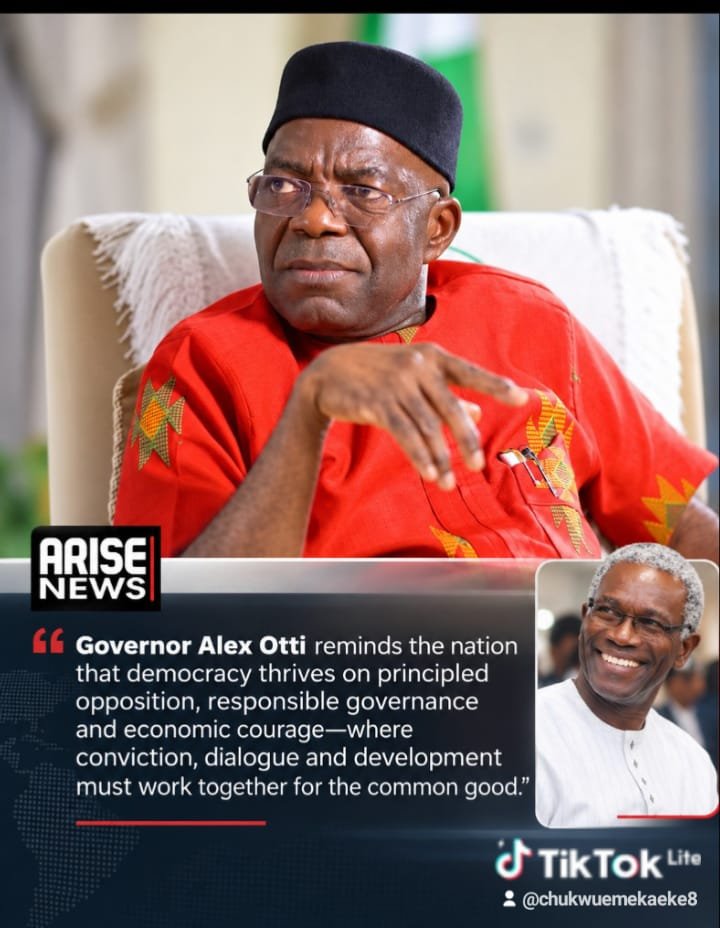
The controversy arose from Governor Alex Otti’s exclusive interview with ARISE News on Friday, 25 September 2026. The interview generated extensive national media attention because Otti attempted to distinguish between supporting President Bola Ahmed Tinubu in the discharge of governmental responsibilities, agreeing with some federal economic policies, and making an electoral choice in 2027.
ARISE News reported the interview under the headline:
“Otti: I’m Supporting Tinubu, But I’m Supporting Labour Party Candidate For 2027 Election.”
This distinction is central to understanding the controversy.
Otti explained that, as a serving governor and participant in the National Economic Council, he works within institutions headed by the President. He argued that continuous public confrontation with the President on every issue could undermine effective governance.
At the same time, he maintained that cooperation with the President does not automatically mean that President Tinubu is his preferred presidential candidate for 2027.
He stated that he still had his own preferred presidential candidate associated with the Labour Party.
WHAT OTTI ACTUALLY SAID
The governor’s position can be separated into three issues.
First, Bola Ahmed Tinubu is the sitting President of Nigeria and Otti must necessarily interact with his administration in the course of governing Abia State.
Second, Otti agrees with some economic policies of the Federal Government, particularly the removal of petrol subsidy.
Third, agreement with government policy does not automatically amount to electoral endorsement.
This distinction is important.
Cooperation in governance is different from party membership.
Agreement with a particular economic policy is different from political endorsement.
Participation in the National Economic Council is different from joining the ruling party.
THE ECONOMIC ARGUMENT
One of the strongest explanations for Otti’s position concerns petrol subsidy.
Otti’s opposition to fuel subsidy did not begin with President Tinubu.
He has argued for years that Nigeria should place greater emphasis on supporting production rather than subsidising consumption.
His broad position is that scarce public resources should increasingly support productive sectors, infrastructure, investment and employment rather than permanently financing consumption subsidies.
This argument is not unique to the current Federal Government.
Before President Tinubu assumed office, organisations such as the International Monetary Fund and the World Bank had repeatedly argued that Nigeria’s petrol subsidy had become extremely expensive and was reducing government’s ability to finance infrastructure, health, education and social programmes.
The IMF estimated Nigeria’s implicit petrol subsidy at approximately ₦1.9 trillion in 2021.
The World Bank later estimated that petrol subsidies consumed approximately 32.4 per cent of government revenues in 2022 and cost about 2.2 per cent of GDP.
These institutions argued that the subsidy was poorly targeted because richer households generally consumed more petrol than poorer households.
However, they also emphasised that subsidy removal should be accompanied by appropriate protection for vulnerable households.
This qualification is important because Nigerian households have experienced serious cost-of-living pressures following increases in fuel prices.
Therefore, the economic argument is not simply that subsidy removal is painless.
The argument is that an expensive universal consumption subsidy may not represent the most efficient use of limited public resources, particularly if savings can be redirected towards infrastructure, productive investment and targeted social protection.
THE DEVELOPMENT ARGUMENT
The developmental argument is based on opportunity cost.
Every naira committed to a general consumption subsidy is money that cannot simultaneously be spent on roads, hospitals, schools, electricity, industrial infrastructure or targeted assistance to vulnerable citizens.
Otti’s position can therefore be interpreted as favouring a transition from subsidising consumption towards supporting productive capacity.
The reasoning is straightforward:
More productive investment can increase output.
Higher output can create employment.
More employment can increase household incomes.
Greater productive capacity can broaden the tax base.
A broader tax base can provide government with additional resources for development.
The important debate is therefore not merely whether subsidies should exist.
It also concerns how reforms are implemented, how quickly they are introduced and what mechanisms are provided to protect vulnerable households.
THE FEDERALISM AND GOVERNANCE ARGUMENT
Nigeria operates a federal system.
A state governor cannot effectively administer a state without interacting with the Federal Government.
States depend on federal institutions and national decisions in areas including:
Federal allocations
Security coordination
National economic policy
Infrastructure
Electricity
Federal roads
Investment approvals
Borrowing frameworks
Development finance
Regulatory institutions
A governor belonging to an opposition party therefore still has a responsibility to maintain a functional working relationship with the President.
From this perspective, cooperation with President Tinubu does not automatically amount to abandoning the Labour Party.
Governmental cooperation and electoral competition can exist simultaneously.
Nigeria has historically experienced situations in which governors belonging to opposition political parties maintained working relationships with presidents belonging to different parties.
That is part of the practical operation of federalism.
Critics may nevertheless argue that opposition parties must clearly articulate alternative policies and provide visible political opposition.
That concern is also legitimate.
The fundamental question is where constructive cooperation ends and partisan alignment begins.
THE POLITICAL-ECONOMY ARGUMENT
There is also a political-economic consideration.
The economic development of Abia State may require cooperation with federal institutions.
Federal decisions can affect:
Infrastructure
Security
Electricity
Investment
Industry
Trade
Fiscal transfers
Development finance
National regulatory approvals
A governor may therefore consider it economically prudent to maintain a constructive relationship with the Federal Government while still retaining a separate political identity.
From that perspective, political disagreement does not necessarily require institutional hostility.
The interests of the State may sometimes require cooperation even where political differences remain.
HISTORICAL CONSISTENCY
One significant part of Otti’s argument is that his position on subsidy predates the Tinubu administration.
During the ARISE interview, he referred to earlier writings in which he argued for subsidy reform before President Tinubu assumed office.
This matters because supporting a policy that one previously advocated does not necessarily constitute support for the political party that later implements it.
Economic ideas can cross party boundaries.
A policy should therefore be examined on its economic merits rather than solely on the political identity of the administration implementing it.
OTTI AND THE 2027 QUESTION
The controversy becomes more complicated when the discussion moves from public policy to electoral politics.
Otti reportedly said that he was “not in a position to oppose” Tinubu’s candidacy while simultaneously participating in national governance institutions.
However, he also distinguished that position from his personal presidential preference.
When pressed during the interview, he stated that his preferred presidential candidate remained associated with the Labour Party.
This distinction generated different newspaper headlines.
Some publications emphasised his cooperation with Tinubu.
Others interpreted his comments as support for Tinubu’s re-election.
Others emphasised his statement that support for particular Tinubu policies should not automatically be interpreted as electoral endorsement.
For that reason, the original interview remains particularly important.
OTTI’S POSITION ON HIS OWN POLITICAL FUTURE
Another relevant element of the interview was Otti’s statement about his own future.
He reportedly said that he did not intend to contest for President, Senate or another elective office after completing his governorship.
He indicated that he intended to retire from elective politics.
He also said that Peter Obi or another presidential candidate would be free to campaign in Abia State.
This statement does not determine what may happen in the future.
It simply represents Otti’s publicly stated position as of September 2026.
THE CENTRAL ISSUE
The debate should therefore separate three different questions:
- Does Governor Otti cooperate with President Tinubu as President of Nigeria?
Yes. His statements indicate that he considers such cooperation necessary for governance.
- Does Otti agree with some Tinubu administration economic policies?
Yes. Petrol subsidy removal is an important example.
- Does agreement with some policies automatically establish his electoral choice for 2027?
Not necessarily. Otti himself publicly distinguished policy cooperation from his preferred presidential candidate.
The controversy largely arises because these three different issues are frequently merged together.
A BALANCED INTERPRETATION
There are reasonable arguments supporting Otti’s approach.
A governor has responsibilities beyond partisan politics.
Abia State requires cooperation with federal institutions.
Economic policy positions may legitimately cross party boundaries.
Otti’s position on subsidy reform predates the present Federal Government.
Constructive federal relations may benefit state development.
At the same time, there are legitimate questions.
Opposition politicians have a responsibility to provide alternative perspectives.
Fuel-price increases have imposed substantial hardship on households.
Public officials must communicate economic reforms carefully and sensitively.
Political cooperation can sometimes create uncertainty among party supporters about where political loyalties ultimately lie.
Those issues should therefore be debated on evidence rather than reduced to political labels.
NEWSPAPER AND MEDIA PUBLICATION TRAIL
ARISE News
Date: 25 September 2026
Reporter: Boluwatife Enome
Interview Anchor: Ojy Okpe
Focus: Otti distinguished his cooperation with President Tinubu from his preferred presidential candidate.
www.arise.tv/otti-im-supporting-tinubu-but-im-supporting-labour-party-candidate-for-2027-election/
Punch Newspapers
Date: 25 September 2026
Reporter: Okiki Adeduyite
Headline: Why I’m supporting Tinubu — Alex Otti
Focus: Otti explained his relationship with the President in the context of governing Abia and participating in the National Economic Council.
www.punchng.com/why-im-supporting-tinubu-alex-otti/
Punch Newspapers
Date: 25 September 2026
Focus: Otti’s support for petrol subsidy removal and his production-versus-consumption argument.
www.punchng.com/otti-backs-fuel-subsidy-removal-says-return-would-hurt-nigeria/
TheCable
Date: 25 September 2026
Reporter: Theophilus Adedokun
Focus: Policy support should not necessarily be interpreted as an endorsement of President Tinubu’s second-term bid.
www.thecable.ng/otti-im-not-in-a-position-to-oppose-tinubus-second-term-bid/
Legit.ng
Date: 25 September 2026
Reporter: Adekunle Dada
Focus: Otti’s explanation of why he was not positioning himself as an opponent of Tinubu while participating in national economic governance.
www.legit.ng/politics/1732836-alex-otti-explains-oppose-tinubus-2027-election-bid/
Punch Newspapers
Date: 25 September 2026
Reporter: Fawzi Kehinde
Focus: Otti stated that he intended to retire from elective politics after his governorship.
www.punchng.com/otti-rules-out-presidential-bid-says-hell-retire-after-tenure/
ECONOMIC BACKGROUND SOURCES
International Monetary Fund
Nigeria Article IV Consultation and subsidy analysis.
International Monetary Fund
Earlier assessment of Nigeria’s fuel subsidy and fiscal situation.
World Bank
Nigeria Development Update and analysis of subsidy reform.
CONCLUSION
The most useful way to understand Governor Alex Otti’s position is to separate governance, economics and electoral politics.
His public statements indicate that he sees cooperation with the President as part of governing effectively within the Nigerian federation.
He also supports particular economic reforms on grounds that he says predate the current administration.
At the same time, he has publicly distinguished those positions from his eventual presidential preference in 2027.
Whether Nigerians find that distinction persuasive remains a matter for citizens themselves to assess.
The evidence, however, suggests that the discussion is more complex than simply describing Otti as either supporting or opposing President Tinubu.
It is ultimately a debate about the intersection of governance, economic conviction, federal cooperation, party identity and electoral politics.