
ABURE’S LATEST GIMMICK WON’T WORK: FREE FORMS CANNOT CURE A DEAD CLAIM TO POWER
By now, Nigerians must have understood the political pattern of Barr. Julius Abure. Whenever the law corners him, he manufactures noise. Whenever legitimacy moves away from him, he manufactures drama. Whenever the Labour Party tries to breathe, reorganise and recover its soul, Abure throws another stone into the water and calls the ripple a revolution.
His latest gimmick is the so-called distribution of “free forms” to aspirants across Nigeria. On the surface, it sounds democratic. In reality, it looks like another desperate attempt to confuse unsuspecting aspirants, mislead members of the public, and create artificial parallel structures where the courts have already pointed in another direction.
Let us trace the genesis of this crisis.
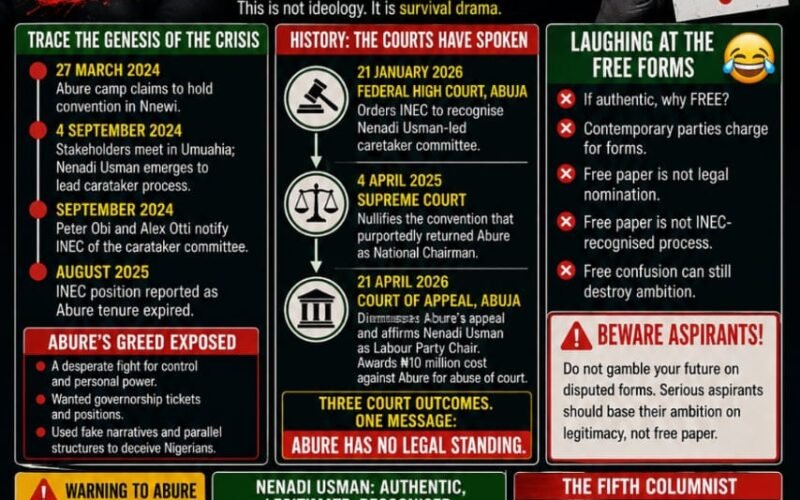
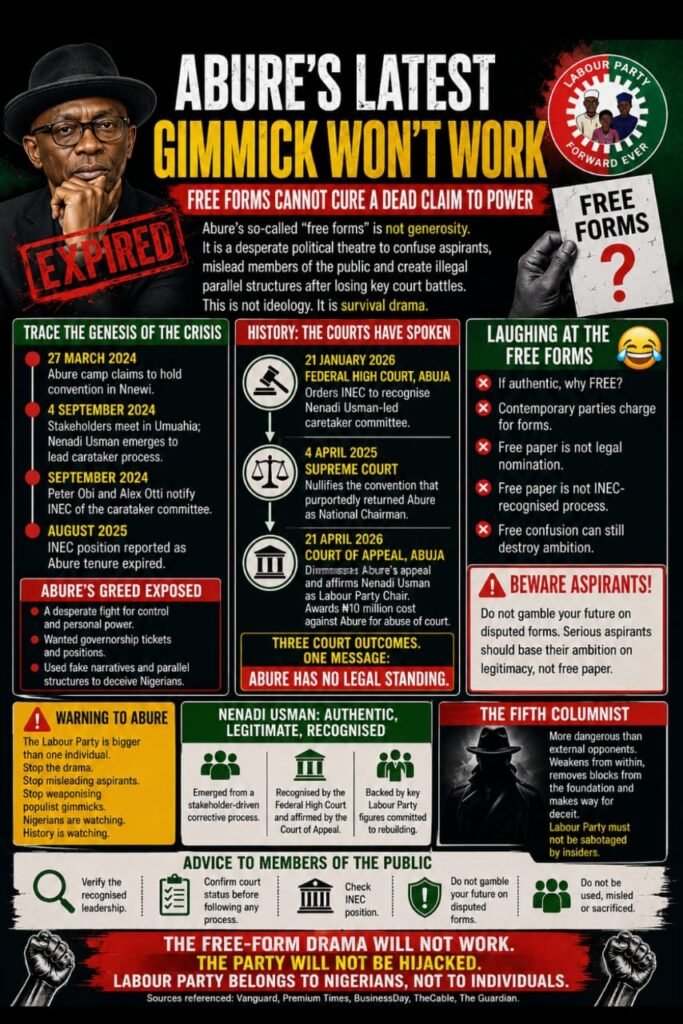
The Labour Party crisis did not begin today. It grew from the stubborn refusal of a faction to accept that political parties are not private estates. On 27 March 2024, Abure’s camp claimed to have held a national convention in Nnewi. That convention became the foundation of his continued claim to leadership. But the crisis deepened when INEC’s position became that Abure’s tenure had expired, a position widely reported in August 2025.
On 4 September 2024, a major stakeholders’ meeting was held in Umuahia, Abia State, where Senator Esther Nenadi Usman, a former Minister of Finance and former Senator representing Kaduna South, emerged as chairman of a 29-member caretaker committee of the Labour Party. That development was not a roadside arrangement. It involved major Labour Party stakeholders, including the party’s most visible national assets after 2023.
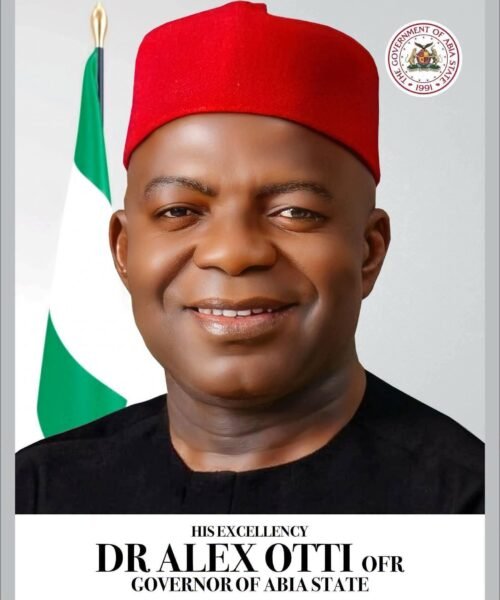
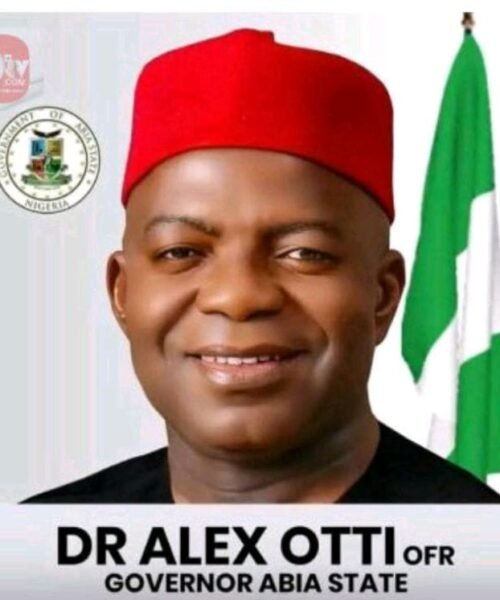
Peter Obi and Governor Alex Otti subsequently notified INEC of the caretaker committee and its mandate to organise congresses and a national convention. This gave the Nenadi process an institutional and political foundation beyond mere factional ambition.
Then came the courts.
On 21 January 2026, the Federal High Court in Abuja ordered INEC to recognise the Senator Nenadi Usman-led caretaker committee as the lawful leadership of the Labour Party, ruling that Abure’s tenure had elapsed.
On 21 April 2026, the Court of Appeal dismissed Abure’s challenge and affirmed Senator Nenadi Usman as Labour Party chair. Premium Times reported that the court held that the Supreme Court had, on 4 April 2025, settled the issue by nullifying the convention that purportedly returned Abure as national chairman.
BusinessDay also reported that the Court of Appeal affirmed Nenadi Usman as the legitimate national chairman and awarded ₦10 million cost against Abure for abuse of court process.
So what exactly is Abure still selling?
If a man’s convention has been judicially questioned, if his tenure has been declared expired, if the Federal High Court and Court of Appeal have recognised another leadership, and if the Labour Party has publicly warned aspirants against his nomination forms, then the so-called “free forms” are not generosity. They are political theatre.
This is why the public must be careful.
Aspirants should not mistake free paper for valid nomination. Free forms are not the same as legal forms. Free forms are not the same as INEC-recognised processes. Free forms are not the same as party authority. Free forms are not the same as electoral legitimacy.
Indeed, the joke is too obvious: if the forms are authentic, why the sudden free distribution? Contemporary parties charge for nomination forms not only to raise administrative funds but to filter seriousness, document processes and finance legitimate primaries. If Abure’s forms truly carry institutional weight, why are they being thrown around like campaign handbills? Why this panic generosity? Why this emergency populism after adverse court decisions?
This is not ideology. It is survival drama.
Abure now says Labour Party must be saved from “political buccaneers.” But who is really behaving like a buccaneer? Is it the court-recognised caretaker leadership trying to restore order, or the factional actor distributing disputed forms after losing major judicial rounds? Is it Nenadi Usman, whose leadership emerged from a stakeholders’ rescue process, or Abure, whose claim now rests on appeal promises and factional press conferences?
The historical parallels are clear.
Every political party that collapses in Nigeria usually passes through this same road: first, a leader overstays; second, a faction captures the letterhead; third, court cases multiply; fourth, parallel primaries emerge; fifth, unsuspecting aspirants are sacrificed; sixth, the party enters the general election divided, wounded and legally exposed.
This is exactly the danger Abure is creating.
His rebuttals follow a familiar pattern. He says the matter is internal. But when courts recognise another leadership, the issue is no longer ordinary internal gossip. He says he is going to the Supreme Court. Fine. Every citizen has the right of appeal. But a pending appeal is not automatic restoration. He says his leadership will participate fully in 2027. But saying “we will participate” does not make a disputed process valid. He says Nenadi’s side is illegal. But the reported court outcomes so far have not strengthened that claim; they have weakened it.
Nenadi Usman’s authenticity rests on three pillars.
First, she emerged from a stakeholder-driven corrective process in Umuahia, not from a secretive private coronation.
Second, she has judicial recognition from the Federal High Court and affirmation from the Court of Appeal.
Third, she carries the political confidence of key Labour Party national figures who understand that the party cannot go into 2027 with confusion, expired claims and factional theatrics.
That is why Abure’s attack on Governor Alex Otti also exposes the real politics behind the crisis. Otti is not the problem. Nenadi is not the problem. Peter Obi is not the problem. The real problem is the attempt to reduce a national political movement into a personal inheritance.
Labour Party did not rise in 2023 because one factional chairman was powerful. It rose because ordinary Nigerians were tired. It rose because young people believed. It rose because workers, students, professionals, traders, artisans, transporters, reform-minded elites and citizens hungry for a new Nigeria saw the party as a vehicle. That vehicle must not now be hijacked by internal fifth columnists whose conduct gives ammunition to opponents.
A fifth columnist inside a movement is more dangerous than an external opponent. The opponent attacks from outside. The fifth columnist weakens from within. The opponent throws stones at the wall. The fifth columnist removes blocks from the foundation. The opponent wants you defeated. The fifth columnist makes your defeat easier.
That is why Labour Party members must be vigilant.
The public must ask simple questions before touching any form: Who issued it? Under what recognised leadership? Under what court-backed authority? Was INEC properly notified? Will the process survive litigation? Will candidates produced through the process be protected from future disqualification battles?
Politics is not comedy. Election nomination is not child’s play. Aspirants must not allow anybody to use them as evidence in a factional court strategy. No serious aspirant should gamble years of ambition on a disputed form merely because it is free.
Free poison is still poison.
Free confusion is still confusion.
Free illegality, if ultimately declared so by the courts, will still destroy ambition.
Abure should be warned clearly: the Labour Party is bigger than one man. The 2023 movement was not created for personal bargaining. The sacrifices of millions of Nigerians must not be converted into factional merchandise. If he truly loves the party, he should stop manufacturing confusion, stop misleading aspirants, stop weaponising populist gimmicks, and allow the party to rebuild through a credible, recognised and court-respecting structure.
The latest free-form drama will not work.
It will not erase the history of the crisis.
It will not cancel the Nenadi mandate.
It will not rewrite the Court of Appeal decision.
It will not deceive politically conscious Nigerians.
It will not convert factional paper into legal nomination.
The Labour Party must move forward, and it must move forward with discipline, legitimacy and institutional sanity. Members of the public, aspirants and supporters must therefore beware of any process that looks cheap today but may become very expensive tomorrow.
Abure’s latest gimmick is not democracy.
It is desperation dressed as generosity.