
ABA BY DESIGN: WHY THE ABA COMMERCIAL SMART CITY MATTERS TO THE NEW ABIA ECONOMY
Aba is not just a city. Aba is an economy.
It is a city of trade, production, leather, fashion, metal works, logistics, creativity and survival. It is a city where ordinary people turn skill into income and resilience into enterprise. Aba has always had the energy of a great commercial centre, but for too long, that energy has grown without the level of planning, infrastructure and investment support it deserves.
This is why the Aba Commercial Smart City project matters.
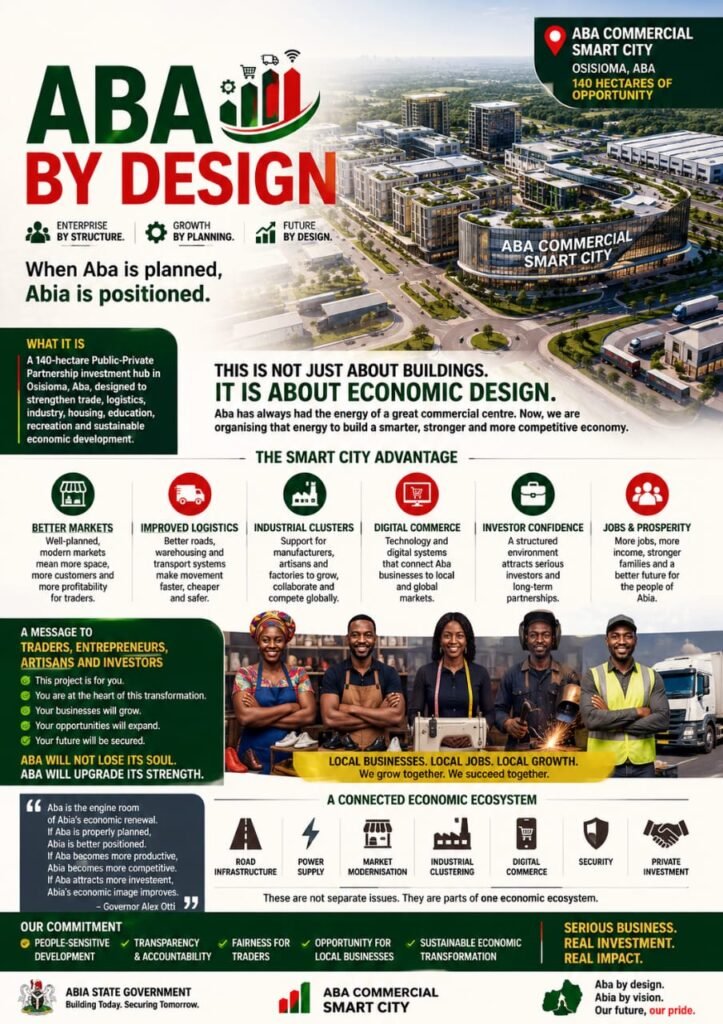
Reports describe the proposed Aba Commercial Smart City as a 140-hectare Public-Private Partnership investment hub located in the Osisioma area of Aba, designed to strengthen trade, logistics and industrial development.
Governor Otti reportedly said the project would help launch Aba into a full-fledged industrial centre for sustainable economic development and job creation. � Another report says the project is intended to include markets, commercial centres, housing, schools and recreation facilities on 140 hectares in Osisioma. �
Punch Newspapers
Radio Nigeria
This is not just about buildings. It is about economic design.
For many years, Aba has grown by the strength of its people rather than the strength of planning.
Traders built the economy. Artisans kept the city alive. Shoemakers made the Aba name famous. Tailors and manufacturers created value with limited support. Transporters, market women, fabricators and small businesses carried the city’s commercial weight.
But the next stage of Aba’s growth cannot depend only on struggle. It must depend on structure.
Aba must grow by design, not by accident.
A smart commercial city has the potential to improve how trade is organised, how goods move, how businesses cluster, how investors engage, how markets function and how the Made-in-Aba identity is upgraded.
It can become a platform for industrial coordination, job creation, improved internally generated revenue and private-sector confidence.
This is the message Governor Otti’s team is communicating.
The Aba Commercial Smart City is sold as an economic transformation platform. It speaks to traders, manufacturers, artisans, youth entrepreneurs, logistics operators, investors and the wider Abia public.
When markets are better planned, traders benefit.
When logistics improve, manufacturers benefit.*
When industrial clusters are supported, artisans benefit.
When private investors commit to Aba, the state benefits.
When jobs are created, families benefit.
Aba is already powerful. The task is to organise that power.
In Gov Otti’s mind, the future of Aba must connect road infrastructure, power supply, market modernisation, industrial clustering, digital commerce, security and private investment.
These are not separate issues. They are parts of one economic ecosystem.
Governor Otti’s advantage is that he can frame Aba as the engine room of Abia’s economic renewal. If Aba is properly planned, Abia is better positioned. If Aba becomes more productive, Abia becomes more competitive. If Aba attracts more investment, Abia’s economic image improves.
The project also sends a message to investors: Abia is open for serious business. Not speculative politics. Not empty promises. Serious business.
As the government also ensures that the project remains people-sensitive, traders are not displaced without fairness. Local businesses are carried along. The ordinary Aba entrepreneur sees opportunity, not exclusion.
The project is implemented with transparency, consultation and practical economic benefit.
That is how development becomes legitimate.
His Excellency’s aides sees The Aba Commercial Smart City is huge a communication opportunity, as the people see it as another bonafide governance test.
It gives the Otti administration a chance to show that Aba can be modernised without losing its soul.
Gov Otti confided in a friend recently saying “Aba does not need to stop being Aba. Aba needs to become a better-planned, better-powered, better-connected and more competitive version of itself.
That is why the slogan is clear:
Aba by design. Enterprise by structure. Growth by planning.
When Aba is planned, Abia is positioned