
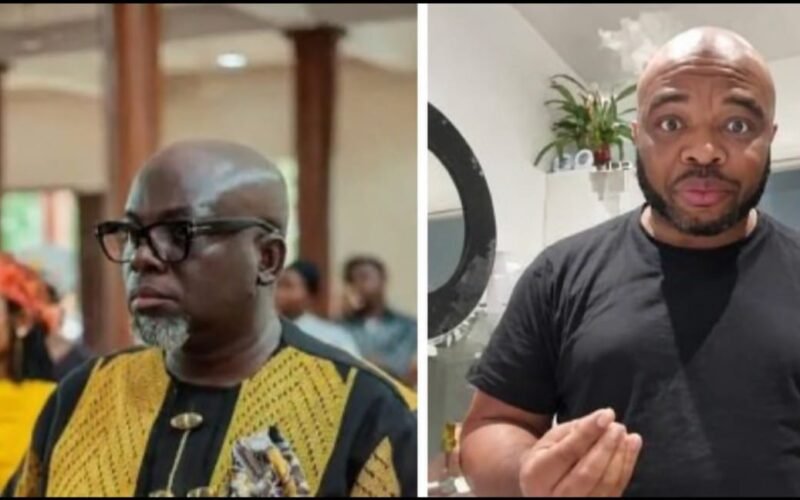
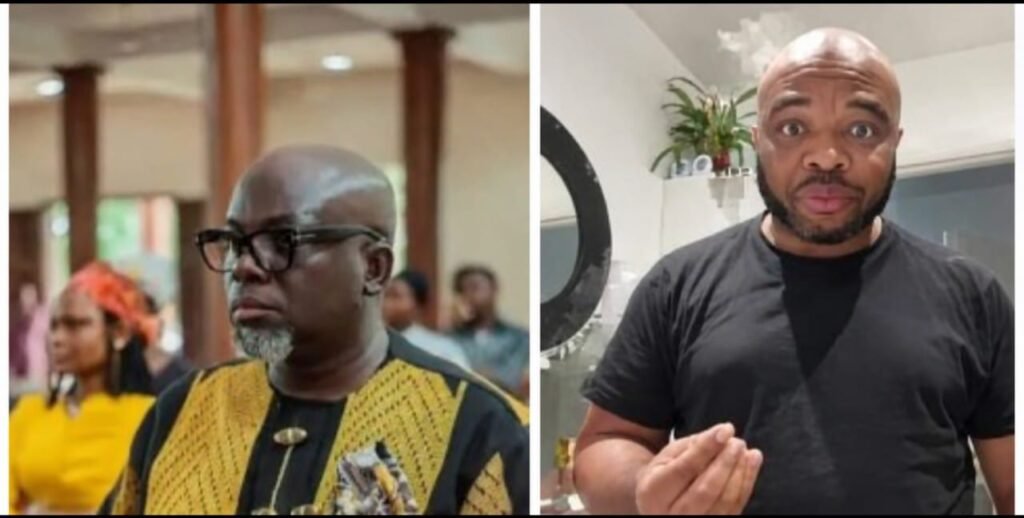
ONE ECHO, TWO MICROPHONES?
Is Obinna Oriaku Becoming the Political Amplifier of Eke O. Ako?
Samuel Okenyi’s glowing portrait of Hon. Obinna Oriaku raises a rather more interesting question than the one it attempts to answer.
Perhaps the question is no longer:
Who is Obinna Oriaku?
Perhaps we should begin asking:
Where does Eke O. Ako end and Obinna Oriaku begin?
😂😂😂
Calm down.
Nobody is suggesting—at least not yet—that Chief Obinna Oriaku wakes up in the morning in Abia, criticises Governor Alex Otti as Obinna Oriaku, flies spiritually to Scotland before lunch, changes into an engineer’s helmet and returns to Facebook as Eke O. Ako.
That would be mischievous.
And the public record actually treats them as two different men: one, a former Commissioner for Finance; the other, a Scotland-based civil engineer and long-standing critic of successive Abia governments.
So, literally:
OBINNA ORIAKU ≠ EKE O. AKO.
Case closed?
Not quite.
Because politics has another kind of identity.
Not identity of person.
Identity of argument.
Identity of narrative.
Identity of emphasis.
Identity of political destination.
And this is where things become deliciously interesting.
IS ORIAKU BECOMING THE FINANCIAL VOICE BOX OF THE AKO SCHOOL OF THOUGHT?
Watch the pattern.
Eke O. Ako interrogates figures.
Obinna Oriaku interrogates figures.
Ako questions expenditure.
Oriaku questions expenditure.
Ako interrogates debt, liabilities and government financial reporting.
Oriaku interrogates debt, budgets, revenue and expenditure.
Ako reaches for the government’s own documents.
Oriaku reaches for the government’s own documents.
Ako asks: Where did the money go?
Oriaku asks, in considerably more financial vocabulary:
Where did the money go?
😂😂😂
Different professions.
Different personalities.
Different locations.
But increasingly, a familiar chorus.
So maybe the fascinating question is not whether Oriaku is Ako.
Maybe it is whether Oriaku has become Ako with spreadsheets.
Or whether Ako is becoming Oriaku without having served as Commissioner for Finance.
😂😂😂
THE MASTER TAPE AND THE AMPLIFIER?
Consider another possibility.
Eke O. Ako has spent years building an identity around relentless interrogation of government claims. He did it under the previous administration and continues under the present one.
Oriaku brings something Ako does not possess:
the aura of the former insider.
He has sat inside government.
He has dealt with public finance.
He can speak the language of allocations, liabilities, cash flows, budget performance, debt and government accounts.
Put those two ingredients together and you get an interesting political combination:
Ako supplies the suspicion.
Oriaku supplies the accounting vocabulary.
Ako throws the stone into the pond.
Oriaku measures the resulting waves.
Ako asks the street question.
Oriaku gives it a balance-sheet accent.
😂😂😂
Is that coordination?
There is presently no evidence before us establishing that.
Is it amplification?
Now that is a much more legitimate question.
Because their names have already appeared together in political statements attacking the financial management of the Otti administration.
Not one masquerading as the other.
But two voices increasingly inhabiting the same argumentative neighbourhood.
THEN COMES THE REALLY INTERESTING QUESTION
Who is amplifying whom?
Is Oriaku amplifying Ako?
Is Ako providing popular reinforcement for Oriaku?
Or are both simply arriving independently at similar conclusions because they are looking at the same government documents?
That third possibility must be admitted.
Two people examining the same budget-performance report can legitimately notice the same entries without conspiracy, telephone calls, WhatsApp groups or political orchestration.
But similarity of source does not automatically establish similarity of interpretation.
That is exactly where both gentlemen should now be interrogated.
Take one claim.
Put Ako’s interpretation on the left.
Put Oriaku’s interpretation on the right.
Put the original government document in the centre.
Then ask:
Are they independently analysing the document?
Is one repeating the analytical framework of the other?
Are identical categories being conflated?
Are the same omissions recurring?
Are the same dramatic numbers appearing?
Are the same conclusions being reached from the same accounting assumptions?
Now we would have something worth studying.
BECAUSE AN ECHO HAS A SIGNATURE
Political amplification can often be detected not merely by identical figures but by identical framing.
For example:
Government reports ₦X.
Critic A says:
“₦X was spent.”
Critic B subsequently says:
“Government spent ₦X.”
But suppose the underlying accounting entry actually represents something more complicated—a liability, commitment, aggregate classification, cumulative expenditure, transfer, counterpart funding or another accounting category.
Then the intriguing issue is no longer that both critics quoted the same number.
It becomes:
How did both arrive at exactly the same interpretation?
Coincidence?
Shared methodology?
Shared source?
Intellectual borrowing?
Political amplification?
Nobody should rush to judgment.
But nobody should forbid the question either.
AND THAT BRINGS US BACK TO SAMUEL OKENYI’S HERO
Okenyi tells us Oriaku’s criticism is “surgical.”
Excellent.
Then surgery permits examination of the surgeon.
If Oriaku’s numbers are sharp, put them on the table.
If his analysis is superior, expose it to forensic examination.
If his experience as former Commissioner for Finance gives him special authority, then that same experience gives citizens even greater reason to examine both his present arguments and his historical record in government.
Expertise cannot become a political bulletproof vest.
You cannot say:
“Believe him because he was Finance Commissioner”
and simultaneously protest:
“Don’t examine what happened when he was Finance Commissioner.”
😂😂😂
It does not work like that.
Public-office experience gives Oriaku standing.
It does not give him infallibility.
SO, IS OBINNA ORIAKU EKE O. AKO?
Biographically?
No evidence whatsoever.
Politically?
Ahhhhh.
Now you are asking a more entertaining question.
😂😂😂
Perhaps they are becoming two instruments playing the same fiscal tune.
Perhaps one is lead guitar and the other bass.
Perhaps Ako is the reconnaissance unit and Oriaku the artillery.
Perhaps neither coordinates with the other and Governor Otti’s budget documents simply keep bringing them to the same junction.
All possibilities remain open.
But here is the hypothesis that deserves watching:
Eke O. Ako may have developed the populist architecture of a particular criticism of Otti’s finances, while Obinna Oriaku increasingly supplies that architecture with the authority, terminology and gravitas of a former Finance Commissioner.
That is a hypothesis.
Not a verdict.
And hypotheses are tested.
So going forward, every major Oriaku fiscal intervention should perhaps be placed beside Ako’s preceding commentary.
Not because the men are secretly one person.
But because political ideas sometimes have fingerprints.
And if the fingerprints repeatedly overlap, eventually the public will ask:
Are we listening to two analysts?
Or one argument with two microphones?
😂😂😂
For now, let us call it:
THE AKO–ORIAKU ECHO HYPOTHESIS.
Two men.
Two backgrounds.
Two microphones.
One increasingly familiar refrain.
And in politics, sometimes the most revealing question is not who said it first?
It is:
Who picked it up, amplified it—and turned up the volume?
The interrogation continues.