

THE ₦158,000 ABSU SALARY STORY: WHERE THE DECEPTION BEGINS
There is a legitimate conversation to be had about the remuneration of university lecturers in Nigeria, including lecturers at Abia State University. But legitimate advocacy does not require statistical sleight of hand, selective comparisons and political hero-making. The viral post being circulated by Obinna Oriaku is a classic example of how a real welfare question can be converted into a misleading political narrative.
FIRST DECEPTION: A BANK ALERT IS NOT A SALARY STRUCTURE
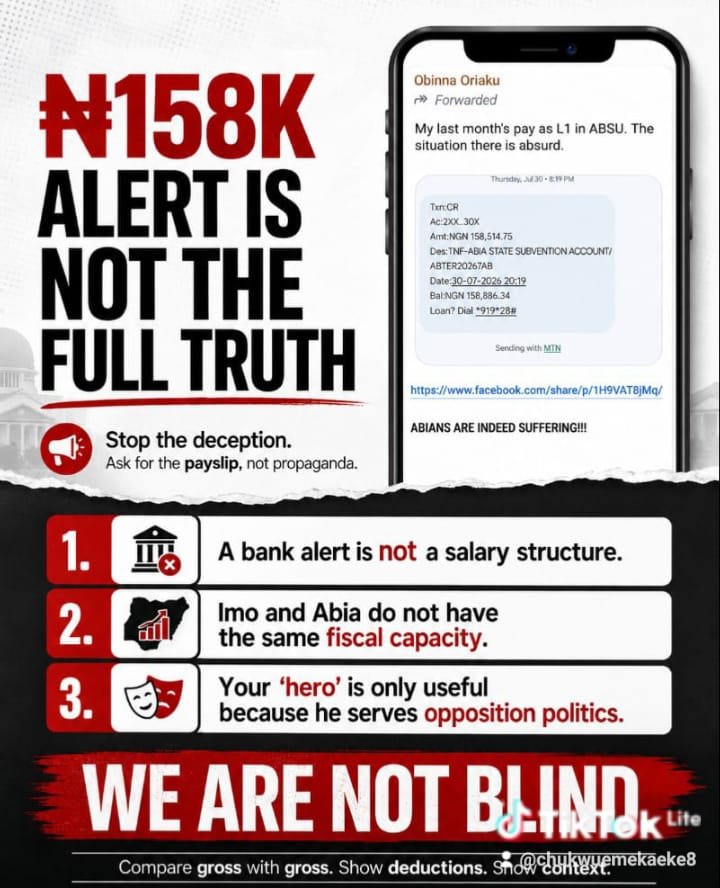
Look carefully at the screenshot. What does it actually establish? It shows a credit of ₦158,514.75 with a narration referencing an Abia State subvention account. That is all the bank alert itself establishes.
The alert does not state:
Lecturer I.
It does not state the individual’s salary step.
It does not show gross salary.
It does not show basic salary.
It does not show allowances.
It does not show PAYE.
It does not show pension deductions.
It does not show cooperative deductions, loans, union dues or any other deductions.
Yet somebody takes this single net-looking credit alert, attaches the description “my last month’s pay as L1 in ABSU”, and suddenly it becomes conclusive evidence of the entire remuneration structure of Abia State University.
That is not serious economic analysis. It is Facebook payroll accounting.
If you want to establish that Lecturer I in ABSU earns ₦158,514, produce the applicable salary table and the payslip showing gross earnings and deductions. That settles the matter scientifically. One anonymous or partially obscured bank alert cannot do the work of a payroll schedule.
SECOND DECEPTION: ₦222,000 IN IMO IS NOT THE ORDINARY NATIONAL GRADUATE-ASSISTANT BENCHMARK
The post says dramatically:
«A Graduate Assistant in Imo State University earns ₦222,000 while a Lecturer I in ABSU earns ₦158,000.»
What it carefully fails to tell readers is that Imo State deliberately introduced an enhanced wage package for workers in 2025. Governor Hope Uzodimma raised the state minimum wage to ₦104,000 and specifically announced an entry salary of roughly ₦220,000–₦222,000 for lecturers in state-owned tertiary institutions. That was an exceptional state policy decision, not proof that ₦222,000 is the universal Nigerian Graduate Assistant wage against which every state university must automatically be measured.
In fact, the federal CONUASS framework itself has undergone substantial adjustments, while implementation across state universities remains uneven. A recent report specifically identified state universities as facing uncertainty over adoption of the newly negotiated federal academic pay improvements.
So the comparison being circulated commits a very elementary error: it compares one state’s specially enhanced wage package with a purported net payment in another state and pretends the two figures are directly comparable.
They are not.
COMPARE LIKE WITH LIKE
If the opposition genuinely wants a credible comparison, let them produce:
IMSU Graduate Assistant gross salary versus ABSU Graduate Assistant gross salary.
Then:
IMSU Lecturer I gross salary versus ABSU Lecturer I gross salary.
Same rank.
Same salary concept.
Same period.
Gross against gross.
Net against net.
Include allowances and deductions.
Anything else is propaganda dressed up as arithmetic.
And even after doing that, differences can still exist because these are state-owned universities financed by governments with different revenues, wage policies, expenditure obligations and fiscal choices.
THE PART ABOUT “ABILITY TO PAY” THEY DON’T WANT TO DISCUSS
States are not identical fiscal entities.
Imo is an oil-producing state and receives 13 per cent derivation revenues. Abia also receives derivation, but the amounts are not equal. During the first five months of 2025, for example, published FAAC figures put Abia’s oil-derivation receipts at approximately ₦8.99 billion, while Imo received approximately ₦14.48 billion—more than ₦5 billion above Abia over that period alone.
That does not mean Abia should refuse to improve university remuneration. It absolutely should continue improving it. But economics requires us to acknowledge fiscal capacity when comparing state wage policies.
There is an additional irony. BudgIT’s fiscal-sustainability methodology specifically examines how capable states are of meeting recurrent obligations from their internally generated revenue and VAT rather than relying excessively on federal transfers. Abia has recorded considerable improvement in recent fiscal assessments, while the state’s 2025 accounts nevertheless showed that its IGR performance remained a constraint: Abia received about ₦315.84 billion in FAAC against a projected ₦268.65 billion, but internally generated revenue underperformed projections.
In other words, responsible government involves balancing salaries, pensions, health, education, roads, debt obligations and capital investment—not simply looking across the border, finding the highest salary another governor has announced and declaring that every other state must instantaneously match it.
AND WHAT ABOUT THE ABSU THEY INHERITED?
This is where the historical amnesia becomes particularly offensive.
Governor Alex Otti did not inherit an ABSU in perfect financial health.
By 2025, the Pro-Chancellor of ABSU publicly stated that the government had cleared an inherited backlog of approximately 11 months of staff salaries. Earlier reports had documented serious disputes surrounding outstanding salary obligations, including complaints from a group of lecturers recruited in 2023.
So let us understand the absurdity.
A government enters office carrying historical liabilities, injects resources into a distressed institution, clears substantial inherited salary arrears and restores regular payments—and the new propaganda is that because Imo later elected to pay a specially enhanced salary, everything happening in Abia amounts to “suffering.”
Criticise the current salary if it is inadequate. Demand improvement. Lecturers deserve better.
But do not delete the institution’s financial history because remembering it would spoil your political story.
PROFESSOR NWAEZE’S SUSPENSION IS A SEPARATE QUESTION
Professor Nnamdi Nwaeze was indeed suspended by ABSU on August 13, 2026. Reports indicate that the university said the suspension concerned social-media publications and alleged professional misconduct, while reports sympathetic to him link the controversy to his criticism of lecturers’ welfare and remuneration.
Those are allegations and counter-narratives that should be subjected to proper institutional due process.
I would therefore separate two questions completely.
Was Professor Nwaeze treated fairly under the university’s rules?
That should be investigated objectively.
Are all the economic claims now being circulated in his name automatically true simply because he has been suspended?
Absolutely not.
Suspension does not confer statistical infallibility.
AND TO THE SUDDENLY EXCITED OPPOSITION: WE ARE NOT BLIND
This sudden canonisation of Professor Nwaeze by opposition politicians is almost comical.
Yesterday, many of these people had no particular interest in his scholarship, his university career or his welfare. Today, because his dispute with ABSU management supplies ammunition against Governor Alex Otti, he has suddenly become the Nelson Mandela of Abia academia.
Please.
We understand Nigerian politics.
Professor Nwaeze is your hero today because his present position serves your political interest. If tomorrow he publishes something favourable to the Otti administration, some of the same people presently celebrating his “courage” will discover within twenty-four hours that he is compromised, hungry, bought over or seeking an appointment.
That is not principled solidarity.
That is political rental of somebody else’s grievance.
We are not blind.
THE HYPOCRISY TEST
Those now screaming “Abians are suffering” should answer some simple questions.
Where were these voices when ABSU accumulated months of salary arrears?
Where were their heroic Facebook campaigns when workers spent months waiting for salaries?
Where were these defenders of lecturers when the university was struggling under inherited liabilities?
Why does lecturers’ welfare become an existential emergency only when it can be converted into an anti-Otti graphic?
And if the issue is genuinely the welfare of Nigerian academics, why stop at the Abia border?
University lecturers nationally have complained for years about poor remuneration, salary shortfalls, delayed allowances and deteriorating purchasing power. Even in 2026, ASUU was still publicly complaining about delayed implementation of revised remuneration and outstanding welfare matters in the federal university system.
So by all means, advocate for better ABSU salaries.
But spare us the manufactured impression that academic underpayment suddenly originated in Umuahia in May 2023.
THE REAL POSITION
If an ABSU Lecturer I is genuinely taking home only ₦158,514 after all legitimate deductions, that remuneration deserves review upward. There is no reason to dodge that point.
Governor Otti’s administration should continually review academic salaries as revenues improve and as the university becomes financially stronger. A competitive university requires competitive remuneration.
But that truthful position is completely different from saying:
“Imo Graduate Assistant gets ₦222,000; ABSU Lecturer I gets ₦158,000; therefore Abians are suffering and Otti has failed.”
That conclusion is intellectually unserious because it ignores gross versus net pay, rank-for-rank comparison, deductions, different salary regimes, special state wage awards, different fiscal capacities and the financial condition inherited by the institution.
That is precisely how propaganda works: take one true-looking number, remove every inconvenient piece of context surrounding it, place another carefully selected number beside it, add three exclamation marks, and invite the public to become angry before anybody asks questions.
Unfortunately for the propagandists, some of us will always ask the questions.
Bring the payslip.
Bring the salary structure.
Compare Lecturer I with Lecturer I.
Compare gross with gross.
Show the deductions.
Show the fiscal context.
Then we can have an adult conversation.
Until then, a ₦158,514 bank alert is evidence that ₦158,514 entered an account.
It is not an economic thesis.