
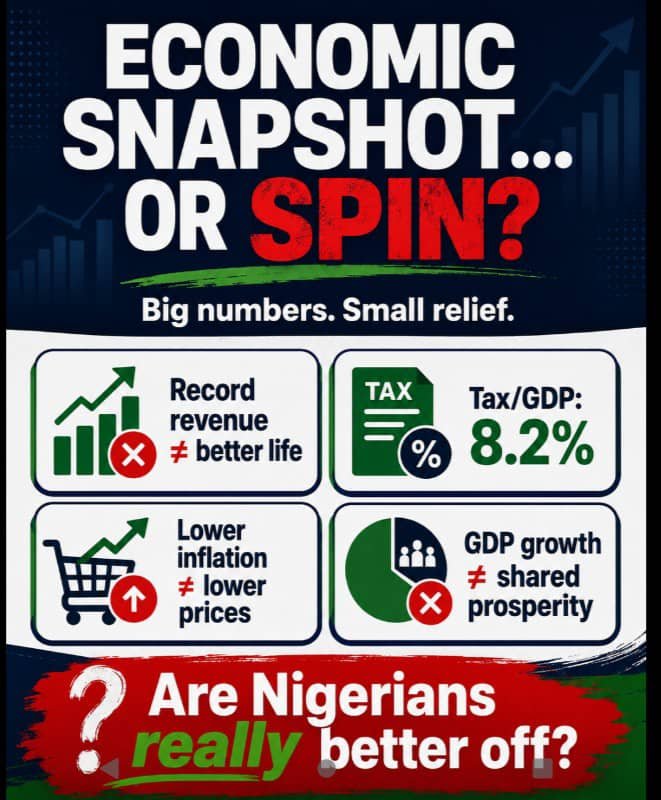
ECONOMIC SNAPSHOT OR ECONOMIC MAGIC? WHEN BIG NUMBERS ARE USED TO HIDE SMALL REALITIES
There is something almost comical about the way Nigeria’s economic “success stories” are sometimes packaged. A colourful chart appears, arrows are pointing upward, revenues are breaking records, inflation is supposedly declining, GDP is growing, debt ratios are becoming “healthier,” and suddenly we are expected to clap.
One is tempted to ask: if the economy is doing this wonderfully on PowerPoint, why does it become shy whenever it meets Nigerians in the marketplace?
That is the problem with this so-called economic snapshot. It may not necessarily contain completely fabricated figures. The deception is often more sophisticated: selective truth arranged to manufacture an impression.
THE MIRACLE OF RECORD REVENUE
We are told that government revenue has risen dramatically.
Wonderful.
Champagne, please.
But before opening the bottle, one elementary economics question must be asked:
Revenue measured in what kind of naira?
Nigeria has experienced substantial inflation and currency depreciation. Therefore, comparing nominal revenues across several years without properly considering the declining purchasing power of the naira can create an exaggerated picture of progress.
If government collected ₦10 trillion when the naira bought considerably more goods and services, and later collects ₦20 trillion after prices, contracts, wages and public expenditure have risen sharply, shouting “100% revenue increase!” may be mathematically correct while economically misleading.
Government may have more naira.
But those naira may purchase far less than the headline suggests.
So yes, the revenue chart can rise beautifully.
Unfortunately, a rising bar chart does not automatically put more food in anybody’s pot.
LOWER INFLATION: CONGRATULATIONS, YOUR SUFFERING IS INCREASING MORE SLOWLY
Perhaps the funniest trick is the celebration of falling inflation as though prices themselves have fallen.
Imagine a commodity moving from:
₦1,000
to ₦1,300
to ₦1,500.
If the rate at which the price increases later slows down, government can announce:
“Inflation is falling!”
Technically, yes.
But the woman buying tomatoes does not eat an inflation rate.
She pays the price.
Falling inflation generally means that prices are increasing at a slower rate. It does not automatically mean that prices have returned to their previous levels.
Yet political communication often quietly converts:
“prices are rising less rapidly”
into
“things are becoming cheaper.”
That is not serious economic analysis.
That is linguistic gymnastics.
The ordinary Nigerian therefore hears that inflation is falling, enters the market, receives another price shock and begins wondering whether perhaps his own market is operating outside the Nigerian economy.
GDP IS GROWING — BUT WHO EXACTLY IS GROWING WITH IT?
Then comes GDP growth, one of the favourite trophies of economic publicity.
GDP is growing, we are told.
Excellent.
But GDP growth is not the same thing as improvement in the welfare of the average citizen.
An economy can grow while income distribution remains highly unequal.
Government revenues can increase while household purchasing power remains weak.
Corporate profits can improve while real wages struggle.
Entire sectors can expand without producing enough decent jobs.
Therefore, announcing GDP growth without discussing real income per person, household consumption, employment quality, poverty and purchasing power is like announcing that a hospital is doing wonderfully because the building has become larger.
The obvious question remains:
Are the patients healthier?
That is the question the glossy snapshot conveniently avoids.
DEBT-TO-GDP: THE GREAT DENOMINATOR PERFORMANCE
Another impressive-looking statistic is debt-to-GDP.
Once GDP is rebased upward, the denominator becomes larger and the debt ratio can suddenly look healthier.
But the debt itself has not magically disappeared.
Nobody arrived at the Debt Management Office carrying a giant cheque and announced:
“Gentlemen, we have cleared the debt!”
The denominator changed.
GDP rebasing is a legitimate statistical exercise because economies evolve and previously undercounted sectors may need to be captured.
But using a lower debt-to-GDP ratio politically without explaining how much of that improvement came from a larger statistical denominator can create a misleading impression.
It is like a man owing ₦10 million announcing that his financial situation has dramatically improved because the estimated value of his family land has been revised upward.
Wonderful balance sheet.
Unfortunately, the creditor is still waiting for ₦10 million.
THE NUMBERS THEY SHOW AND THE NUMBERS THEY QUIETLY LEAVE AT HOME
The most revealing part of the economic snapshot may not even be the figures it contains.
It is the figures it avoids.
Where is real household disposable income?
Where is purchasing power?
Where is food affordability?
Where are real wages?
Where is the cost of transportation?
Where is the burden of electricity tariffs?
Where is poverty?
Where is underemployment?
Where is the proportion of household income now devoted simply to survival?
Curiously, these indicators always seem to miss the photoshoot whenever government economic achievements are being advertised.
Instead, Nigerians are shown macroeconomic aggregates and encouraged to admire them from a safe distance.
That is where the deception becomes clearer.
A balanced economic scorecard should show both:
macroeconomic stabilisation
and
household welfare.
Showing only the indicators that are improving while hiding those that reveal continuing hardship is not neutral economic reporting.
It is framing.
THE ECONOMY ON TELEVISION VERSUS THE ECONOMY IN THE KITCHEN
Nigeria may indeed be experiencing elements of macroeconomic adjustment.
Revenue mobilisation may improve.
Foreign exchange conditions may stabilise.
Economic growth may strengthen.
Inflation may moderate.
Where genuine progress occurs, it should be acknowledged.
But government should not translate every improvement in a macroeconomic statistic into an announcement that Nigerians are already prospering.
There appear to be two Nigerian economies.
There is the economy of the presentation slide, where arrows are green, graphs rise majestically and every ratio appears disciplined.
Then there is the economy of the kitchen, where families calculate whether rice, transport, rent, school fees, electricity and medication can survive the monthly income.
Until these two economies begin telling roughly the same story, Nigerians are entitled to laugh whenever another beautiful “economic snapshot” appears announcing that everything is moving upward.
Because sometimes the only thing genuinely moving upward is the graph.
THE QUESTION THE PROPAGANDA CANNOT ESCAPE
The response to all the colourful charts is remarkably simple:
If revenue is booming, GDP is growing, inflation is falling, debt ratios are improving and reforms are succeeding, why has the improvement not translated proportionately into the purchasing power and disposable income of the ordinary Nigerian?
Answer that question convincingly and the economic success story becomes meaningful.
Avoid it, and all those impressive graphs increasingly resemble:
economic statistics dressed for a political photoshoot.
CAPTION
“The graphs are smiling. Revenue is celebrating. GDP is growing. Inflation is ‘falling.’ Wonderful! Now somebody please inform the Nigerian household — apparently, it missed the economic miracle.”