
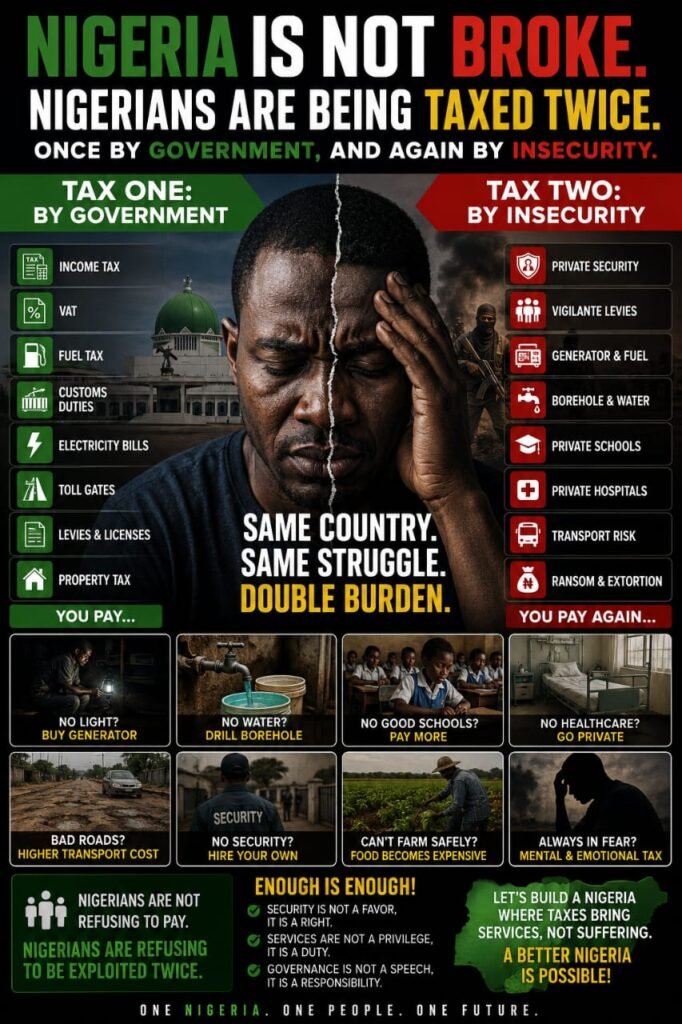
NIGERIA IS NOT BROKE — NIGERIANS ARE BEING TAXED TWICE: ONCE BY GOVERNMENT, AND AGAIN BY INSECURITY
There is a lie Nigerians have been forced to accept for too long: that the country is broke.
Nigeria is not broke.
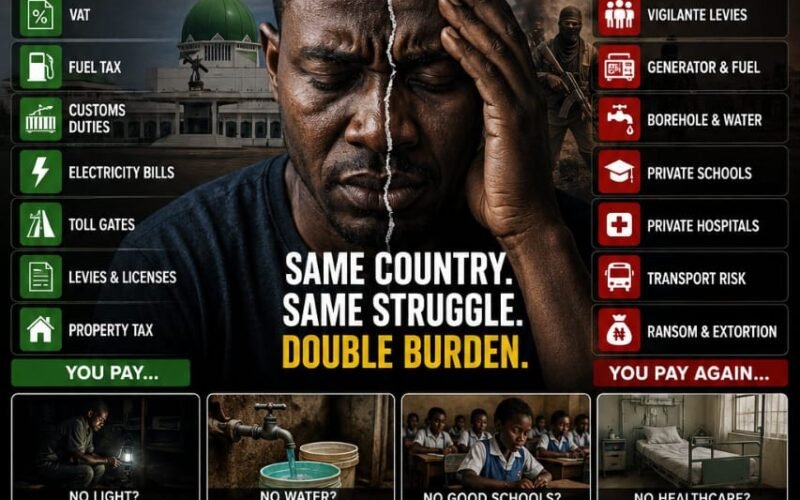
The real tragedy is that Nigerians are being made to pay twice for the same country. They pay government through taxes, levies, tariffs, duties, fuel price adjustments, electricity bills, school fees, road charges, local government permits, market levies, transport costs and endless official demands. Then, after paying government, they pay again to survive the failure of that same government.
This second payment is not written boldly in any budget document. It is not debated properly in the National Assembly. It is not captured fully in most economic reports. It is not announced as VAT. It is not called company income tax. It is not listed as personal income tax. Yet, it is one of the heaviest taxes Nigerians pay today.
It is the tax of insecurity.
It is the tax of self-help.
It is the tax of government absence.
It is the tax that forces a father to pay school fees and still contribute money for private security around the school. It is the tax that forces a mother to pay transport fare and still pay higher prices because drivers are avoiding dangerous roads. It is the tax that forces a trader to pay shop rent, market levy and local government charges, yet still contribute to vigilante groups to protect the same market. It is the tax that forces communities to buy whistles, torches, motorcycles, security uniforms and sometimes even fuel for patrol vehicles because official security presence is weak, delayed or absent.
This is the hidden tax nobody is counting.
When a Nigerian buys a generator because public power is unreliable, that is taxation by failure.
When a family drills a borehole because public water does not run, that is taxation by failure.
When parents send children to private schools because public schools have collapsed, that is taxation by failure.
When a sick person pays private hospital bills because public hospitals lack basic service, that is taxation by failure.
When landlords employ night guards because the police are overstretched, underfunded or too far away, that is taxation by failure.
When citizens contribute money to settle kidnappers, pay ransom, relocate children, abandon farms, close shops early, avoid night travel, pay escorts, or pay community security levies, that is taxation by insecurity.
And this is why the Nigerian cost-of-living crisis is deeper than inflation alone.
Inflation is not only what the National Bureau of Statistics announces. Inflation is also fear. Inflation is distance. Inflation is danger. Inflation is the extra money people spend because the state has failed to guarantee normal life. In Nigeria today, insecurity has become an economic policy imposed on the poor without legislation.
A bag of rice is expensive not only because of exchange rate problems or fuel prices. It is also expensive because farmers are afraid to go to farms in many communities. It is expensive because transporters face bad roads, checkpoints, extortion, bandits, kidnappers and fuel costs. It is expensive because the trader has to build all these risks into the final price. By the time the food reaches the market, the ordinary Nigerian is not only buying rice. He is also buying fear, risk, distance, diesel, bribes, delay and insecurity.
That is the second taxation.
A bus fare is no longer just a bus fare. It now carries the cost of insecurity. Drivers avoid some roads. They travel in convoys. They pay informal charges. They calculate risk. They raise fares. Passengers complain, but the driver too is trapped. The final burden returns to the ordinary Nigerian.
That is the second taxation.
School fees are no longer just school fees. Parents now pay for fences, guards, gates, surveillance, safer boarding arrangements, relocation, extra transport, private hostels, emergency communication and sometimes psychological trauma after attacks on schools elsewhere. Every school kidnapping in one part of Nigeria sends fear into classrooms in another part of Nigeria. The parent in Abuja, Lagos, Ibadan, Enugu, Port Harcourt, Kano, Kaduna, Jos, Makurdi, Owerri, Umuahia, Sokoto or Maiduguri may not be directly attacked, but the fear enters the household budget.
That is the second taxation.
Even churches and mosques are not spared. Worshippers contribute to security arrangements. Ushers now think like guards. Religious centres spend more on gates, lighting, personnel and surveillance. A place of worship that should simply be a sanctuary has now become a small security command post. The congregation pays.
That is the second taxation.
Businesses are bleeding quietly. A small business owner pays government taxes, regulatory fees, power bills, diesel costs, staff salaries and rent. After that, he pays private security. He installs CCTV. He buys iron protectors. He closes earlier than normal because of fear. He loses night customers. He rejects delivery to certain locations. He increases prices. The consumer pays.
That is the second taxation.
Farmers are suffering perhaps more brutally than anyone else. In many rural communities, insecurity has turned farming into gambling with life. Some farmers pay to access their own farms. Some abandon farms completely. Some harvest early to avoid attacks. Some are displaced. Some pay levies to non-state actors. Some communities negotiate with criminals just to stay alive. When farming becomes unsafe, hunger becomes national policy by default.
That is the second taxation.
What makes this matter painful is that Nigerians are not refusing to pay government. Nigerians pay. They pay directly and indirectly. Every time they buy fuel, they pay. Every time they buy goods, they pay. Every time they recharge phones, register businesses, renew papers, clear goods, pay school fees, pay electricity bills, pay rent, buy food or move around, they pay. The Nigerian citizen is one of the most heavily burdened citizens in practical terms, not because official tax-to-GDP ratios are necessarily the highest, but because the citizen is forced to privately replace almost every public service.
A Nigerian does not merely live in Nigeria. A Nigerian funds Nigeria twice.
He funds the formal government through official payments.
Then he funds the informal survival system through fear payments.
That is why the argument that Nigeria needs more revenue must be handled carefully. Government may need revenue, yes. But citizens also need value. A government that asks people to pay more must first show that what they already pay is producing safety, dignity and service. You cannot keep increasing the burden on citizens while citizens are still building their own roads, providing their own water, generating their own electricity, guarding their own streets, securing their own schools, and paying ransom to recover their own relatives.
That is not governance.
That is abandonment with receipts.
The Nigerian state must understand something very clearly: insecurity is not only a security problem. It is an economic problem. It is a food inflation problem. It is an education problem. It is a health problem. It is a business problem. It is a transport problem. It is a mental health problem. It is a poverty problem. It is a national productivity problem.
A country cannot grow properly when citizens are budgeting for fear.
A country cannot industrialise when investors must first calculate kidnapping risk.
A country cannot feed itself when farmers are afraid of farms.
A country cannot educate its children when parents are afraid of schools.
A country cannot build trust when communities feel they must negotiate their own survival.
A country cannot claim to be reforming while ordinary families are becoming poorer from both official policy and unofficial insecurity.
The most dangerous thing about this hidden tax is that it is regressive. It punishes the poor more than the rich. The rich can hire guards, move to secured estates, travel by air, buy armored vehicles, relocate children abroad, install solar systems, drill boreholes, use private hospitals and pay for safe alternatives. The poor cannot. The poor man faces the failed road, the unsafe farm, the collapsing public school, the overcrowded hospital, the powerless community and the dangerous night.
So when insecurity rises, inequality rises.
When public services fail, inequality rises.
When citizens must privately buy survival, inequality rises.
This is why Nigeria’s poverty debate must move beyond speeches. Poverty is not only lack of income. Poverty is also the inability to live safely. Poverty is the inability to sleep without fear. Poverty is the inability to send children to school with confidence. Poverty is the inability to travel home for Christmas without calculating kidnapping routes. Poverty is the inability to farm ancestral land. Poverty is the inability to open a shop late into the evening because insecurity has shortened business hours.
That is the real Nigeria many people are living in.
And yet, the Nigerian people have shown unbelievable resilience. They build, trade, farm, pray, study, hustle, innovate and survive. But resilience should not become an excuse for government failure. Nigerians are resilient, yes, but they are tired. Nigerians are hardworking, yes, but they are overburdened. Nigerians are hopeful, yes, but hope cannot replace security. Nigerians are patriotic, yes, but patriotism should not mean paying endlessly for services government has already promised to provide.
The truth must be said plainly.
The greatest tax in Nigeria today may not be the one written in law.
It may be the tax imposed by insecurity, poor infrastructure and weak public service delivery.
It is the money Nigerians pay because government is absent.
It is the money Nigerians pay because institutions are weak.
It is the money Nigerians pay because criminals are confident.
It is the money Nigerians pay because communities have been left to improvise.
It is the money Nigerians pay because public systems no longer carry their proper weight.
The solution is not grammar. The solution is not propaganda. The solution is not blaming citizens. The solution is a serious national reset around security, accountability and service delivery.
First, security must be treated as economic infrastructure. Just as roads, power and ports support growth, security supports every market, farm, school, hospital, church, mosque and household. Without security, every other reform becomes fragile.
Second, government must count the real cost of insecurity. Nigeria needs serious public accounting of how insecurity affects food prices, school attendance, farm output, transport cost, investment decisions, business closures, displacement, ransom payments and household poverty. What is not counted is easily ignored.
Third, the Nigerian state must stop measuring performance only by money spent. Spending is not achievement. Budget size is not impact. A security vote is not security. A road contract is not mobility. A school building is not education. A hospital structure is not healthcare. Nigerians need outcomes, not announcements.
Fourth, federal, state and local governments must rebuild trust with communities. Security intelligence begins with trust. Communities know strange movements. They know local risks. They know criminal routes. But people will not cooperate with a state they do not trust, or a system that does not protect informants.
Fifth, public services must be restored so that citizens are not forced to privately replace government. A country where every household must provide its own water, power, school, hospital and security is not reducing poverty; it is transferring the cost of governance to citizens.
This is the conversation Nigeria must now have.
Not the usual shallow argument of whether government is broke.
The deeper question is: why are citizens paying twice?
Why should Nigerians pay government and still pay to protect themselves?
Why should Nigerians fund public institutions and still privately replace those institutions?
Why should parents pay taxes and still fear for their children in school?
Why should farmers feed the nation and still beg for access to their farms?
Why should traders pay levies and still pay criminals indirectly through fear?
Why should citizens obey the law while criminals behave like parallel authorities?
Nigeria is not broke in the way politicians want citizens to believe.
Nigeria is leaking value through insecurity, waste, duplication, fear and failure.
The people are not merely poor.
They are being overcharged for survival.
Until Nigeria confronts this hidden tax, every economic reform will remain incomplete. You cannot tax people into prosperity while insecurity is taxing them into poverty. You cannot ask citizens to sacrifice endlessly while criminals are collecting their own unofficial revenue from fear. You cannot build a productive economy on exhausted households.
The Nigerian citizen does not need more slogans.
The Nigerian citizen needs protection.
The Nigerian citizen needs working schools, roads, hospitals, farms, courts, police, power and water.
The Nigerian citizen needs a government that reduces the private cost of survival.
Because the real measure of governance is simple:
How much of the citizen’s burden has government removed?
If government collects taxes but citizens still provide everything for themselves, then governance has become too expensive and too absent at the same time.
That is the Nigerian contradiction.
And that is why this matter must be said loudly:
Nigeria is not broke. Nigerians are being taxed twice — once by government, and again by insecurity.
Until that second tax is removed, the ordinary Nigerian will continue to pay for a country that is not fully protecting him.
And no nation can rise sustainably while its citizens are forced to pay extra just to stay alive.
REFERENCES AND SOURCE LINKS
Reuters — Nigeria’s kidnapping nightmare spreads south, June 2026:
https://www.reuters.com/world/africa/we-want-our-children-back-nigerias-kidnapping-nightmare-spreads-south-2026-06-05/
Reuters — Nigeria projects 2026 deficit as Tinubu proposes spending plan, December 2025:
https://www.reuters.com/world/africa/nigeria-projects-2026-deficit-428-gdp-tinubu-proposes-spending-plan-2025-12-19/
Reuters — Nigeria’s inflation picks up for the first time in a year, April 2026:
https://www.reuters.com/world/africa/nigerias-inflation-picks-up-first-time-year-march-2026-04-15/
National Bureau of Statistics / UNDP — Nigeria Multidimensional Poverty Index 2022:
https://www.nigerianstat.gov.ng/pdfuploads/NIGERIA%20MULTIDIMENSIONAL%20POVERTY%20INDEX%20SURVEY%20RESULTS%202022.pdf
SBM Intelligence — The Economics of Nigeria’s Kidnap Industry, 2025:
https://sbmintelligence.substack.com/p/the-economics-of-nigerias-kidnap
The Guardian Nigeria — Nigeria records 2.2m kidnappings, N2.2tr ransom payments in one year, says report, May 2026:
https://guardian.ng/news/nigeria-records-2-2m-kidnappings-n2-2tr-ransom-payments-in-one-year-says-report/
Bertelsmann Transformation Index — Nigeria Country Report 2026:
https://bti-project.org/en/reports/country-report/NGA