
NIGERIA AT THE DEVELOPMENTAL INFLECTION POINT: HISTORICAL LESSONS FROM THE UNITED STATES, BRITAIN AND GERMANY
By AProf. Chukwuemeka Ifegwu Eke
Introduction
Nigeria’s contemporary socio-economic and political condition raises one of the most important questions in comparative development: at what point in the historical evolution of today’s developed economies did they experience circumstances broadly comparable to those confronting Nigeria today? The question is not merely academic. It speaks directly to the anxiety of a society confronted simultaneously by inflation, declining purchasing power, unemployment and underemployment, infrastructure deficits, insecurity, institutional distrust, political contestation and far-reaching economic reforms. For many Nigerians, the immediate experience is one of hardship and uncertainty. Yet economic history suggests that periods of profound difficulty sometimes coincide with deeper structural transitions whose consequences become fully visible only years or decades later.
It would, however, be analytically misleading to suggest that Nigeria in 2026 is simply America in a particular nineteenth-century year, Britain at some precise stage of the Industrial Revolution or Germany before industrial unification. History does not move in a straight line, and countries do not follow identical developmental calendars. Nigeria is operating within a twenty-first-century global economy characterised by digital technology, instantaneous communication, international capital flows, democratic politics, global supply chains and vastly different demographic conditions. Nevertheless, comparative historical analysis remains useful because countries often encounter similar structural contradictions. Political institutions created for one type of society may become increasingly inadequate for another; technological change can undermine established economic arrangements; urbanisation can create new political constituencies; and expanding education can increase popular expectations faster than governments can satisfy them.
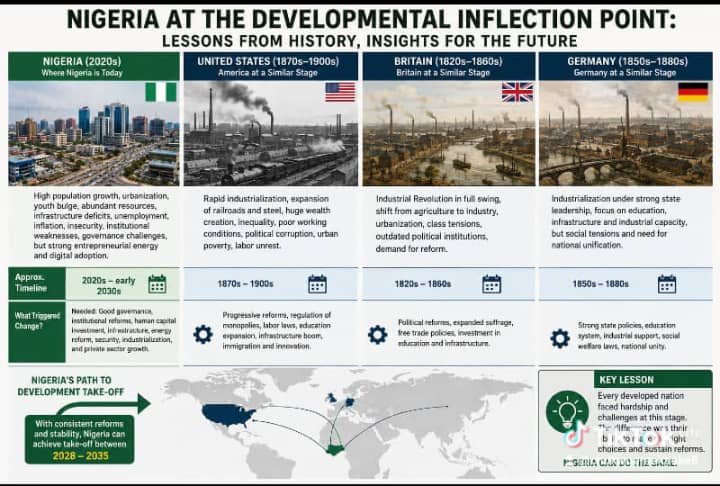
Viewed from this perspective, Nigeria appears to exhibit features that resemble the United States between approximately 1870 and 1905, Britain between roughly 1820 and 1870, and Germany between approximately 1850 and 1890. These analogies should not be understood as chronological equivalence. They are better interpreted as comparisons of developmental tension: periods during which old institutional structures were under pressure from emerging economic, demographic and technological realities.
The American Experience: Economic Dynamism Amid Institutional Disorder
The United States in the decades following the Civil War underwent a transformation of extraordinary magnitude. Railways expanded across the continent, industrial production accelerated, cities grew rapidly and corporations achieved scales previously unknown in American history. Steel, petroleum, finance, manufacturing and transportation became increasingly central to the economy. Individuals accumulated immense fortunes while large numbers of workers experienced difficult working and living conditions. The result was an economy capable of generating unprecedented wealth but also an increasingly visible concentration of that wealth.
This period, commonly associated with the Gilded Age, illustrates a developmental contradiction that has relevance for contemporary Nigeria. Economic dynamism was advancing faster than institutional adaptation. Political patronage remained extensive, corruption was a major concern, urban governments were frequently dominated by powerful political machines, labour disputes became increasingly intense and citizens questioned the relationship between concentrated wealth and political influence. Yet the same period also created the economic foundations of America’s later prosperity. The problem was therefore not the absence of productive change, but the inability of existing political and social institutions to manage that change equitably and efficiently.
America’s eventual response emerged gradually. A stronger professional middle class developed, journalism increasingly exposed abuses, organised labour expanded, civil-service reform gained support and political movements began demanding improved regulation and greater accountability. By the beginning of the twentieth century, these pressures were contributing to what became known as the Progressive Era. Regulation of corporate activity increased, administrative reforms developed, public-health institutions expanded and political practices gradually changed.
The American lesson for Nigeria is therefore particularly important. Economic reform and economic growth do not automatically produce social stability or inclusive prosperity. Productive transformation must eventually be accompanied by institutional transformation. An economy can change faster than its political system, but that divergence cannot continue indefinitely without creating considerable tension. Nigeria’s contemporary challenge may similarly involve the reconciliation of a rapidly evolving economy and society with political and administrative institutions that developed under very different historical circumstances.
Britain: Industrial Transformation and the Gradual Reorganisation of Political Power
Britain offers another instructive example because its transformation demonstrates how industrial development can alter the distribution of political power. The Industrial Revolution changed not merely the manner in which goods were produced; it altered the structure of British society. Industrial towns expanded rapidly, traditional rural patterns were disrupted, commercial and manufacturing interests accumulated greater economic influence and a new urban working population became increasingly important.
Yet political institutions did not initially change at the same speed. Representation remained heavily influenced by older landed interests even as economic activity was shifting toward rapidly growing industrial centres. The contradiction between an emerging industrial society and an older political system eventually became difficult to sustain. Political reform therefore became part of economic transformation.
The nineteenth-century British reform process was gradual rather than revolutionary. The Reform Acts progressively expanded political participation and adjusted representation to reflect a changing society. The repeal of the Corn Laws represented more than a change in agricultural policy; it symbolised the increasing political influence of industrial and commercial interests relative to traditional landed elites. The rise of organised labour subsequently altered the political equilibrium even further.
Britain’s experience suggests that major economic transformations ultimately create constituencies demanding corresponding political adjustments. As education spreads, cities grow and private enterprise expands, citizens increasingly expect institutions to reflect their changing economic importance. Political structures that fail to accommodate these transformations become progressively more difficult to sustain.
This has considerable relevance for Nigeria. The Nigerian society of 2026 is substantially different from that of independence in 1960. The population has expanded enormously, cities have grown, education has spread, telecommunications have transformed information exchange, an increasingly assertive entrepreneurial sector has emerged and younger citizens are significantly more connected to global economic and political ideas. Yet many governmental institutions continue to operate according to administrative assumptions inherited from earlier periods. One of Nigeria’s deepest developmental challenges may therefore be the gradual redesign of institutions to correspond with the complexity of the society they are expected to govern.
Germany: Industrialisation, State Capacity and the Construction of a Developmental Bargain
Germany’s experience introduces another dimension to the analysis because German industrialisation demonstrated the importance of state capacity. Germany’s rise during the nineteenth century was associated with expanding railway networks, industrial production, scientific and technical education, sophisticated banking institutions and increasing economic integration. Industrialisation did not occur solely because markets were allowed to operate freely. It also involved institutions capable of coordinating investments, supporting education, developing infrastructure and facilitating industrial expansion.
The German state subsequently confronted the social consequences of industrialisation. Rapid economic change created a growing industrial working class and new forms of political mobilisation. The response under Bismarck included pioneering social-insurance arrangements designed partly to integrate workers into the emerging economic order and reduce the destabilising consequences of industrial transformation. This illustrated a critical feature of successful development: major structural change often requires a new social bargain.
For Nigeria, the German experience emphasises that macroeconomic reforms alone cannot constitute a developmental strategy. Markets require institutional complements. Industries require reliable electricity, transportation and finance. Investors require security and predictable regulation. Workers require skills. Citizens require public services capable of making economic transitions socially sustainable. Where state capacity is weak, reforms may change prices without sufficiently changing productivity.
Nigeria’s transformation will therefore depend partly upon whether government at federal, state and local levels can convert financial and institutional reforms into measurable improvements in productive capacity. The central issue is not simply whether government spends more or less. It is whether public institutions can increasingly convert resources into electricity, roads, ports, security, education, healthcare, water, digital infrastructure and an environment in which businesses can expand.
Understanding the Combination That Produces Developmental Change
The central lesson emerging from these historical comparisons is that transformation rarely results from one factor. Development is fundamentally combinatorial. Economic pressure may create the demand for reform, but economic pressure alone can produce instability rather than progress. Technology can generate opportunities, but those opportunities may remain unrealised where infrastructure and human capital are insufficient. Education can create a skilled population, but educated citizens may migrate if the domestic economy cannot absorb their capabilities. Political competition can encourage accountability, but it can equally deteriorate into identity-based mobilisation if institutions remain weak.
Successful transformation therefore occurs when several forces begin reinforcing one another. Economic pressure challenges unsustainable arrangements. Institutional adaptation improves the capacity of government to respond. Human-capital accumulation increases productivity. Capital formation finances productive investment. Urbanisation enlarges markets and facilitates economic interaction. Political competition creates incentives for governments to perform. Technology reduces production and transaction costs while opening entirely new industries.
The interaction among these variables is more important than any individual component. A country becomes increasingly developmental when positive feedback mechanisms emerge between them. Better infrastructure attracts investment; investment generates employment and tax revenue; revenue allows additional infrastructure; education improves worker productivity; higher productivity raises incomes; rising incomes expand domestic markets; larger markets attract further investment. Once these relationships become sufficiently strong, development begins to acquire momentum of its own.
It is this transition from fragmented improvements to self-reinforcing development that may properly be described as a developmental take-off.
Nigeria’s Present Structural Contradiction
Nigeria today contains many characteristics of an economy approaching a major structural transition, although there is no guarantee that the transition will succeed. The country has one of the largest domestic markets in Africa, an exceptionally youthful population, a rapidly urbanising society and a highly entrepreneurial private sector. Digital technology has transformed payments, communications, entertainment, commerce and the organisation of economic activity. Nigerian firms and professionals increasingly participate in global markets, while the country’s creative and technological sectors have achieved international visibility.
At the same time, significant constraints remain. Electricity continues to limit industrial productivity. Transport and logistics costs remain high. Insecurity undermines agricultural production and discourages investment in affected areas. Inflation has imposed serious pressure upon household purchasing power. Unemployment and underemployment create frustration among an increasingly educated youth population. Institutional weaknesses increase transaction costs, while dependence upon imported goods and petroleum-related revenue has historically exposed the economy to external shocks.
The important point is that Nigeria is not simply experiencing hardship. It is experiencing hardship within a period of substantial structural adjustment and social transformation. This makes the present period particularly consequential. A difficult economy can deteriorate into prolonged stagnation, but it can also create political and institutional incentives for deeper reform. Which path Nigeria follows will depend upon whether present adjustments eventually expand productive capacity.
From Macroeconomic Stabilisation to Developmental Transformation
The distinction between stabilisation and transformation is central to understanding Nigeria’s prospects. Governments can improve fiscal balances, reorganise exchange-rate systems, reform taxation, restructure subsidies and increase public revenues without necessarily improving the immediate living conditions of households. Such reforms may be economically necessary, but their developmental significance depends upon what follows them.
Macroeconomic stabilisation becomes development only when improved financial conditions stimulate productive investment. Productive investment must then generate output and employment. Employment must generate sustainable increases in household income. Higher incomes must expand domestic demand and government revenue. Increased public revenue must subsequently return to the economy through infrastructure, education, healthcare, security and other productivity-enhancing public goods.
Nigeria therefore faces what may be described as a stabilisation-to-transformation gap. Crossing this gap is considerably more difficult than implementing individual reforms. It requires coordination across sectors and continuity across political cycles.
If economic reform merely redistributes existing burdens without expanding productivity, popular resistance will eventually intensify. If, however, reforms facilitate domestic refining, more reliable electricity, stronger agricultural productivity, improved transport systems, competitive manufacturing, expanding digital services and greater private investment, the meaning of the current economic difficulties may look very different when viewed retrospectively.
Federalism and the Possibility of Developmental Competition
One factor that may significantly influence Nigeria’s trajectory is its federal structure. Federalism is frequently discussed primarily in terms of revenue allocation and political representation. Its potentially greater developmental value lies in its capacity to generate competition among subnational governments.
When citizens and businesses can compare the performance of different states, political accountability can gradually become more empirical. A governor who attracts investment, expands electricity supply, improves roads, strengthens education and creates a safer business environment provides a visible benchmark against which other governments can be evaluated. Successful policies can be copied. Investors can increasingly reward competent jurisdictions, while poorly governed states may face growing political and economic pressure.
Such a process could gradually transform Nigerian electoral politics. Political competition has historically been influenced strongly by ethnicity, religion, regional identity and access to distributable state resources. These influences are unlikely to disappear. Nevertheless, their relative importance could decline if voters increasingly perceive tangible economic differences between competing models of governance.
A developmental federation would therefore not require every state to progress at the same speed. Indeed, unequal experimentation could become an advantage if successful states demonstrate what is possible and create pressure for imitation elsewhere.
The Nigerian Developmental Window
Predicting an exact year of national economic transformation would be intellectually irresponsible. Development does not occur at midnight on a particular date. It is a cumulative process, and its true beginning is frequently identifiable only retrospectively. Nevertheless, demographic, economic and political trends can be used to identify periods during which transformation becomes more probable.
Nigeria’s current restructuring suggests that the years between approximately 2026 and 2036 may constitute such a period. The first part of this window is likely to remain dominated by adjustment, institutional reform and efforts to restore macroeconomic stability. The later part could become a period in which the productive consequences of those reforms either become visible or fail to materialise.
Within this broader period, a working hypothesis of approximately 2032, with a margin of five years on either side, provides a useful analytical benchmark. This should not be interpreted as a prophecy that Nigeria will “take off” in 2032. Rather, it represents the midpoint of a period during which several potentially transformative variables may converge: demographic change, urbanisation, infrastructure investment, digital technology, energy-sector reform, expanding domestic capital, increased subnational competition and generational political change.
If these forces combine successfully, the early 2030s could mark the period in which Nigeria begins moving from episodic growth toward sustained productivity-driven development. If they fail to combine, Nigeria may instead experience another cycle of macroeconomic adjustment without structural transformation.
The Political Economy of the Coming Transition
Ultimately, Nigeria’s developmental challenge is political as much as economic. Every economic system creates interests that benefit from its continuation. An economy organised substantially around the distribution of rents creates political constituencies interested in preserving access to those rents. A productive economy, by contrast, gradually creates businesses, workers, professionals and taxpayers whose interests increasingly depend upon functioning infrastructure, stable institutions, reliable electricity, efficient logistics and predictable regulation.
This means that economic development can eventually alter the nature of political competition itself. As more citizens derive their livelihoods from productive economic activity rather than direct access to state patronage, their demands upon government may change. The central political question gradually becomes less about who controls the distribution of existing revenue and more about which government can expand the opportunities from which new wealth is created.
This transformation was visible in different forms in Britain, Germany and the United States. New productive classes eventually acquired sufficient economic and political influence to demand institutional arrangements compatible with their interests. Nigeria may increasingly experience similar pressures as entrepreneurs, professionals, technology workers, industrialists, organised labour and an expanding urban population demand better-performing institutions.
The decisive political transformation may therefore occur when poor governance becomes economically more expensive to political elites than reform. At that point, the incentives within the political system begin to change.
Why Hardship Alone Cannot Produce Development
There is a danger in historical comparison if the suffering associated with past development is interpreted as evidence that present suffering must eventually produce prosperity. This would be both economically incorrect and morally problematic. Hardship is not itself a developmental asset. Countries can remain poor for extremely long periods. Economic crisis can destroy institutions, accelerate migration, discourage investment and deepen political instability.
What mattered in the historical transformations of Britain, Germany and the United States was not simply that their populations experienced difficult periods. What mattered was that those periods coincided with rising productive investment, technological advancement, institution building, human-capital formation and political adaptation.
Nigeria therefore cannot justify present economic pain simply by describing it as the price of future prosperity. The legitimacy of difficult reforms ultimately depends upon whether they generate measurable increases in national productive capacity. Citizens must eventually encounter the consequences of reform in their electricity supply, transport costs, employment opportunities, real incomes, food prices, schools, hospitals and personal security.
A developmental transition succeeds when sacrifices cease to be permanent and begin producing observable economic returns.
The 2032 Hypothesis and a Nigerian Developmental Take-Off Index
The proposition that Nigeria could approach an important developmental threshold around the early 2030s should ultimately be subjected to empirical analysis. A useful next stage would therefore be the construction of a Nigerian Developmental Take-Off Index capable of measuring the degree to which the underlying conditions for sustained transformation are converging.
Such an index could incorporate economic growth per capita, manufacturing expansion, electricity availability, capital formation, productivity, export diversification, infrastructure, human capital, agricultural output, private-sector credit, real wages, government revenue, technology adoption and institutional effectiveness. The objective would not simply be to produce another ranking but to identify whether Nigeria is moving toward a combination of structural conditions historically associated with sustained economic take-off.
Historical observations from the United States, Britain and Germany could be supplemented with more recent late-industrialising countries such as South Korea, China, Malaysia and perhaps Vietnam. This would make it possible to distinguish between developments peculiar to nineteenth-century industrialisation and those that appear more generally across successful development experiences.
The resulting framework could then test the 2032 hypothesis rather than accepting it as a rhetorical prediction. The question would become whether Nigeria’s trajectory across a specified collection of measurable variables is converging toward historically observed developmental thresholds and, if so, at what probable date.
Conclusion
Nigeria’s current socio-economic difficulties should therefore be interpreted neither through excessive pessimism nor through uncritical optimism. The country is experiencing a period of significant economic and institutional disruption, but history demonstrates that disruption can lead in fundamentally different directions. It can produce stagnation, political instability and social fragmentation, or it can become the transitional stage preceding a more productive economic order.
The experiences of the United States, Britain and Germany indicate that national transformation occurs when economic change begins altering political institutions, when productive groups acquire greater influence, when technological possibilities are supported by infrastructure and skills, and when the state develops sufficient capacity to manage the social consequences of transition.
Nigeria presently possesses elements of each of these processes, but they have not yet converged sufficiently to make sustained transformation inevitable.
The central developmental challenge facing the country is therefore the conversion of reform into productivity. Macroeconomic adjustments must become industrial expansion. Infrastructure spending must reduce actual production costs. Education must produce economically useful human capital. Federalism must become a mechanism for developmental competition. Technology must improve productivity rather than merely consumption. Political competition must increasingly reward measurable performance.
If these transitions occur simultaneously and become mutually reinforcing, the period between the late 2020s and the middle of the 2030s could ultimately be remembered as Nigeria’s developmental turning point. Within that window, approximately 2032 provides an interesting analytical hypothesis rather than a predetermined destination.
The ultimate lesson of history is therefore not that Nigeria must become prosperous because Britain, Germany and the United States eventually did. History offers no such guarantee. The deeper lesson is that countries change when the economic and political incentives sustaining an old equilibrium become weaker than the forces demanding a new one.
Nigeria may now be moving toward precisely such a contest.
The defining question of the next decade will be whether the country merely survives the present economic disruption or succeeds in converting it into the foundations of a new developmental order.