
BEYOND POLITICS: HUMAN DIGNITY, INSTITUTIONAL RESPONSIBILITY AND THE ECONOMICS OF SOCIAL STABILITY IN ABIA
By AProf Chukwuemeka Ifegwu Eke
The transformation of Abia State must be understood within a broader developmental framework that extends beyond physical infrastructure to encompass human dignity, institutional responsibility, social inclusion and productive engagement across the different tiers of government.
In my continuing Abia Then, Abia Now research undertaking, I recognise that development is a multidimensional process. Roads, hospitals, schools and industrial infrastructure constitute its physical expression, while security, institutional cooperation, social harmony and human welfare constitute its enduring foundation.
Recent developments provide an opportunity to explain these important dimensions of governance and their implications for the economic future of Abia State.
PRESIDENTIAL PROTOCOL: GOVERNANCE BEYOND PARTY BOUNDARIES
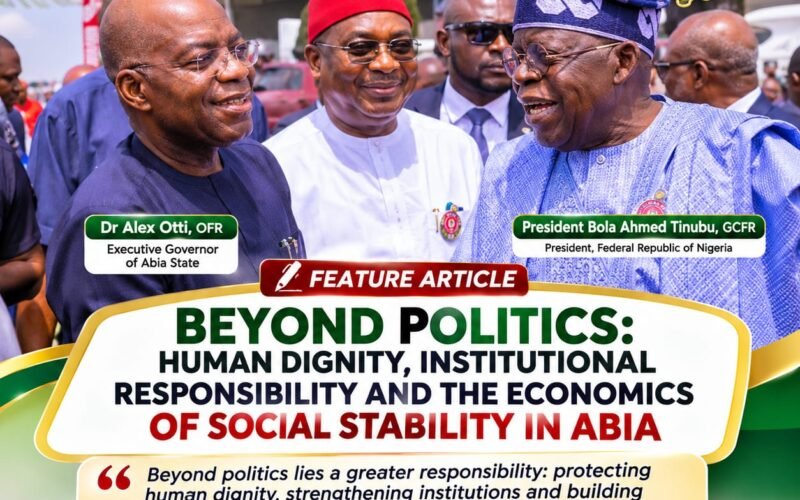
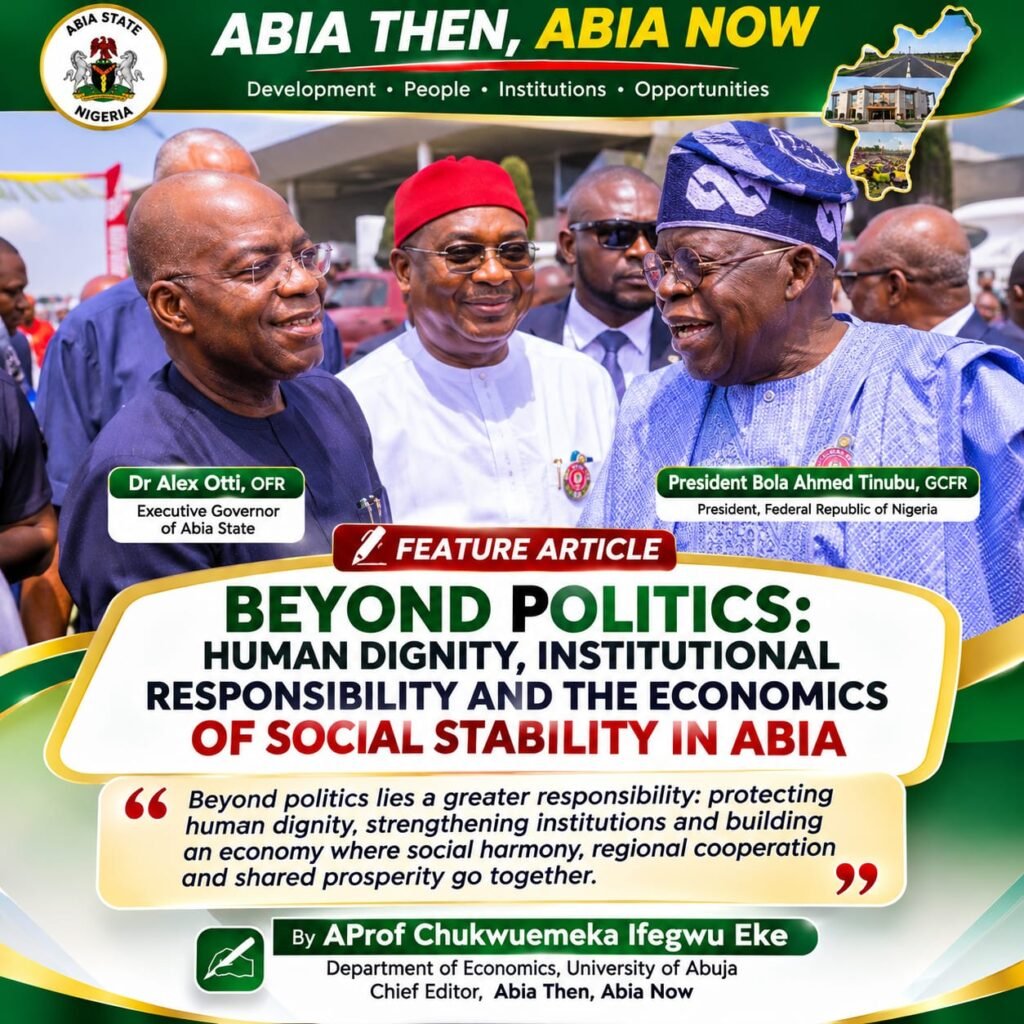
On Saturday, November 28, 2026, Governor Alex Otti, alongside other governors of the South-East geopolitical zone, received President Bola Ahmed Tinubu during his visit to Enugu State.
All five South-East governors participated in the presidential reception, notwithstanding their different political affiliations.
This development provides an important opportunity to explain the architecture of Nigeria’s federal system and the economic significance of intergovernmental relations.
Nigeria operates a federation comprising 36 states, the Federal Capital Territory and 774 local government areas.
Within this institutional arrangement, effective cooperation between the federal government and constituent states remains indispensable to sustainable development.
The responsibilities of a state governor extend considerably beyond the affairs of his political party.
He must engage federal institutions, development agencies, regulatory authorities, international development partners and other subnational governments in pursuit of the legitimate interests of his people.
For Abia, such institutional engagements are particularly relevant to:
- Federal road infrastructure.
- Railway and transportation development.
- Electricity generation and distribution.
- Industrial expansion.
- Agricultural value-chain development.
- Security coordination.
- Development financing.
- International investment mobilisation.
- Regional economic integration.
The development requirements of Abia State cannot be confined within partisan boundaries.
I distinguish between political competition and institutional cooperation. While the former concerns the pursuit of electoral mandates, the latter concerns the discharge of public responsibilities.
Receiving the President of the Federal Republic of Nigeria does not, by itself, establish a change of political affiliation or an electoral alliance.
Interestingly, the Labour Party presidential candidate, Dr Chibuzo Okereke, also publicly explained the distinction between Governor Otti’s official responsibilities and partisan political engagements.
The economic interests of Abia’s manufacturers, traders, farmers, entrepreneurs and professionals must remain central to discussions concerning intergovernmental cooperation.
THE ECONOMICS OF REGIONAL COOPERATION
The South-East geopolitical zone comprises five states: Abia, Anambra, Ebonyi, Enugu and Imo.
These states share extensive commercial, cultural, transportation and economic relationships.
The economic fortunes of Aba cannot be entirely separated from developments in Onitsha, Nnewi, Owerri, Enugu and Abakaliki.
Goods, services, labour, capital and entrepreneurial knowledge move across these geographical boundaries.
A manufacturer in Aba requires access to markets beyond Abia.
An agricultural producer in Umunneochi benefits from efficient regional transportation networks.
An entrepreneur in Umuahia can access investment opportunities originating outside the state.
The economic principle is straightforward: regional cooperation can expand markets, reduce transaction costs and create opportunities for productive investment.
Consequently, engagements involving the five South-East governors and federal authorities provide opportunities for addressing matters of shared economic interest.
I consider this regional dimension particularly important in understanding Abia’s long-term industrial and commercial prospects.
INCLUSIVE EDUCATION: INVESTING IN EVERY ABIA CHILD
The Special Education Centre, Afara, Umuahia, occupies an important position in the state’s human capital development architecture.
In August 2024, the institution’s old students association publicly acknowledged Governor Otti’s interventions, including support for perimeter fencing and the provision of a school bus.
The significance of these interventions extends beyond their immediate physical value.
For children with disabilities, accessible transportation, secure learning environments and appropriate educational infrastructure can determine the extent to which they participate in formal education.
The continued engagement of the institution’s alumni provides an opportunity for sustained collaboration between government, education professionals, parents and other stakeholders.
From the perspective of development economics, expenditure on inclusive education should be understood as investment in human capital.
When children acquire relevant knowledge, professional skills and opportunities for independent living, society benefits from their productive contributions.
Educational inclusion also reduces the long-term economic costs associated with marginalisation and dependency.
I believe that continued investment in assistive technology, specialised teaching facilities, professional capacity and student welfare represents an important dimension of Abia’s development agenda.
Every child deserves opportunity.
Every child deserves dignity.
Every child deserves an enabling environment in which to develop their potential.
FORTUNATE CHIAMAKA: OUR COLLECTIVE HUMANITY
I also wish to acknowledge the publicly reported appeal by Mr Phillip Aku concerning his daughter, Miss Fortunate Chiamaka, a nursing graduate of Abia State University.
Her father appealed to Governor Alex Otti and the Commissioner of Police for assistance following her reported disappearance.
I join the family in appealing for every available lawful security, investigative, technological and community resource to be deployed towards establishing her whereabouts and securing her safe recovery.
I encourage individuals with credible information to cooperate with the relevant authorities.
The protection of human life transcends political considerations.
A young woman who has invested years in professional training represents not merely an individual aspiration but also a valuable contribution to society’s human capital.
At this moment, compassion, responsible communication and institutional cooperation are indispensable.
My prayers remain with her family.
SOCIAL STABILITY AS AN ECONOMIC ASSET
One of the most important but frequently understated components of economic development is social stability.
Economists recognise that uncertainty increases the cost of doing business.
Political hostility, insecurity and institutional fragmentation can discourage investment, disrupt commercial activities and undermine long-term economic planning.
Conversely, predictable institutions, effective public administration and peaceful social relationships create conditions conducive to productive enterprise.
This relationship is particularly significant for Abia, given its extensive commercial and manufacturing activities.
The footwear manufacturer in Aba requires a predictable business environment.
The agricultural producer in Abiriba requires reliable access to markets.
The trader in Umuahia requires security.
The entrepreneur in Ohafia requires institutional confidence.
The investor considering Abia requires an environment in which legitimate business interests are protected.
Social stability, therefore, constitutes an important form of economic capital.
The developmental conversation must continually recognise the relationship between political order, institutional effectiveness, human welfare and economic prosperity.
ABIA THEN, ABIA NOW: A MULTIDIMENSIONAL DEVELOPMENT FRAMEWORK
Through my continuing research, I have identified five complementary dimensions for examining Abia’s developmental transition:
- Physical infrastructure.
Roads, transportation systems, electricity and public facilities.
- Human capital development.
Education, healthcare, professional training and social inclusion.
- Institutional effectiveness.
Public administration, regulatory efficiency and intergovernmental cooperation.
- Social stability.
Security, community harmony, public confidence and the protection of human dignity.
- Economic transformation.
Industrial development, enterprise expansion, investment mobilisation and employment creation.
These dimensions are mutually reinforcing.
A road achieves greater economic significance when citizens can travel safely.
A school achieves greater developmental significance when its facilities accommodate every category of learner.
A hospital achieves greater significance when its professionals can discharge their responsibilities effectively.
Industrial investment achieves greater significance when institutional stability provides entrepreneurs with the confidence to expand.
This is why I examine development as an interconnected system rather than a collection of isolated physical projects.
THE RESPONSIBILITY OF CITIZENSHIP
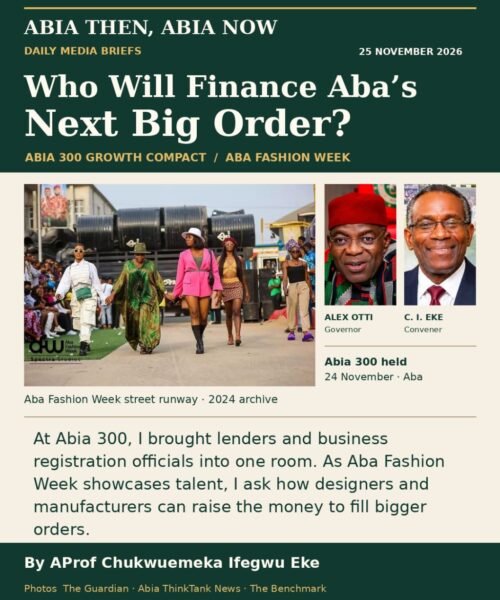
At the recently concluded Abia 300 Growth Compact in Aba, I emphasised the importance of moving beyond the conventional understanding of development as an exclusive responsibility of government.
Citizens, professionals, entrepreneurs, educational institutions, financial organisations and community associations possess resources, expertise and institutional capacities that can contribute to economic transformation.
Government provides the enabling framework.
Citizens contribute initiative, enterprise, knowledge and productive engagement.
The interaction between these complementary responsibilities can create sustainable economic opportunities.
This philosophy remains central to my understanding of participatory development.
As Abia continues its developmental journey, constructive engagement among government institutions, private enterprises and community stakeholders remains indispensable.
BEYOND POLITICS, ABIA COMES FIRST
The economic future of Abia must remain greater than individual political ambitions.
The welfare of our children must transcend partisan considerations.
The protection of human life must command our collective attention.
Institutional cooperation must serve the development interests of our people.
Our political engagements must recognise the enduring importance of peaceful coexistence and mutual respect.
The ultimate purpose of governance is human welfare.
The ultimate purpose of economic development is the expansion of human opportunity.
The ultimate purpose of institutional cooperation is the advancement of society.
That is the broader developmental conversation I seek to sustain through Abia Then, Abia Now.
Let governance serve humanity. Let institutions expand opportunity. Let social harmony strengthen economic prosperity. Above all, let the collective interests of Abia remain paramount.
AProf Chukwuemeka Ifegwu Eke
Department of Economics,
University of Abuja.
Chief Editor,
Abia Then, Abia Now.
29 November 2026.