
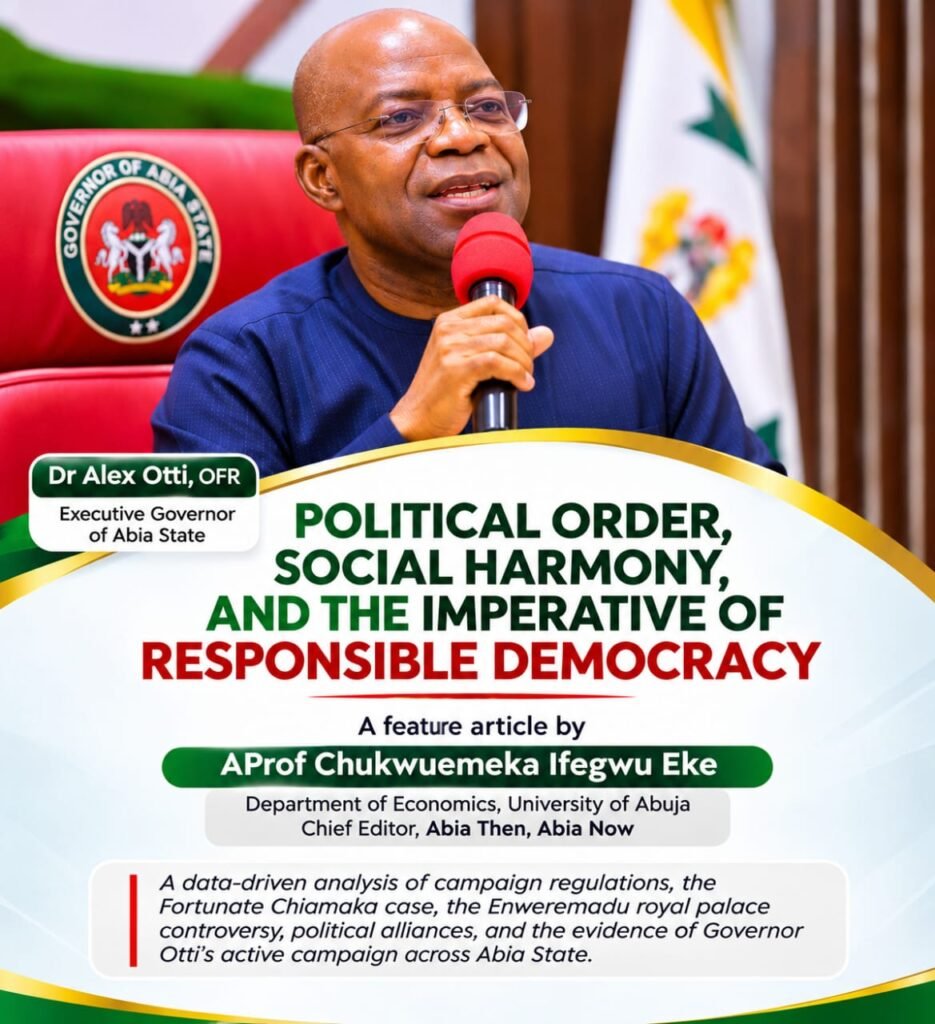
POLITICAL ORDER, SOCIAL HARMONY, AND THE IMPERATIVE OF RESPONSIBLE DEMOCRACY
By AProf Chukwuemeka Ifegwu Eke
The true test of democratic transformation is not merely the number of roads constructed, hospitals rehabilitated or schools reconstructed. It is equally the capacity of a society to accommodate political differences, preserve institutional integrity, protect human dignity and maintain public order without compromising democratic freedoms.
As I continue my examination of Abia’s developmental transition through the Abia Then, Abia Now research project, I find it necessary to interrogate some of the narratives currently circulating in the media concerning Governor Alex Otti’s administration.
From the regulation of political campaign materials to the unfortunate disappearance of a young nursing graduate, the controversy surrounding the Enweremadu royal household and speculation about political alliances, these developments deserve thoughtful examination rather than sensational interpretation.
CAMPAIGN REGULATIONS: THE ECONOMICS OF AN ORDERLY SOCIETY
One of the fundamental responsibilities of government is the management of public spaces.
Roads, pedestrian walkways, public buildings, electricity poles, bridges and urban infrastructure constitute collective assets. Their management cannot be surrendered entirely to the competing interests of political organisations, commercial advertisers or individual citizens.
The November 27, 2026, announcement by the Abia State Structures for Signage and Advertisement Agency concerning unauthorised political campaign materials must therefore be examined within the broader context of urban management, environmental sustainability and public safety.
Significantly, the regulation of political advertisements in Abia did not originate with Governor Alex Otti.
As far back as 2012, Abia had established a statutory framework for regulating signage and advertisements through Law No. 9 of 2012. Ahead of the 2023 general elections, under the previous administration, guidelines were issued requiring political candidates to obtain approvals and pay applicable advertising fees.
Lagos State similarly introduced comprehensive political advertising guidelines in May 2022, including minimum spacing of 100 metres between certain categories of campaign signs and restrictions designed to protect public infrastructure and road users.
The historical perspective is instructive:
- 2012 — Abia establishes its signage regulatory framework.
- 2022 — Abia issues advertising guidelines ahead of the 2023 general elections.
- 2022 — Lagos issues comparable political advertising regulations.
- 2023 — Alex Otti assumes office.
- 2026 — Abia renews enforcement of campaign advertising requirements.
The underlying economic principle is what economists describe as the management of negative externalities.
When campaign materials obstruct traffic visibility, deface public infrastructure, generate environmental waste or create physical hazards, the resulting social costs are borne by the entire population.
Political competition should not diminish the quality of the urban environment.
The legitimacy of such regulation, however, depends upon its proportionality, affordability, transparency and uniform application across political parties.
The ultimate objective should be social harmony, environmental orderliness, political cohesion and the protection of shared infrastructure.
Democracy does not mean the absence of regulations. It means the existence of institutions and regulations that protect the rights and interests of everyone.
DEMOCRACY WITHOUT POLITICAL HOSTILITY
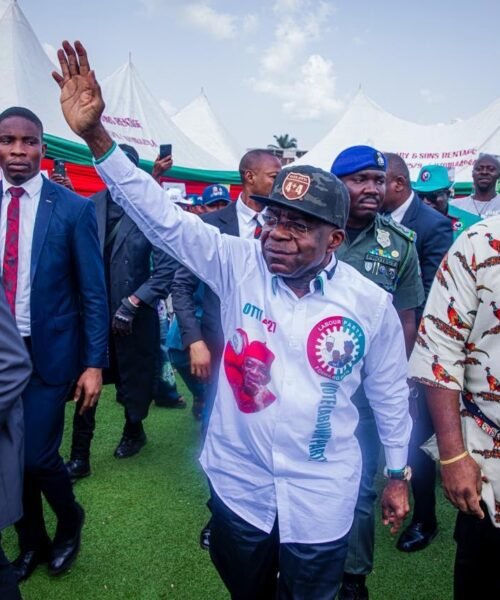
At the formal inauguration of his re-election campaign on November 1, 2026, Governor Otti publicly warned Labour Party supporters against obstructing or intimidating political opponents.
He maintained that opposition parties should have access to public facilities subject to established regulations.
On November 17, while receiving four campaign vehicles donated by supporters at the Michael Okpara Auditorium, the governor reiterated his commitment to equal political opportunities, citing the use of public facilities by other political parties.
These public commitments establish an important standard against which the implementation of advertising regulations can be assessed.
Abia’s democratic institutions should ensure that political competition remains robust without becoming destructive and that the same rules govern every political organisation.
The objective of political competition must never be the destruction of the very society that political actors seek to govern.
FORTUNATE CHIAMAKA: THE IMPERATIVE OF OUR COLLECTIVE HUMANITY
Beyond political disagreements, there are moments when society must rediscover its collective humanity.
The disappearance of Miss Fortunate Chiamaka Aku, a nursing graduate of Abia State University undertaking her internship at the Abia Specialist Hospital, Umuahia, represents one such moment.
According to media reports, she went missing on Monday, November 23, 2026, after leaving home for her afternoon duty.
Her father, Mr Phillip Aku, has appealed to Governor Alex Otti, the Commissioner of Police and other relevant authorities to assist in locating his daughter.
I join this distressed father in appealing for the mobilisation of every available security, intelligence, technological and community resource towards establishing the whereabouts of this promising young Nigerian.
Hospitals, transport operators, community leaders, telecommunications service providers and security agencies should cooperate within the appropriate legal framework.
The immediate priority must be her safe recovery.
I appeal equally to members of the public who possess credible information to make it available to the relevant security authorities.
Every additional hour matters.
Every credible piece of information matters.
Every responsible intervention matters.
At this moment, the anguish of a father transcends political affiliation.
Our collective prayers, compassion and practical support must accompany the efforts to reunite this young woman with her family.
THE ENWEREMADU ROYAL PALACE: PROTECTING THE DIGNITY OF TRADITIONAL INSTITUTIONS
The reported controversy involving members of the Enweremadu royal family in Isiala Ngwa North Local Government Area requires considerable diplomatic sensitivity.
Traditional institutions occupy an important position in the sociocultural architecture of Igbo society.
They embody historical continuity, community identity, customary authority and indigenous mechanisms for conflict resolution.
Royal palaces should remain places of dignity, reconciliation and communal stability.
The petition addressed to Governor Otti concerning alleged political violence and intimidation deserves appropriate institutional attention. Equally, counter-allegations concerning attacks on Labour Party members require impartial consideration.
I would encourage every concerned stakeholder to exercise restraint while the appropriate authorities establish the facts.
Political disagreements are temporary. The traditional institutions of our communities are enduring.
No electoral contest should permanently damage relationships cultivated across generations.
I believe the most constructive outcome would be one that restores mutual confidence, protects the integrity of the royal institution and reinforces peaceful political coexistence.
There is a time for political competition and there must always be room for reconciliation.
POLITICAL ALLIANCES: COURTESY IS NOT COALITION
The recent speculation surrounding the relationship between Governor Alex Otti and Senator Orji Uzor Kalu raises a fundamental question about political maturity.
Must every meeting between politicians belonging to different political parties be interpreted as an electoral alliance?
On November 19, 2026, Senator Orji Uzor Kalu reportedly paid a courtesy visit to Governor Otti.
Subsequent speculation intensified following the appearance of a billboard featuring President Bola Ahmed Tinubu, Governor Otti and Senator Kalu.
Chief David Ogba Onuoha Bourdex, the Labour Party senatorial candidate for Abia North, subsequently dismissed speculation concerning the purported political alliance during his public affairs broadcast.
I consider it important to distinguish three separate dimensions of political interaction:
- Institutional cooperation between elected public officials.
- Personal courtesy and mutual respect.
- Formal electoral alliances between political organisations.
These are not interchangeable.
A governor must be capable of engaging senators, ministers, federal institutions and other elected representatives irrespective of their political affiliations.
Such engagements can facilitate infrastructure development, investment mobilisation and intergovernmental cooperation.
The documented political position of Governor Otti is that he is seeking re-election on the platform of the Labour Party alongside his deputy, Engineer Ikechukwu Emetu.
His inauguration of the Labour Party Campaign Council on October 5 and the formal commencement of his campaign on November 1 provide public evidence of his current party commitment.
No formal electoral alliance with Senator Kalu has been established by the reports examined.
Political courtesy should not automatically be interpreted as political compromise.
ACTIONS SPEAK LOUDER THAN WORDS: THE EMPIRICAL EVIDENCE OF OTTI’S CAMPAIGN
Perhaps the most easily verifiable political misinformation in recent weeks is the claim that Governor Alex Otti had decided not to campaign for re-election.
On November 27, 2026, Africa Check independently debunked this assertion.
Premium Times had also reported the government’s repudiation of the false statement on November 22.
The appropriate response to such misinformation is documentation.
I have therefore assembled a chronological record of reported campaign appearances by Governor Otti during November 2026.
DOCUMENTED CAMPAIGN APPEARANCES
- November 1, 2026
LGA: Umuahia North
Venue: Umuahia Township Stadium
Senatorial District: Abia Central.
- November 6, 2026
LGA: Umunneochi
Venue: Peace Secondary School, Isuochi.
Senatorial District: Abia North.
- November 12, 2026
LGA: Obingwa
Venue: Ntighauzor South Primary School, Agalaba.
Senatorial District: Abia South.
- November 18, 2026
LGA: Ohafia
Venue: Central School Field, Elu Ohafia.
Senatorial District: Abia North.
- November 19, 2026
LGA: Ukwa West
Venue: Obehie Central School.
Senatorial District: Abia South.
- November 20, 2026
LGA: Umuahia South
Venue: Ubakala Central School, Apumiri.
Senatorial District: Abia Central.
STATISTICAL ANALYSIS OF DOCUMENTED CAMPAIGN ACTIVITIES
- Total LGAs in Abia State: 17.
- LGAs captured in this preliminary campaign register: 6.
- Minimum documented LGA coverage: 35.29%.
- Total senatorial districts: 3.
- Senatorial districts reached: 3.
- Senatorial district coverage: 100%.
- Documented campaign appearances in Abia North: 2 (33.33%).
- Documented campaign appearances in Abia Central: 2 (33.33%).
- Documented campaign appearances in Abia South: 2 (33.33%).
- Interval between the first and latest catalogued rallies: 19 days.
These statistics represent a minimum documented record rather than an exhaustive campaign register.
Additional campaign activities, including references to Bende North, require confirmation of their precise dates, venues and the governor’s personal attendance before inclusion in the statistical analysis.
Nevertheless, the available evidence contradicts the assertion that Governor Otti is not campaigning.
CONNECTING POLITICAL ENGAGEMENTS WITH DEVELOPMENT ECONOMICS
What I find particularly interesting from a development economics perspective is the intersection between political engagement and the presentation of measurable developmental outcomes.
During the Umunneochi campaign, for example, government reports indicated that 12 of the area’s 18 primary healthcare centres had been delivered and made functional.
That represents approximately 66.7% of the identified facilities, according to the administration’s account.
In Obingwa, the November 12 campaign coincided with the commissioning of road infrastructure, including the approximately 12.6-kilometre corridor connecting communities around Ohanze, Ntighauzor, Obete, Oberete and Akirika Obu.
These developments illustrate the importance of examining political communication alongside physical infrastructure, healthcare accessibility and the geographical distribution of public investment.
This is precisely the methodological foundation of my Abia Then, Abia Now research undertaking: documenting development through measurable indicators, identifiable locations, historical comparisons and verifiable evidence.
Development communication becomes more meaningful when citizens are equipped with information that enables them to independently examine public policies and their outcomes.
BEYOND THE ELECTION: BUILDING A HARMONIOUS ABIA
Ultimately, the development of Abia State must transcend the competition for political office.
I envisage an Abia where political parties compete without violence; where traditional institutions command universal respect; where the disappearance of a young woman mobilises collective concern; where public infrastructure is protected from indiscriminate abuse; and where political leaders can interact across party lines without every handshake becoming a controversy.
Political orderliness is an economic asset.
Social cohesion reduces the cost of governance.
Public safety strengthens investor confidence.
Institutional stability supports long-term development.
Credible information remains indispensable to democratic accountability.
As Abia approaches another electoral cycle, I believe the quality of its political discourse should reflect the quality of the society its citizens aspire to build.
Let the facts speak.
Let institutions function.
Let humanity prevail.
And above all, let the collective destiny of Abia remain greater than the individual political ambitions of any of its citizens.
Actions speak louder than words, but documented actions speak louder than speculation.
AProf Chukwuemeka Ifegwu Eke
Department of Economics,
University of Abuja.
Chief Editor,
Abia Then, Abia Now.