

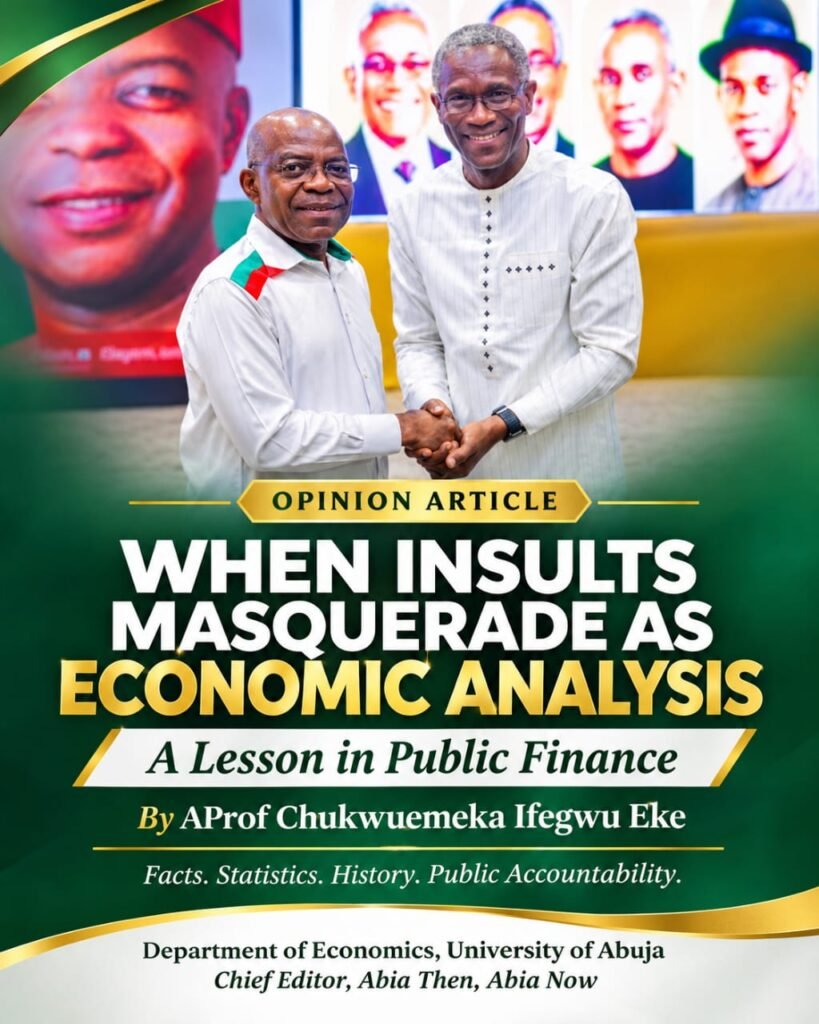
WHEN INSULTS MASQUERADE AS ECONOMIC ANALYSIS: A LESSON IN PUBLIC FINANCE
By AProf Chukwuemeka Ifegwu Eke
My dear brother, I have read your intervention. Beneath the mountain of personal insults, grammatical acrobatics and unsolicited assessment of my academic qualifications, I found a few questions that actually deserve intellectual attention.
Unfortunately, you have attempted to conduct an economic audit with the instruments of a village quarrel.
Calling me a sycophant does not establish a fiscal fact. Calling me an otimpku does not constitute an econometric argument. And calling a professor uneducated does not automatically confer a professorship on the person making the allegation.
I welcome public scrutiny of governance. What I reject is the substitution of suspicion for statistics, allegations for audited accounts, and social media arithmetic for development economics.
- INCREASED FEDERAL ALLOCATION IS NOT PECULIAR TO ABIA
You have discovered that federal allocations increased following President Bola Tinubu’s removal of fuel subsidy in May 2023. Congratulations on this discovery. Unfortunately, the other 35 states of the federation also received increased allocations.
The economic question, therefore, is not simply how much money a government received, but what it accomplished with the resources available to it.
If increased allocation automatically translated into development, Nigeria would have become Switzerland several oil booms ago.
Money is an input. Development is an outcome. Between the two lies the quality of leadership, institutional efficiency, fiscal discipline and resource management.
Furthermore, an increase in nominal revenue does not necessarily translate into an equivalent increase in purchasing power. Construction materials, diesel, machinery, transportation and labour costs have also increased.
Even a petty trader in Ariaria International Market understands the difference between turnover and profit. Apparently, that distinction deserves greater attention in this debate.
- WHERE DID YOUR ALLEGED ₦2 TRILLION COME FROM?
You presented an alleged ₦2 trillion allocation without providing a single authenticated financial statement.
I challenge you to distinguish between:
- Federal statutory allocations.
- VAT receipts.
- Internally generated revenue.
- Capital receipts and grants.
- Local government allocations.
- Budgetary appropriations.
- Actual revenue and expenditure.
These are separate public finance concepts.
A budget is not a bank alert. An appropriation is not necessarily cash received. Combining all these figures indiscriminately is not financial analysis; it is preparing economic vegetable soup.
Abia State’s financial statements and budget implementation reports are publicly accessible.
Official sources:
Abia State Government:
https://abiastate.gov.ng/budgets-reports/
National Bureau of Statistics:
https://microdata.nigerianstat.gov.ng/index.php/catalog/156
Local Government Allocation and Accountability Portal:
https://lgaportal.org/
I invite you to produce your calculations, identify your reporting periods and reconcile your figures against these records.
The burden of proving an allegation rests with the person making it. Even a calculator deserves to know where you got the numbers you are feeding it.
- LET US CONSULT BUDGIT, NOT THE WHATSAPP SCHOOL OF ECONOMICS
BudgIT, an independent fiscal transparency organisation, ranked Abia 4th in its 2025 fiscal performance assessment, compared with its reported 17th position in 2023.
Consider these reported fiscal indicators:
Internally Generated Revenue:
- 2024: ₦41.26 billion.
- 2025: ₦67.86 billion.
- Increase: Approximately 64%.
Domestic Debt:
- 2024: ₦102.45 billion.
- 2025: ₦48.41 billion.
- Reduction: Approximately 53%.
I did not manufacture these statistics in my bedroom. Neither did Governor Otti establish BudgIT.
Read for yourself:
Perhaps BudgIT must now join me in the association of professors, economists and professional otimpkus!
- YOUR ₦300 BILLION LOCAL GOVERNMENT ALLOCATION ARGUMENT
Even assuming, without conceding, that the 17 local governments collectively received ₦300 billion over 36 months, that translates into an average of approximately ₦490 million per local government monthly.
From that amount come personnel costs, primary education obligations, administration, infrastructure, sanitation, healthcare and other statutory responsibilities.
It is not ₦300 billion sitting in one account waiting for somebody to construct a skyscraper in his village.
Furthermore, on July 11, 2024, the Supreme Court delivered its landmark judgment on local government financial autonomy.
Any serious investigation of council finances must distinguish state government revenue from local government receipts and examine the responsibilities of each tier of government.
I support such scrutiny wholeheartedly. But please bring the accounts, not a megaphone.
- SIGNATURE PROJECTS: DID OMENUKO BRIDGE SUDDENLY DISAPPEAR FROM THE MAP?
You asked for signature projects beyond the Umuahia transport terminal.
Let me assist you.
OMENUKO BRIDGE
- Construction flag-off: February 4, 2025.
- Commissioning: February 13, 2026.
- Associated Abam–Arochukwu road corridor: 30 kilometres.
Successive administrations struggled with this strategic crossing for decades. The Otti administration undertook its reconstruction and commissioned it.
Federal Government confirmation:
Perhaps you were expecting Governor Otti to construct the River Niger inside Abia before recognising a bridge as a signature project.
PORT HARCOURT ROAD, ABA
The approximately 6.7-kilometre reconstruction project was flagged off in October 2023 and awarded to Julius Berger. Its reported project value was approximately ₦30 billion.
Independent media reports:
Anyone describing the comprehensive reconstruction of Port Harcourt Road as ordinary road patching needs to explain what, in his understanding, constitutes road construction.
Must the governor manufacture the asphalt personally before the project qualifies?
OTHER MAJOR INFRASTRUCTURE INTERVENTIONS
These include:
- The six-lane Aguiyi Ironsi Boulevard.
- Ohanku Road.
- Umuahia–Uzuakoli–Abiriba–Ohafia corridor.
- Umuahia multimodal transport terminal.
There are also ongoing strategic projects, including the Abia Medical City and Aba transport terminal, which must be distinguished from completed projects.
Reconstructing an existing economically strategic road can deliver greater economic returns than constructing an entirely new road to nowhere.
That is development economics, not ribbon-cutting economics.
- THE 414 ROADS: BRING YOUR MEASURING TAPE
In May 2026, Governor Otti reported the completion of 414 road projects covering 864.12 kilometres.
The Ministry of Works also presented its performance alongside interventions undertaken through the Greater Aba Development Authority and Greater Ohafia Development Authority.
The reported figures translate into an average of approximately 2.09 kilometres per road project.
You are perfectly entitled to request the comprehensive register containing the locations, lengths, contractors, costs and completion dates. I support that request.
However, demanding that I recite 414 roads from memory as a condition for acknowledging infrastructure development is rather entertaining.
By that logic, a medical professor must recite the names of every patient treated in a teaching hospital before acknowledging that the hospital is functional.
I have not independently verified every one of the 414 projects, and I will not pretend otherwise. But neither can you invalidate all 414 projects merely by asking a question about them.
Evidence:
- YOU UNDERESTIMATE THE ECONOMICS OF SALARY PAYMENT
Your attempt to trivialise regular salary payment exposes a misunderstanding of the relationship between household income and economic activity.
John Maynard Keynes explained the relationship between consumption, income and aggregate demand as far back as 1936.
When workers receive salaries regularly, they purchase goods, pay school fees, patronise transport operators, support businesses and discharge household obligations.
These transactions generate additional rounds of economic activity through the multiplier mechanism.
Regular salary payment alone does not establish successful governance. But it is an essential obligation with important economic consequences, especially in an economy previously characterised by salary arrears.
The same petty traders you dismiss as ignorant are among the beneficiaries of these consumption expenditures.
A tomato seller does not need a doctorate in macroeconomics to understand the consequences of customers going six months without salaries.
Her account book may contain more economic wisdom than an entire afternoon of Facebook arguments.
- DEVELOPMENT IS NOT A COMPETITION IN MONUMENTAL CONSTRUCTION
Singapore’s development was not founded exclusively on spectacular buildings. It involved infrastructure, institutional reforms, human capital, fiscal management and the deliberate improvement of its investment environment.
Development economics recognises several dimensions of progress:
- Human capital development.
- Infrastructure and connectivity.
- Institutional efficiency.
- Fiscal sustainability.
- Private investment.
- Employment and productivity.
- Access to essential services.
According to the Otti administration’s third-anniversary reports, 5,394 teachers had been recruited, alongside substantial recruitment of healthcare personnel and infrastructure interventions.
These are legitimate indicators to investigate alongside measurable improvements in educational and healthcare outcomes.
Not every meaningful government investment must be tall enough to appear on Google Earth.
- WHY I WROTE ABIA THEN, ABIA NOW
I did not spend months developing the multi-volume Abia Then, Abia Now compendium because I lacked something better to do.
I undertook the exercise because the development trajectory of Abia deserves historical documentation, comparative analysis and systematic interrogation.
I recognise the distinction between governance before May 29, 2023, and governance thereafter.
I recognise the difference between inherited infrastructure and reconstructed infrastructure, between revenue generation and expenditure, and between government announcements and measurable outcomes.
My positive assessment of particular achievements does not mean that every government decision is beyond criticism.
Academic independence does not mean compulsory opposition.
A scholar is not required to manufacture negative conclusions simply to satisfy somebody’s political appetite.
- FINALLY, ON EKE AKO AND THE POLITICS OF PERSONAL INSULTS
I am prepared to engage Eke Ako or anybody else on substantive questions of governance, public expenditure and development economics.
But I will not accept the proposition that criticism is automatically intellectual while commendation is automatically sycophancy.
That is a double standard wearing an academic gown it did not earn.
You accused me of being a vuvuzela. Yet you supplied enormous financial allegations without accompanying financial statements.
Surely, the first responsibility of someone complaining about noise is to ensure that his own trumpet is not louder than his evidence.
Bring your statistics.
Bring your audited accounts.
Bring your comparative performance indicators.
Bring your project assessments.
Let us interrogate them publicly.
I have no difficulty debating a thousand pages of evidence. What I refuse to do is mistake a thousand words of insults for a single page of research.
Public accountability is too important to be reduced to a quarrel. Economics is too serious to be practised through guesswork. And Abia’s development is too consequential to be evaluated through political bitterness.
When next you come to class, please bring your textbooks, your financial statements and your calculator.
You may leave the vuvuzela at home.
AProf Chukwuemeka Ifegwu Eke
Department of Economics
University of Abuja
Chief Editor, Abia Then, Abia Now