
One Roofer, One Photograph, One Sweeping Verdict: How a PHC Renovation Was Turned into “Evidence of Fraud”
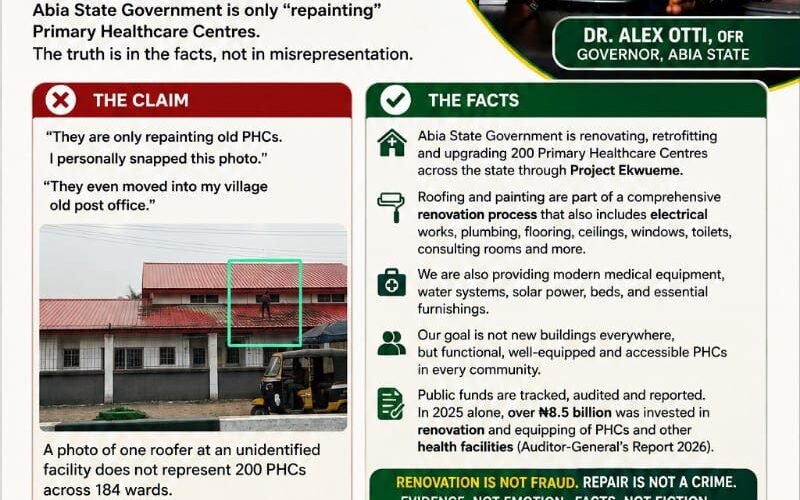
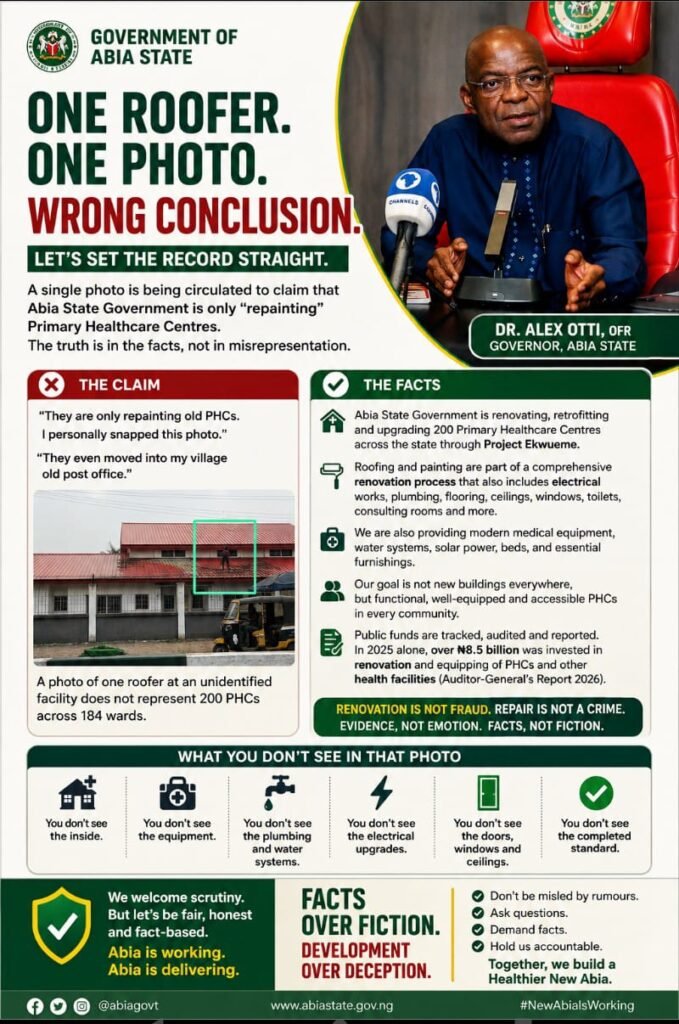
The latest photograph being circulated as supposed proof that the Abia State Government merely “repainted” Primary Healthcare Centres is a good illustration of how a limited visual can be stretched into a sweeping political conclusion. The photograph shows a building undergoing roof work. That is all the photograph proves. It does not show the identity of the facility, the original condition of the building, the full scope of the contract, the internal works carried out, the equipment supplied, the plumbing or electrical rehabilitation, the condition of consulting rooms, staff areas, toilets, water systems or any other component of a PHC upgrade. Yet from that single frame, the conclusion has already been announced: “fraud.”
That is not how evidence works.
The Abia State Government never presented Project Ekwueme as a programme to demolish 200 existing health centres and construct 200 entirely new buildings from the foundation. The official description was the renovation, remodelling, retrofitting and provision of operational infrastructure to existing Primary Healthcare facilities across the state.
That distinction immediately exposes the central deception in the argument. If government says it is renovating an existing facility, then replacing or repairing its roof is not evidence that the project is fraudulent. Roof rehabilitation is exactly the kind of work one would expect during renovation. Repainting an existing wall is not fraudulent merely because the wall existed before the present administration. Retaining a structurally usable building while replacing defective components can, in fact, be more economical than demolition and complete reconstruction.
The photograph therefore does not contradict the government’s stated programme. It appears consistent with renovation work. To prove otherwise, a critic would need to establish what that particular facility was contracted to receive and then demonstrate that the contractor failed to deliver those items. That requires a project location, contract scope, Bill of Quantities, completion status and physical inspection. A man standing on a roof cannot perform the work of an audit report.
The claim that an old building was formerly a post office also proves remarkably little. Public buildings are routinely repurposed when they remain structurally useful. The economically relevant questions are whether the building is suitable for healthcare delivery after rehabilitation, whether it complies with required PHC standards and whether taxpayers received value for the expenditure. The age or previous use of a structure does not make its conversion into a health facility fraudulent.
More importantly, the PHC intervention cannot fairly be reduced to paint and roofing simply because one photograph captures roofing work. A renovation project can include roofing, ceilings, electrical works, plumbing, water supply, flooring, windows, doors, consulting rooms, equipment, sanitation facilities and external works. A single photograph taken at one stage of construction cannot reveal the total scope of intervention.
This does not mean every facility must automatically be assumed perfect. If a particular PHC received shoddy work, identify it. If only roofing and painting were completed where the contract provided for substantially more work, publish the contract and expose the discrepancy. If equipment was paid for but never delivered, identify the missing equipment. Those would be serious allegations capable of investigation. But one cannot photograph one stage of work on one roof and extrapolate from it that an entire statewide programme amounts to fraud.
There is another basic error in the argument: renovation is being deliberately redefined as construction. The critic first demands to see “the PHCs this government built,” and then treats the continued existence of an older structure as proof of deception. But the intervention was publicly described as renovation and retrofitting. A renovated hospital does not cease to be a government project because its foundations were laid decades earlier. By that standard, virtually every government that rehabilitates a school, hospital, court, secretariat or road would be guilty of fraud because it did not first destroy the old asset.
The phrase “I personally snapped this” adds authorship to the photograph; it does not add evidentiary weight to the conclusion. Taking a photograph personally proves that the photographer was present when the image was captured. It does not prove the value of the contract, the percentage of work completed, the scope of rehabilitation, the origin of project funding or the existence of fraud.
There is also a significant difference between saying, “I believe this facility was poorly renovated,” and saying, “This proves the PHC programme is fraudulent.” The first is an observation that can be investigated. The second is an accusation requiring evidence far beyond what this photograph supplies.
Abia State should welcome scrutiny of every PHC. Publish the names of the facilities. Match each one to its intervention package. Show the before-and-after condition where records exist. State what was renovated, what was replaced and what equipment was supplied. That is the strongest answer government can give.
But critics must also observe elementary standards of fairness. A renovation programme cannot suddenly be judged as if government promised greenfield hospitals. An old structure is not proof of fraud. A repaired roof is not proof of fraud. Fresh paint is not proof of fraud. Even poor workmanship, where established, would first establish poor workmanship—not automatically a statewide criminal conspiracy.
The irony is that the photograph offered as the smoking gun does not establish what the caption says it establishes. It shows work being done on an existing structure under a programme designed to renovate existing structures.
That is not a smoking gun.
It is a photograph searching for a scandal.