

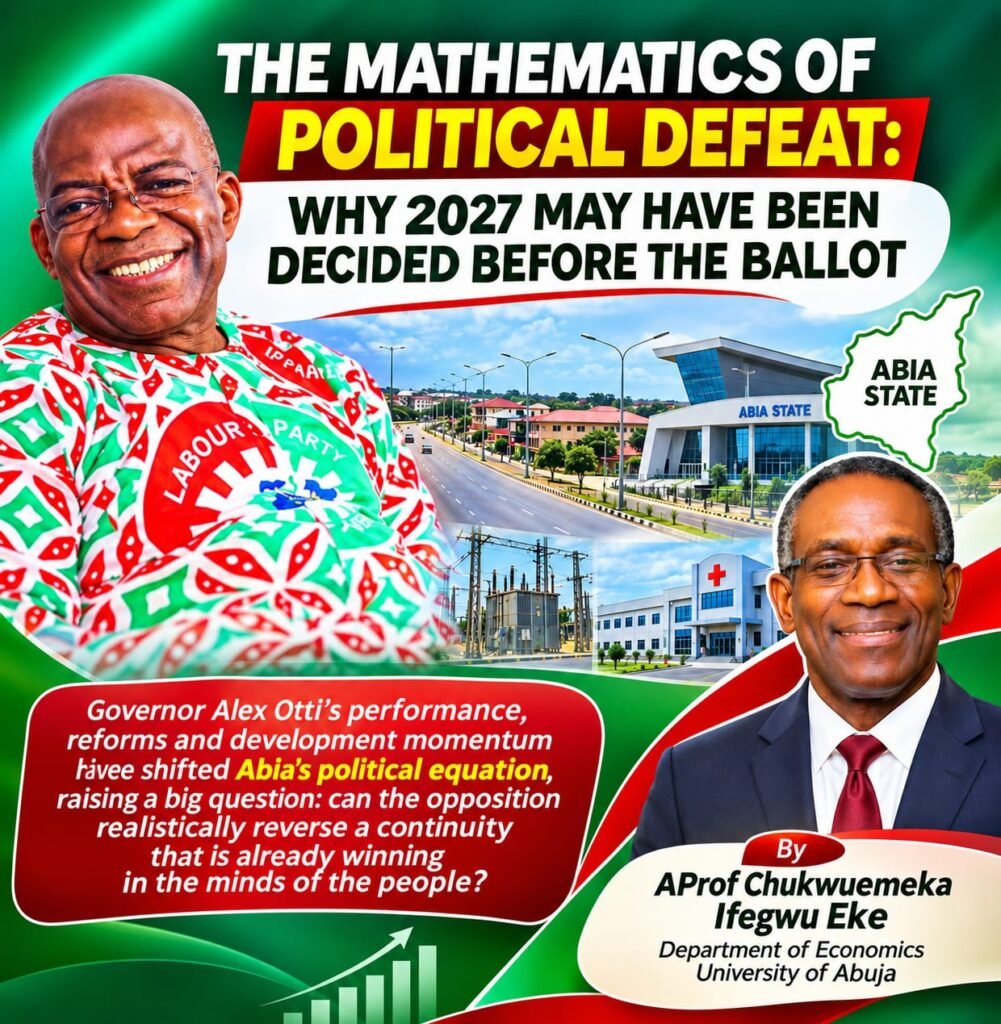
THE MATHEMATICS OF POLITICAL DEFEAT: WHY 2027 MAY HAVE BEEN DECIDED BEFORE THE BALLOT
By AProf Chukwuemeka Ifegwu Eke
Department of Economics, University of Abuja
There is something profoundly fascinating about the mathematics of political defeat. It is that curious branch of political arithmetic in which the loudest contestants sometimes possess the weakest electoral equations, the most enthusiastic critics frequently mistake indignation for strategy, and those who mistake political visibility for popular legitimacy discover, rather painfully, that democracy does not award marks for noise.
I have followed the evolving political conversation in Abia State with considerable intellectual interest, particularly Governor Alex Chioma Otti’s recent declaration that his administration has merely laid the foundation for a more ambitious phase of development.
The statement, made on November 8, 2026, and widely reported the following day, deserves more than the superficial interpretation ordinarily associated with partisan exchanges.
It raises a fundamental question about democratic competition: What happens when an incumbent enters an election with a visible record of government activity, an established political organisation, and a development narrative that his opponents must either challenge convincingly or concede?
My answer is that the political contest may begin to acquire its decisive characteristics long before the electorate approaches the ballot box.
That is the central proposition behind my title.
The mathematics of political defeat may already be taking shape in Abia State. Whether the eventual answer confirms that proposition will depend on the electorate, the strength of competing candidates, and the integrity of the electoral process.
But there is enough in the present political configuration to justify a serious examination of the equation.
THE FIRST EQUATION: POLITICAL NOISE IS NOT ELECTORAL CAPITAL
Permit me to begin with a distinction that appears elementary but is frequently overlooked in contemporary Nigerian politics.
Political activity is not necessarily political effectiveness.
A politician can dominate conversations without dominating constituencies. He can command an impressive collection of social media commentators without commanding a corresponding number of registered voters. He can produce daily criticisms of an administration without developing a coherent alternative programme of government.
Indeed, the difference between political agitation and electoral competitiveness is sometimes as substantial as the difference between a bank account balance and the owner’s imagination.
One is measurable. The other can be remarkably extravagant.
Political economists understand that electoral competition involves the mobilisation of scarce resources under conditions of uncertainty. Candidates compete for public attention, organisational loyalty, political credibility and, ultimately, votes.
These resources are neither identical nor perfectly interchangeable.
A thousand enthusiastic online comments cannot automatically be converted into a thousand votes. Neither can a crowded political meeting establish statewide electoral dominance.
For any opposition seeking to displace an incumbent, the essential assignment is to demonstrate that its alternative represents a sufficiently attractive improvement over the existing administration.
That assignment becomes considerably more difficult when the incumbent has already established a politically resonant narrative of development.
And this is where Governor Otti’s consolidation argument becomes strategically important.
THE SECOND EQUATION: THE INCUMBENCY ADVANTAGE MUST BE EARNED, NOT MERELY INHERITED
Political science recognises incumbency advantage as a potentially important determinant of electoral outcomes.
However, incumbency is not synonymous with invincibility.
An incumbent may control substantial political visibility while simultaneously suffering from declining popularity. Access to government machinery does not automatically translate into electoral affection.
The relevant variable is the quality of the relationship between government performance and public perception.
In Abia State, Otti’s administration has deliberately placed infrastructure, electricity, institutional reform and public accountability at the centre of its political identity.
Consider the state’s 2026 budget.
On December 29, 2025, Governor Otti signed an appropriation law of approximately ₦1.016 trillion.
The administration’s budget presentation identified approximately ₦169.3 billion for road construction, reconstruction, rehabilitation and maintenance, alongside approximately ₦149.7 billion proposed for healthcare.
These are substantial fiscal commitments.
Nevertheless, as an economist, I insist upon an important distinction: appropriation is not expenditure, expenditure is not automatically implementation, and implementation is not necessarily development impact.
The significance of these figures lies in the administration’s publicly declared priorities. Their ultimate value must be assessed through actual releases, completed projects, service delivery and measurable improvements in welfare.
This is precisely why the political argument should move from personal antagonism to empirical evaluation.
If the opposition believes that these fiscal commitments have not produced adequate development outcomes, the appropriate response is to demonstrate the shortfall with credible evidence.
If the government believes otherwise, it should present independently verifiable results.
That is how serious political competition advances democratic accountability.
THE THIRD EQUATION: THE ECONOMICS OF CONTINUITY
One of the most interesting dimensions of Governor Otti’s November 8 declaration is its underlying economic philosophy.
He described the achievements of his first three years as the foundation of a broader development programme and identified consolidation as the next phase.
That distinction is important.
Development is not a collection of isolated ceremonies. It is an intertemporal process in which decisions made today influence the productivity and welfare possibilities of tomorrow.
Road infrastructure, for instance, may reduce transportation costs, improve market accessibility and facilitate the movement of agricultural and industrial products.
Electricity reform can influence manufacturing productivity, household expenditure and investment decisions.
Healthcare investment can strengthen human capital, while institutional improvements may reduce administrative uncertainty.
These relationships can be expressed through a simplified development framework:
Long-Term Development = Infrastructure Quality + Human Capital + Institutional Effectiveness + Productive Investment
The equation is conceptual rather than an estimated econometric model, but it illustrates a fundamental point.
The economic justification for continuity must rest on the proposition that sustained implementation of productive policies can generate greater long-term benefits than discontinuity.
Yet continuity is not valuable merely because it is continuity.
An ineffective policy should not survive simply because substantial resources have already been committed to it.
The appropriate case for consolidation is therefore conditional: existing policies must be demonstrably productive, institutionally sustainable and responsive to the changing needs of the population.
Otti’s political challenge is to establish that his administration satisfies these conditions.
His opponents’ challenge is to prove that they can achieve superior outcomes.
Anything less reduces a serious developmental debate to an unnecessarily expensive shouting competition.
THE FOURTH EQUATION: THE OPPOSITION’S CREDIBILITY PROBLEM
There is a particular intellectual difficulty confronting any political opposition that seeks to regain public authority after previously participating in government.
Its criticism of the present administration must coexist with public memories of its own record.
This is not an argument that former officeholders should remain silent.
On the contrary, they possess valuable experience and should contribute meaningfully to public debate.
However, political credibility requires consistency between past conduct and present declarations.
A former public official who attacks present infrastructure standards should be prepared to explain the standards maintained during his own period of responsibility.
One who questions fiscal discipline must demonstrate an understanding of public expenditure management.
One who invokes transparency must accept scrutiny of the institutions and decisions with which he was previously associated.
This is not persecution.
It is elementary accountability.
In economics, credibility matters because expectations influence behaviour.
In politics, credibility matters because voters evaluate promises partly through the evidence of past actions.
Political redemption is possible. Parties can reorganise, acknowledge previous errors, recruit competent leadership and present credible alternatives.
But political rehabilitation requires more than changing slogans.
A new political vocabulary does not automatically produce a new political character.
I find it particularly amusing when political actors appear to believe that the electorate possesses neither memory nor comparative judgment.
The people of Abia are not laboratory specimens whose political preferences can simply be manipulated through repetitive declarations.
They are citizens capable of examining competing claims against their experiences.
THE FIFTH EQUATION: WHY PERFORMANCE CHANGES THE COST OF POLITICAL COMPETITION
From the standpoint of electoral economics, performance can increase the political cost of challenging an incumbent.
The reason is straightforward.
Where an administration enjoys a favourable public reputation, opponents must devote additional effort to persuading voters that a change of government would produce superior benefits.
This is a problem of comparative advantage.
A challenger does not win merely by demonstrating that the incumbent is imperfect. Every administration is imperfect.
The challenger must persuade enough voters that the expected benefits of an alternative administration exceed the expected benefits of retaining the incumbent.
A simplified voter-choice model illustrates the argument:
Net Benefit of Change = Expected Benefit of Alternative Government − Expected Benefit of Continuity
Where the net benefit is positive, a voter may rationally favour change.
Where it is negative, continuity becomes the more attractive option.
Of course, actual voting behaviour incorporates identity, party affiliation, local relationships, candidate appeal and other considerations that cannot be reduced to one equation.
Nevertheless, the model reveals the weakness of an opposition strategy built exclusively around denunciation.
Criticism can identify problems.
It cannot, by itself, establish the superiority of the critic.
This is why credible opposition parties must move beyond expressions of dissatisfaction and present concrete programmes concerning employment, electricity, transportation, education, healthcare, investment and public finance.
The true measure of electoral preparedness is not the volume of political hostility generated.
It is the quality of the governing alternative offered.
THE SIXTH EQUATION: ELECTRICITY, PRODUCTIVITY AND THE NEXT DEVELOPMENT FRONTIER
Governor Otti’s recent remarks concerning electricity deserve particular attention.
According to reports of his November 8 address, the administration intends to strengthen Abia’s electricity regulatory arrangements and expand the possibilities for more reliable power supply.
The economic implications are considerable.
Abia possesses an important commercial and manufacturing ecosystem, particularly around Aba.
For businesses operating under conditions of unreliable electricity, energy costs can constitute a significant constraint on competitiveness.
Improved electricity reliability could reduce dependence on private generation, support longer production hours and strengthen commercial activity.
However, regulatory reform alone cannot guarantee uninterrupted electricity.
Effective implementation will require investment, technical capacity, appropriate tariff structures, distribution infrastructure and financial sustainability.
These are the variables by which the administration’s electricity ambitions should eventually be judged.
The strategic significance is nevertheless unmistakable.
If electricity reform produces measurable improvements in industrial productivity and household welfare, it could become a powerful component of the administration’s development record.
If the promised outcomes fail to materialise, the policy will provide legitimate grounds for criticism.
Either way, the appropriate debate concerns evidence and outcomes.
THE SEVENTH EQUATION: THE POLITICAL SIGNIFICANCE OF AN OPEN ELECTORAL FIELD
Another notable aspect of the unfolding political season is Otti’s public position on electoral participation.
At the November 1, 2026 flag-off of the Labour Party’s governorship campaign in Umuahia, the governor warned supporters against obstructing opposition political activities.
He also directed that opposition parties should be permitted to use public facilities, subject to established approval procedures.
These statements were reported by national media organisations, including Punch and Premium Times.
The position is significant because democratic legitimacy requires more than the popularity of an incumbent.
It requires meaningful opportunities for competing political organisations to campaign, assemble, communicate and contest elections without intimidation.
For an administration confident in its record, an open political environment provides an opportunity to defend its performance through public scrutiny.
For opposition parties, the same environment creates an obligation to organise effectively and present persuasive alternatives.
I consider this a healthier basis for electoral competition than intimidation, obstruction or politically motivated violence.
The paradox is that an incumbent who genuinely protects political competition may strengthen the legitimacy of any eventual victory.
That legitimacy cannot be manufactured through propaganda.
It must arise from the conduct of a credible election.
THE EIGHTH EQUATION: WHY 2027 MAY HAVE BEEN DECIDED BEFORE THE BALLOT
Now we arrive at the central intellectual question.
Can an election be politically shaped long before votes are cast?
Certainly.
Can its actual outcome be established before the election takes place?
Certainly not.
The distinction is fundamental.
Electoral outcomes emerge from interactions among candidate credibility, public expectations, party organisation, economic conditions, local political networks and campaign effectiveness.
These variables develop over time.
Consequently, the conditions that eventually produce an electoral victory or defeat may begin crystallising months or years before polling day.
The ballot merely provides the institutional mechanism through which accumulated political preferences are expressed.
This is the sense in which I employ the provocative proposition that 2027 may already have been decided.
It is not a claim that the votes have been counted.
It is a hypothesis that the political foundations of the eventual result may already be forming.
In Abia, Governor Otti enters this period with an established incumbency, an active re-election organisation, a development-centred political message and a publicly articulated programme of consolidation.
His Labour Party campaign was formally flagged off on November 1, 2026, with Deputy Governor Ikechukwu Emetu continuing as his running mate.
The opposition, meanwhile, must demonstrate that it possesses the leadership, organisation and policy alternatives necessary to challenge that position effectively.
The degree to which it can accomplish this remains an open empirical question.
A compelling political headline should not be mistaken for a scientific forecast.
There is currently no electoral model presented in this article that establishes the probability of victory for any candidate.
There are no fabricated polling figures, invented vote projections or imaginary margins of defeat.
The mathematics is an analytical framework for understanding political advantage.
And its principal conclusion is that electoral competitiveness must be constructed before election day.
THE NINTH EQUATION: THE DANGER OF MISTAKING PUBLICITY FOR POPULARITY
One weakness of modern political discourse is its tendency to exaggerate the significance of digital visibility.
A political statement may circulate widely without changing a single vote.
An online controversy may dominate public discussion while remaining irrelevant to the daily concerns of households.
The electorate’s priorities are often substantially more practical.
Citizens want functioning roads, accessible healthcare, quality education, employment opportunities, personal security, reliable electricity and an economic environment in which legitimate enterprise can flourish.
Political communication becomes effective when it connects these concerns to credible policy choices.
This is why I remain sceptical of political arguments that offer elaborate personal accusations but little economic substance.
Abia’s political future should not be reduced to a competition in rhetorical aggression.
The relevant questions concern measurable development outcomes and the comparative capacity of aspiring leaders.
How many kilometres of roads have been completed to acceptable engineering standards?
How much has actually been spent against approved budgetary provisions?
What proportion of public health facilities is functional?
What measurable improvements have occurred in electricity reliability?
How have employment opportunities, business conditions and household welfare changed?
These are questions that deserve precise answers.
They also provide a far stronger basis for political judgment than the popularity of individual commentators.
THE TENTH EQUATION: HISTORY DOES NOT REWARD POLITICAL COMPLACENCY
There is one final lesson that political actors on every side should understand.
No election is won by intellectual argument alone.
No government possesses an automatic entitlement to renewal.
Political history contains numerous examples of incumbents who appeared secure until shifting economic conditions, organisational weaknesses or changing public expectations transformed the electoral environment.
The same history records opposition parties that recovered from seemingly hopeless positions through effective coalition-building, disciplined organisation and compelling leadership.
For this reason, claims of inevitable victory should always be treated cautiously.
Governor Otti’s supporters may interpret the administration’s record as a persuasive argument for continuity.
His opponents may identify weaknesses that they believe justify a change of leadership.
Both positions belong within a legitimate democratic contest.
What matters is whether their respective arguments survive scrutiny.
In the final analysis, the strongest electoral proposition is one that can withstand comparison with evidence.
MY CONCLUDING POSITION: THE BALLOT WILL CONFIRM OR REJECT THE EQUATION
I began with the mathematics of political defeat.
I conclude with the economics of political legitimacy.
The emerging contest in Abia State offers an interesting opportunity to examine how government performance, political expectations and organisational capacity interact before an election.
Governor Alex Otti has placed consolidation at the centre of his re-election narrative.
His administration’s infrastructure commitments, electricity ambitions and institutional reform agenda provide identifiable areas for public assessment.
His political opponents have the democratic right to contest that record, question its adequacy and propose alternative approaches.
Indeed, the existence of credible opposition is essential to preventing political confidence from degenerating into complacency.
But criticism must eventually become a governing proposition.
An opposition that cannot explain what it would do differently, how it would finance its programmes and why its leadership would produce superior results faces a serious electoral disadvantage.
Equally, an incumbent that relies on declarations without demonstrating implementation risks undermining the very credibility on which its political advantage rests.
For me, the decisive question is therefore not who speaks most loudly about 2027.
It is who can establish the strongest relationship between promises, performance and public welfare.
That relationship will determine whether the present political advantages of the Otti administration become durable electoral support or whether an alternative political force succeeds in changing public expectations.
The mathematics of political defeat begins long before election day. It is written in the credibility of institutions, the performance of governments, the quality of political alternatives and the judgment of citizens.
Abia’s voters will supply the final answer.
And when the ballots are counted in 2027, we shall discover whether the political equation had indeed been taking shape all along.
Until then, the most intelligent political strategy remains the simplest: produce evidence, defend your record, respect the electorate and allow democracy to perform its arithmetic.
AProf Chukwuemeka Ifegwu Eke
Department of Economics
University of Abuja
Abuja, Nigeria
November 10, 2026