
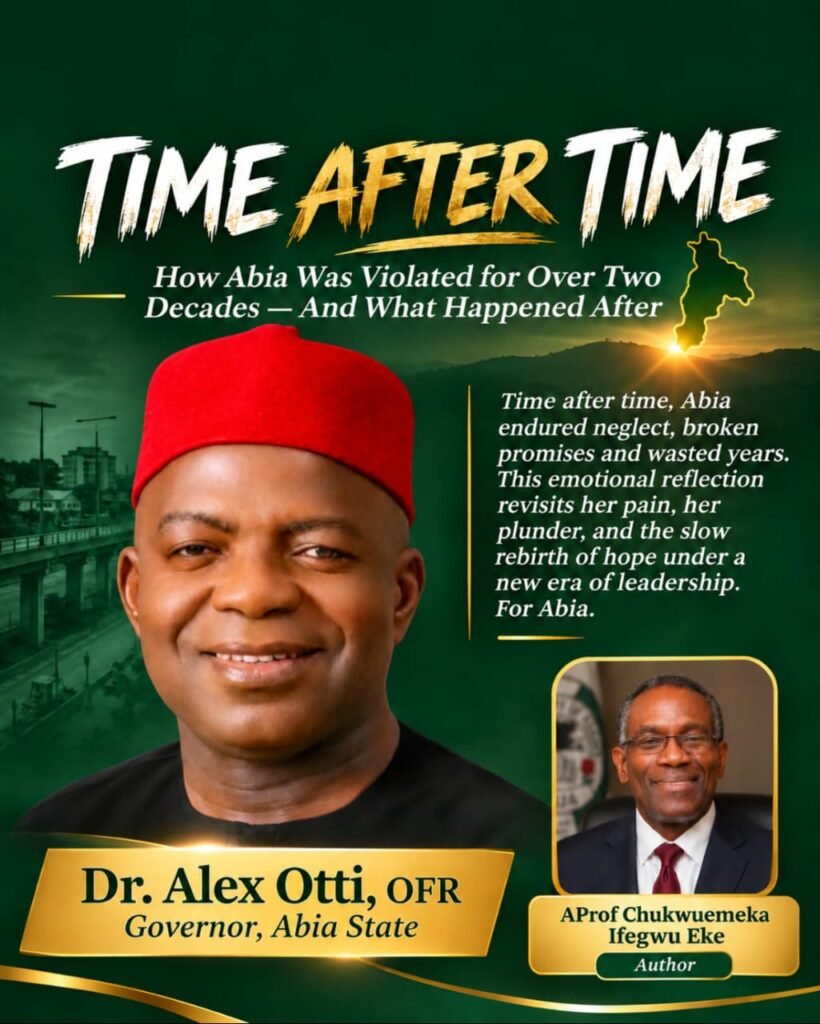
EMOTIONALITY: TIME AFTER TIME
The Rape of Abia, the Silence of Twenty-Four Years, and the Man Who Heard Her Cries
By AProf Chukwuemeka Ifegwu Eke
Political Economist | University of Abuja
There are songs that entertain the ears, songs that excite the imagination, and songs that penetrate the most carefully guarded chambers of the human heart. And then there are those extraordinary musical compositions that transcend their original intentions, escape the geographical limitations of their composers, and become the emotional vocabulary of generations.
One such composition is Time After Time.
In 1983, American singer-songwriter Cyndi Lauper, working with musician Rob Hyman, composed what would become one of the most hauntingly beautiful love ballads of the twentieth century. The song appeared on Lauper’s debut studio album, She’s So Unusual, released in October 1983, before emerging as a single in March 1984.
Interestingly, its title was borrowed from a television listing for the 1979 science-fiction film Time After Time. What began as a provisional title became the permanent identity of a musical masterpiece.
The composition was born from deeply personal emotional experiences. Both Lauper and Hyman were navigating difficulties in their relationships. They transformed their vulnerabilities into a lyrical meditation on affection, separation, uncertainty, remembrance and unwavering devotion.
At its emotional centre lies a simple assurance:
“If you fall, I will catch you.”
Those eight words communicate a philosophy infinitely larger than romantic affection. They express the moral obligation to rescue the vulnerable, the responsibility to remember the abandoned, and the enduring possibility that someone, somewhere, will eventually answer the cries of a wounded soul.
The song subsequently reached number one on the American Billboard Hot 100 in June 1984, establishing itself as one of Lauper’s defining artistic achievements.
Yet, listening to its slowed and reverberating rendition recently, I experienced something rather unusual.
I did not hear merely a woman singing about love.
I heard a woman crying across history.
I heard the muffled anguish of a wounded political community.
I heard the unmistakable voice of Abia State.
And suddenly, Time After Time ceased to be merely a song.
It became an indictment.
It became a lamentation.
It became the soundtrack of twenty-four years of political betrayal.
It became the biography of a woman repeatedly violated by those who had sworn to protect her.
Her name was Abia.
THE BEAUTIFUL WOMAN CALLED ABIA
Permit me to introduce you to a woman.
She was born on 27 August 1991, when the Nigerian federation created Abia State from the old Imo State.
Her birth was celebrated with enormous expectations.
She possessed extraordinary natural and human endowments. Her commercial intelligence was remarkable, her entrepreneurial temperament exceptional, and her cultural inheritance profoundly rich.
Her children were industrious, resilient and extraordinarily resourceful.
In Aba, she possessed one of West Africa’s celebrated concentrations of indigenous entrepreneurship, commerce and manufacturing.
In Umuahia, she carried the historical dignity of an administrative capital.
In Arochukwu, Ohafia, Bende, Isuikwuato, Umunneochi, Ikwuano, Isiala Ngwa, Osisioma, Ukwa and the other communities constituting her seventeen local government areas, she possessed immense possibilities for agriculture, commerce, tourism, education and industrial development.
She was not a woman without resources.
She was a woman whose resources required enlightened stewardship.
She was not barren.
She was extraordinarily fertile.
She was not intellectually impoverished.
Her children were among the finest demonstrations of the ingenuity of the Igbo entrepreneurial spirit.
What she needed was not a political miracle.
She needed leadership capable of converting her inherited advantages into sustainable prosperity.
Unfortunately, the democratic era beginning in 1999 would introduce a disturbing contradiction between her possibilities and her lived experiences.
For twenty-four years, from May 1999 to May 2023, Abia passed through three successive eight-year governorship administrations.
Those years were not devoid of every achievement. No serious historical assessment should pretend otherwise.
But the cumulative condition of major public infrastructure, persistent salary and pension grievances, and the deterioration of important commercial corridors revealed a profound failure to realise the state’s potential.
And so, in the language of political metaphor, I say that Abia was raped.
Not because a geographical entity can literally experience sexual violence, but because her developmental inheritance was violated, her possibilities repeatedly diminished, and her citizens compelled to endure indignities that responsible government should have prevented.
The metaphor is severe because the consequences were severe.
TIME AFTER TIME: THE ANATOMY OF A POLITICAL VIOLATION
In the language of economics, development is fundamentally concerned with expanding human capabilities, productive opportunities and access to essential public goods.
When public institutions fail persistently, the resulting deprivation extends far beyond damaged roads or deteriorating buildings.
A collapsed road increases transportation costs.
Increased transportation costs undermine competitiveness.
Reduced competitiveness discourages investment.
Declining investment destroys employment opportunities.
Unemployment weakens household purchasing power.
Weak purchasing power depresses local demand.
And declining local demand eventually suffocates the very businesses upon which a regional economy depends.
That is how infrastructural neglect becomes an intergenerational economic tragedy.
Consider Aba.
For decades, the city demonstrated a remarkable capacity for indigenous industrial production.
Its artisans manufactured footwear, garments, leather products, fabricated equipment and countless other commodities.
Its traders connected local producers to markets across Nigeria and beyond.
Yet many businesses operated within an environment where essential infrastructure remained distressingly inadequate.
Port Harcourt Road became a particularly painful symbol of that contradiction.
This commercially important corridor, once associated with industrial activity and economic opportunity, deteriorated over the years until its condition became emblematic of Aba’s infrastructural distress.
The tragedy was not simply that a road had failed.
It was that the failure persisted while successive generations of entrepreneurs struggled to preserve their livelihoods.
Imagine the economic consequences of such neglect.
Consider the mechanic whose customers could no longer conveniently reach his workshop.
Consider the trader whose transportation costs continued to escalate.
Consider the manufacturer whose finished products encountered unnecessary distribution difficulties.
Consider the young apprentice whose prospects of establishing an independent enterprise diminished because the commercial environment had become increasingly hostile.
Those were not merely inconveniences.
They represented lost productive hours, weakened competitiveness and opportunities surrendered to more functional commercial environments.
Abia was not merely losing roads. She was losing time.
And time, as every economist understands, is among the few resources that cannot be replenished.
Time after time, she waited.
Time after time, she hoped.
Time after time, political promises competed with the stubborn realities of everyday existence.
And time after time, the clock continued ticking.
THE ECONOMICS OF A WOUNDED WOMAN
There is something particularly disturbing about the spectacle of a naturally endowed society struggling beneath preventable developmental deficiencies.
It is the economic equivalent of watching an exceptionally gifted student denied the opportunity to attend school.
The tragedy is not the absence of ability.
It is the systematic frustration of ability.
Abia’s economic predicament must therefore be understood through the concept of opportunity cost.
Every year in which essential infrastructure remains dysfunctional represents a year in which alternative productive outcomes could have been realised.
Every abandoned commercial corridor has implications for employment, tax revenues, property values and household welfare.
Every delayed salary imposes costs on families whose consumption, savings and financial planning depend on predictable earnings.
Every unpaid pension threatens the dignity of citizens who devoted their productive years to public service.
These consequences cannot be adequately understood through partisan exchanges or colourful political rhetoric.
They demand serious economic interpretation.
A government is not successful simply because it exists.
Nor does occupying public office automatically constitute evidence of public service.
Leadership must ultimately be assessed by the quality of institutions it strengthens, the opportunities it creates and the measurable improvement it brings to human welfare.
A society cannot eat political slogans.
Its industries cannot manufacture with ceremonial speeches.
Its pensioners cannot settle medical expenses with partisan declarations.
And its children cannot construct prosperous futures upon the ruins of neglected public infrastructure.
For too long, Abia’s enormous economic potential contrasted painfully with the developmental outcomes visible across important sectors.
She possessed the capacity to prosper, yet repeatedly confronted the limitations of an inadequate enabling environment.
She possessed entrepreneurial brilliance, yet lacked sufficient infrastructural support.
She possessed citizens willing to work, yet too often confronted public systems incapable of adequately rewarding their efforts.
The woman was strong.
But her strength was mistaken for an unlimited capacity to endure mistreatment.
WHEN THE CLOCK STRUCK MAY 29, 2023
Then came 29 May 2023.
Dr Alex Chioma Otti assumed office as Governor of Abia State, following an election that ended the long-standing dominance of the political establishment associated with the previous twenty-four years.
For many Abians, the transition represented something deeper than the replacement of one administration by another.
It represented the possibility of a different relationship between government and the governed.
The symbolism was profound.
A people accustomed to measuring political promises against accumulated disappointment had acquired another opportunity to demand measurable results.
But hope, however emotionally powerful, is not itself development.
The significance of the new administration would ultimately depend on what it did with public resources, institutional authority and the confidence entrusted to it.
And that is precisely where the story becomes interesting.
THE MAN WHO HEARD HER CRIES
There is a particular beauty in restoration.
It is not always dramatic.
Sometimes it begins with the reconstruction of an abandoned road.
Sometimes it begins with a pensioner receiving an overdue payment.
Sometimes it begins with a public servant discovering that a monthly salary can arrive predictably.
Sometimes it begins with a trader returning to a commercial corridor previously considered inaccessible.
Since assuming office, Governor Otti has placed considerable emphasis on road infrastructure, public-sector welfare and the rehabilitation of neglected facilities.
One of the administration’s most prominent interventions has been the reconstruction of Port Harcourt Road in Aba.
The project was formally flagged off in October 2023, with the government presenting it as an effort to revive a commercially important corridor whose deterioration had undermined business activity.
Its significance extends beyond the physical road.
A properly functioning commercial corridor can reduce logistical friction, improve access to customers, stimulate property rehabilitation and encourage the return of productive enterprises.
In July 2026, the administration continued to publicise the road’s reconstruction as part of its broader effort to restore Aba’s commercial environment.
More recently, on 21 October 2026, the government commenced additional reconstruction initiatives involving Uratta Road and Old Express Road in Aba.
These projects matter because urban development is not achieved through isolated ceremonial interventions.
It requires interconnected infrastructure capable of supporting a functioning economic ecosystem.
Of course, construction announcements are not equivalent to completed projects, just as approved budgets are not equivalent to actual expenditure.
Their developmental value must ultimately be demonstrated through completion, durability, accessibility and measurable economic benefits.
Nevertheless, the renewed attention to long-neglected commercial roads represents an important departure from the resignation with which many residents had come to regard infrastructural deterioration.
The welfare dimension is equally significant.
In May 2025, Governor Otti disclosed that his administration had committed more than ₦40 billion towards clearing inherited salary and pension arrears.
The administration also reported improvements in the regularity of monthly salary and pension payments.
Such developments possess economic and moral significance.
For a pensioner, receiving an entitlement is not an act of governmental generosity.
It is the fulfilment of an obligation.
For a civil servant, predictable remuneration facilitates household planning, financial stability and the preservation of personal dignity.
The restoration of these basic expectations may appear administratively ordinary in better-functioning societies.
But where they have historically been unreliable, their improvement carries considerable emotional weight.
And so, when I return to Cyndi Lauper’s haunting assurance, I find myself contemplating its political significance.
Not because a governor is a romantic saviour.
Not because institutions should depend on the benevolence of one individual.
But because public leadership is fundamentally an obligation to respond when citizens fall.
The true measure of leadership is not how loudly it announces affection for the people, but how faithfully it responds to their needs.
THE SCARS THAT DEVELOPMENT MUST HEAL
Let nobody misunderstand the profundity of Abia’s experience.
Twenty-four years of accumulated developmental deficiencies cannot be corrected through twenty-four months of political enthusiasm.
Neither can the psychological consequences of prolonged public disappointment disappear merely because a new administration assumes office.
Institutional restoration requires consistency.
Economic reconstruction requires discipline.
Public confidence requires evidence.
And sustainable prosperity requires continuity beyond the personality of any incumbent.
The woman called Abia must therefore be allowed to recover completely.
Her recovery must be reflected in stronger schools, accessible healthcare, reliable infrastructure, productive employment and expanding private investment.
It must be evident in the circumstances of ordinary households, not merely in the vocabulary of political communication.
Her children must experience development rather than simply hear about it.
Her entrepreneurs must enjoy the practical benefits of lower business costs and more reliable public services.
Her farmers must gain improved access to markets.
Her young people must encounter meaningful opportunities to develop and deploy their abilities.
And her public institutions must become sufficiently strong to protect progress against future political reversals.
That, ultimately, is what genuine restoration demands.
THE EMOTIONALITY OF REMEMBRANCE
One of the most fascinating characteristics of human memory is its refusal to disappear simply because circumstances have changed.
A woman who has endured repeated betrayal may eventually encounter kindness, but kindness does not immediately erase the memory of injury.
Trust must be rebuilt.
Confidence must be earned.
And every promise must survive the examination of experience.
Abia’s political history demands precisely this kind of sober remembrance.
We must remember the roads that deteriorated.
We must remember the pensioners who struggled.
We must remember the businesses constrained by infrastructural inadequacy.
We must remember the opportunities surrendered to neglect.
But remembrance must serve a constructive purpose.
It should strengthen our determination never again to normalise avoidable deprivation.
The objective is not to imprison Abia permanently within the narrative of her suffering.
It is to ensure that suffering becomes a historical warning rather than a recurring destiny.
Indeed, one of the greatest mistakes a recovering society can make is to confuse the arrival of improvement with the completion of transformation.
The rebuilding of Abia is an ongoing institutional responsibility.
It must not end with one administration.
It must become the permanent expectation of her citizens.
TIME AFTER TIME, ABIA MUST NEVER FALL AGAIN
As I listened to Time After Time, something about the slowed rendition struck me with unusual force.
Perhaps it was the melancholy.
Perhaps it was the quiet persistence of the melody.
Perhaps it was the manner in which the passage of time seemed to become both an accusation and a promise.
I imagined Abia standing before a mirror.
For twenty-four years, she had watched successive political administrations come and go.
She had listened to assurances.
She had endured disappointments.
She had concealed her frustration beneath the remarkable resilience of her people.
Her children continued trading.
Her artisans continued manufacturing.
Her farmers continued cultivating.
Her mothers continued sacrificing.
Her pensioners continued hoping.
And her young people continued dreaming of a society in which talent and hard work would receive appropriate institutional support.
Then, in 2023, the political landscape changed.
She did not instantly become prosperous.
Her wounds did not miraculously disappear.
Her economic challenges did not evaporate.
But the possibility of renewal acquired a new political expression.
And today, as projects advance and longstanding obligations receive renewed attention, her citizens have an opportunity to assess whether that expression is becoming durable institutional change.
I am persuaded that the most important question is no longer whether Abia deserved better.
She always did.
The question is whether the improvements now being pursued can establish a permanent culture of responsible governance.
For I refuse to believe that a state endowed with Aba’s entrepreneurship, Umuahia’s administrative potential, and the enormous human capital of seventeen local government areas was destined for developmental mediocrity.
I refuse to believe that the ingenuity of Abia’s citizens should forever be constrained by avoidable institutional deficiencies.
And I refuse to accept that recurrent political disappointment must remain the defining narrative of her existence.
Abia deserves better than the management of misery. She deserves the architecture of prosperity.
THE FINAL VERSE: A WOMAN RECLAIMS HER DIGNITY
Cyndi Lauper’s Time After Time was never written about Abia State.
It was composed thousands of kilometres away, decades before the political events examined in this essay.
Yet great art possesses the extraordinary capacity to illuminate experiences its creators never consciously contemplated.
The song speaks of steadfastness in the face of uncertainty.
Abia’s history speaks of resilience in the face of institutional disappointment.
The song evokes the fear of abandonment.
Abia’s experience reminds us of the consequences of neglect.
The song offers the possibility of reassurance.
Abia’s current developmental journey invites us to consider the practical meaning of political responsibility.
And therein lies the connection.
A wounded society does not require endless declarations of love.
It requires evidence of commitment.
A neglected economy does not need sentimental apologies alone.
It requires investment, institutional reform and productive opportunities.
A disappointed population does not need another generation of extravagant promises.
It requires measurable improvements in everyday life.
I therefore see in Abia today neither a woman whose difficulties have completely vanished nor a society condemned to eternal suffering.
I see a woman attempting to reclaim her dignity.
I see a state rediscovering the possibilities of its own economic endowments.
I see a people whose remarkable resilience deserves to be matched by equally remarkable public leadership.
And I see in Governor Alex Otti’s administration an opportunity to demonstrate that political power can be exercised as a responsibility to restore rather than a privilege to consume.
The ultimate judgement will belong to history, informed by evidence and the lived experiences of ordinary citizens.
But as the music fades, one conviction remains.
Abia must never again be expected to endure institutional neglect as though suffering were her natural inheritance.
She must never again mistake political promises for developmental achievements.
She must never again allow the passage of time to conceal the economic costs of failed leadership.
For twenty-four years, the clock kept ticking.
For twenty-four years, her enormous potential remained insufficiently realised.
For twenty-four years, too many of her people waited for a more convincing demonstration of the dividends of democracy.
Now, the responsibility is to ensure that every new hour brings measurable progress.
Time after time, Abia suffered.
Time after time, Abia endured.
Time after time, Abia hoped.
But this time, Abia must rise.
And when future generations write the history of her recovery, may they remember this period not simply as the emergence of another governor, but as the beginning of a durable transformation in the relationship between political leadership and public welfare.
Because the greatest tribute to a wounded woman is not merely to acknowledge her pain.
It is to build a society in which the conditions that produced her suffering can never again become acceptable.
And perhaps that is the most beautiful meaning of Time After Time.
AProf Chukwuemeka Ifegwu Eke
Department of Economics
University of Abuja