

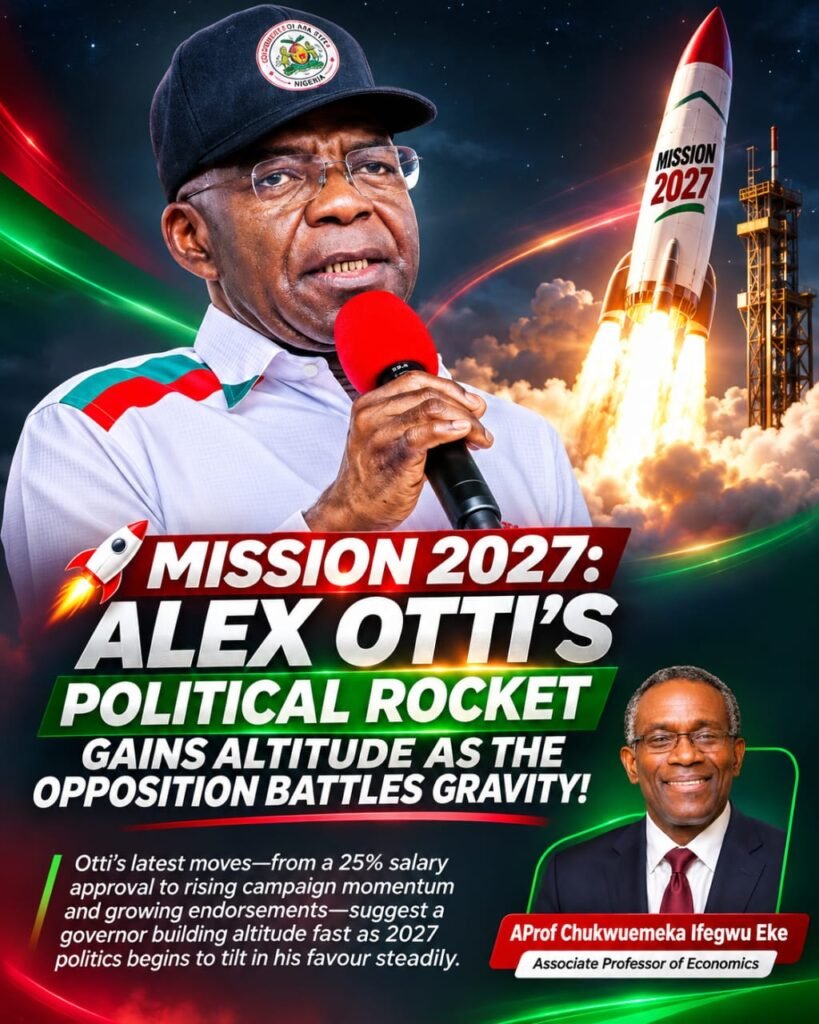
🚀 MISSION 2027: ALEX OTTI’S POLITICAL ROCKET GAINS ALTITUDE AS THE OPPOSITION BATTLES GRAVITY!
Rider: From salary reforms and expanding political endorsements to a growing regional presence, Abia’s governor is rewriting the political equations while his opponents struggle to understand the mathematics of his momentum.
By AProf Chukwuemeka Ifegwu Eke
Associate Professor of Economics, University of Abuja
November 12, 2026
There is something profoundly fascinating about the science of rocketry. Before a rocket ascends into space, its engineers must contend with gravitational resistance, atmospheric friction, structural limitations and the enormous energy required to escape the earth’s gravitational pull. Yet, once sufficient thrust is generated, the rocket begins to acquire altitude, leaving behind the gravitational forces that previously constrained its movement.
I find this scientific phenomenon remarkably useful in interpreting the contemporary political developments unfolding in Abia State under Governor Alex Chioma Otti.
For those who understand political economy, something significant is happening. The governor’s political machinery is acquiring momentum, his influence is extending beyond the geographical boundaries of Abia, and his administration continues to generate policy decisions that command public attention.
Meanwhile, the opposition confronts a familiar dilemma: how does one intercept a rocket whose propulsion system is increasingly sustained by governance, political organisation and expanding alliances?
The answer, regrettably for its strategists, cannot be found in the mathematics of resentment.
THE FIRST STAGE: WHEN SALARY REFORMS BECOME INSTITUTIONAL STATEMENTS
On November 11, 2026, Governor Otti approved the implementation of a 25 per cent adjustment under the Consolidated Legislative Salary Structure (CONLESS) for eligible employees of the Abia State House of Assembly and its Service Commission.
The implementation is scheduled to commence in January 2027.
According to the state government’s announcement, Abia will become the first state in the South-East to implement this particular consolidated remuneration arrangement for parliamentary workers.
This development deserves examination beyond the ceremonial language of political announcements.
In public finance, remuneration policy constitutes an important component of institutional development. Legislative institutions require competent administrative personnel, professional researchers, technical officers and supporting workers whose contributions sustain the machinery of representative government.
Where remuneration remains inadequate or structurally inconsistent, employee motivation and institutional effectiveness may suffer.
By approving CONLESS implementation, the administration has taken a step towards addressing an outstanding remuneration concern within the legislative establishment.
Naturally, the actual economic benefits will depend on effective implementation, inflation, fiscal sustainability and the number of eligible beneficiaries.
Nevertheless, the political significance of the announcement is unmistakable.
While political actors debate the destination of Abia’s future, the government has announced a measurable commitment affecting workers’ compensation.
One is reminded that the most effective political communication frequently takes the form of a government decision rather than a campaign advertisement.
A salary adjustment does not automatically guarantee electoral support. However, it provides a concrete policy development against which citizens can assess an administration’s priorities.
And therein lies an important distinction between political rhetoric and administrative action.
THE SECOND STAGE: OTTI’S ROCKET ENTERS IMO AIRSPACE
While the salary announcement was attracting attention in Abia, another development unfolded across the eastern political landscape.
On November 11, Governor Otti addressed Labour Party candidates and supporters at the official launch of the party’s campaign in Imo State.
The event took place at All Saints Cathedral Church Field, Egbu, Owerri.
His message was unambiguous: electoral participation must extend beyond merely casting ballots to ensuring that votes are protected through lawful democratic processes.
The governor expressed confidence in the Labour Party’s prospects and encouraged candidates to intensify grassroots mobilisation.
What interests me particularly is the broader political implication.
Otti’s participation illustrates an expanding regional role within the Labour Party. His political activities are no longer confined to the administrative boundaries of Abia State.
He is increasingly participating in conversations about electoral organisation and party leadership across the South-East.
This is not an insignificant development.
In political science, regional influence emerges when a political actor acquires sufficient visibility, organisational credibility and strategic relevance to participate meaningfully in affairs beyond his immediate constituency.
That influence may ultimately translate into electoral success, but the two should never be confused.
Political visibility is not an election result.
Nevertheless, the ability to attract attention beyond one’s state is an important indicator of political relevance.
Interestingly, Otti also cautioned supporters against unnecessary comparisons between state governors, recognising that different states face different developmental circumstances.
That intervention deserves acknowledgement.
Leadership is not a competition in theatrical applause. It is a responsibility to confront the peculiar developmental challenges of one’s jurisdiction.
Perhaps this is where some political commentators require elementary instruction.
Governance is not a football league in which every governor must score against another governor to prove his competence.
THE THIRD STAGE: THE ENDORSEMENT ENGINE BEGINS TO ROAR
The emerging political endorsements surrounding Governor Otti’s 2027 ambition constitute another important component of the present political equation.
Across different communities and political constituencies, stakeholders have publicly expressed support for his re-election.
In October 2026, stakeholders from Nvosi, his hometown in Isiala Ngwa South Local Government Area, endorsed his second-term ambition.
The Bende Forum–New Abia also publicly endorsed his re-election, while other stakeholder organisations have announced similar positions.
Earlier, former Abia political officeholders and community leaders from Abia North declared their intention to support continuity in the state’s governance.
Of particular interest is the emergence of endorsements from individuals associated with other political parties.
Such developments indicate that electoral loyalties may not always correspond neatly with formal party affiliations.
Political scientists describe this phenomenon through concepts of cross-party alignment, candidate-centred voting and the declining rigidity of partisan identification.
In practical terms, voters and political actors sometimes evaluate individual candidates independently of their party labels.
However, an endorsement is not necessarily evidence of a corresponding electoral majority.
A crowd at a political event cannot substitute for a statistically representative opinion survey.
Still, the accumulation of endorsements is politically consequential because it contributes to visibility, organisational networking and the perception of electoral momentum.
One might describe it as the progressive accumulation of propulsive energy.
The rocket is gathering thrust.
THE FOURTH STAGE: FROM ABIA 2027 TO THE NATIONAL POLITICAL CONVERSATION
An additional development reported on November 12, 2026, introduces an intriguing dimension to the discussion.
Simon Oshi, a former House of Representatives aspirant, publicly identified Governor Otti as a possible South-East presidential candidate for 2031.
His remarks were reported by The Sun.
Oshi argued that Otti had demonstrated leadership capacity through developments in Abia and should be considered within future discussions about presidential representation from the South-East.
This should not be misinterpreted as an official presidential declaration by Governor Otti.
Neither should one individual’s endorsement be presented as the collective political position of the entire South-East.
Nevertheless, the significance of the conversation lies in the changing scale of political expectations.
A governor whose immediate political assignment concerns the 2027 Abia governorship election is now being mentioned in discussions about national leadership beyond that electoral cycle.
Whether such speculation eventually develops into a serious political project remains uncertain.
What is clear is that Otti’s name is increasingly appearing in political conversations extending beyond his present office.
From a rocket-science perspective, one could say that observers are beginning to speculate about destinations beyond the immediate mission.
But successful missions require discipline.
The primary assignment remains governance in Abia State.
THE FIFTH STAGE: THE OPPOSITION AND THE PHYSICS OF POLITICAL GRAVITY
I have always maintained that political opposition performs an indispensable function in democratic society.
An effective opposition scrutinises public expenditure, interrogates government policies, proposes credible alternatives and holds political officeholders accountable.
Such activities strengthen democracy.
However, opposition politics becomes intellectually impoverished when criticism substitutes for policy analysis.
It is particularly unproductive when political actors assume that every government initiative must be dismissed simply because it originates from a rival administration.
The recent CONLESS approval provides an instructive illustration.
A serious opposition could examine the estimated fiscal implications, the scope of employee eligibility, implementation procedures and the sustainability of the proposed salary structure.
That would constitute substantive political engagement.
Likewise, discussions about the governor’s regional political activities should focus on institutional responsibilities, electoral integrity and the relationship between governance and party organisation.
These are legitimate questions.
But merely declaring that an administration has achieved nothing, without confronting publicly documented policies and their measurable outcomes, is hardly a persuasive political strategy.
The opposition’s real challenge is therefore not the existence of Otti’s political momentum.
It is the responsibility to develop an alternative programme capable of commanding public confidence.
In orbital mechanics, gravitational attraction does not disappear because an object refuses to acknowledge it.
Similarly, political realities do not disappear because an opponent finds them inconvenient.
THE ECONOMICS OF POLITICAL MOMENTUM
As an economist, I consider the developments surrounding Governor Otti particularly interesting because they illustrate the interaction between governance and political capital.
Political capital may be understood as the stock of public confidence, institutional credibility, political relationships and organisational capacity available to a leader.
Like other forms of capital, it can accumulate, depreciate or be misallocated.
Its accumulation may be influenced by policy outcomes, leadership conduct, public communication and the effectiveness of political institutions.
In the present circumstances, three mutually reinforcing developments deserve attention.
First, the CONLESS announcement introduces a specific policy commitment concerning legislative workers’ welfare.
Second, the governor’s participation in the Imo Labour Party campaign demonstrates his continuing engagement in regional party organisation.
Third, endorsements from community stakeholders and individual political figures suggest that his re-election effort is attracting support from different political constituencies.
Together, these developments contribute to the perception of political momentum.
Yet, perception must ultimately confront measurement.
The strongest evidence of successful governance remains improvements in public welfare, infrastructure quality, educational opportunities, healthcare accessibility, employment conditions and economic productivity.
Political momentum may help a government communicate its achievements, but it cannot replace the obligation to produce verifiable results.
That is precisely why the coming electoral contest deserves serious attention.
It presents an opportunity to evaluate competing claims against observable records.
MISSION 2027: THE FINAL APPROACH
The most fascinating aspect of the developing political situation is that Governor Otti’s re-election campaign is unfolding simultaneously with continuing administrative decisions and expanding political engagements.
The governor has inaugurated campaign structures, commenced formal political mobilisation and received endorsements from different constituencies.
At the same time, his administration has continued announcing policy measures, including the latest CONLESS approval.
This convergence between governance and electoral organisation is central to understanding his present political position.
Yet, elections are never won by metaphor alone.
Rockets require functioning engines, accurate navigation, adequate fuel and favourable operational conditions.
Political campaigns similarly require credible candidates, competent organisation, persuasive programmes, voter participation and confidence in the electoral process.
The opposition retains every democratic opportunity to contest Governor Otti’s record and present an alternative vision for Abia.
Ultimately, the electorate must determine which political programme deserves its mandate.
For now, however, I find the rocket analogy irresistible.
A governor has announced another workers’ remuneration initiative.
His party activities have extended into neighbouring Imo State.
Stakeholder endorsements continue to generate political attention.
And conversations about his possible future national relevance have begun appearing in the media.
These are separate developments, but together they present an intriguing picture of a political figure whose influence is attracting sustained attention.
Mission 2027 has entered an important phase.
The political rocket is acquiring altitude.
The opposition must decide whether to build a competing vehicle or continue arguing with the laws of political gravity.
And if the trajectory continues, the most consequential question may no longer be how loudly the rocket is celebrated.
It may be whether its governance engine can generate enough sustained public confidence to complete the mission.
After all, in politics, as in rocket science, successful take-off is impressive. But reaching the intended destination is what ultimately defines the mission.
AProf Chukwuemeka Ifegwu Eke
Department of Economics
University of Abuja
November 12, 2026