

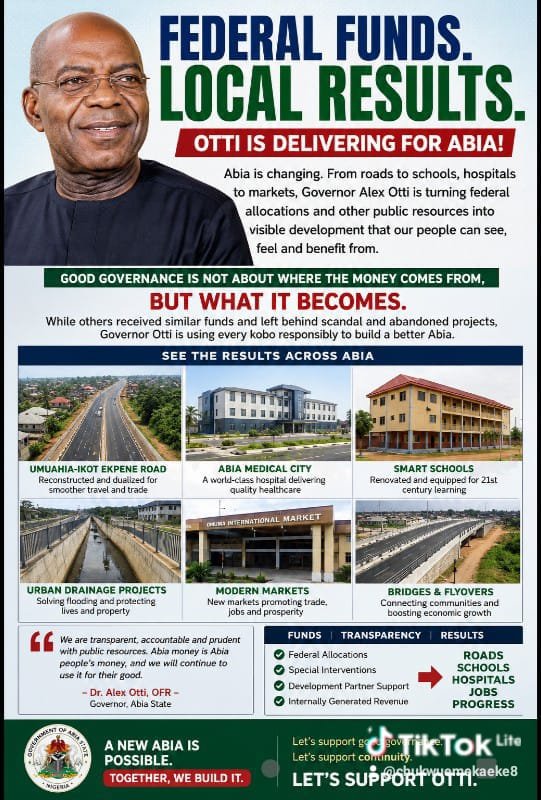
Federal Funds, Local Results: How Otti Is Turning Special Allocations into Visible Development
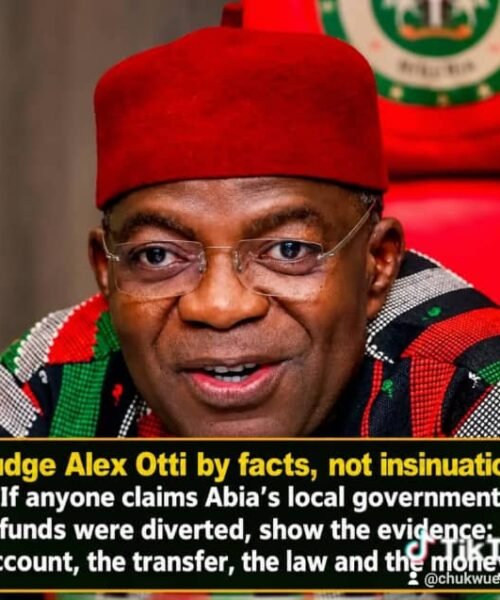
The growing attempt to diminish Governor Alex Otti’s developmental record by repeatedly shouting that “the Federal Government released the money” rests on a remarkably weak understanding of governance. Federal allocations, special interventions, ecological funds, bailout funds, UBEC grants and other transfers do not transform themselves into roads, schools, hospitals or functioning infrastructure. Money is merely an input. Governance determines the output.
Nigeria’s experience since 1999 makes this distinction particularly important. Federal money has reached state governments under virtually every civilian administration since the return to democracy. Yet the history of those transfers contains court convictions, criminal prosecutions, anti-graft investigations and allegations of diversion involving funds originally intended for ecological remediation, education, salaries, infrastructure and local development. Consequently, the appropriate question in Abia cannot simply be, “Who released the money?” It must also be, “What did the governor do with the money after it was released?”
That is where the Otti argument becomes stronger. A governor does not deserve applause merely because money enters a government account. He deserves assessment based on whether the money becomes measurable public value. Nigeria’s history provides enough counter-examples to demonstrate that receipt of federal money is by no means synonymous with development.
What follows is not an allegation that every governor discussed below was judicially found to have personally stolen money. That distinction matters. In some cases there are final convictions; in others there were EFCC prosecutions, investigations or allegations reported by established newspapers. The broader point, however, remains unchanged: federal money can reach a state without reaching the people in the form intended.
- Plateau State — Joshua Dariye and the Ecological Fund: The Guardian’s Record of a Conviction
Perhaps the most powerful historical answer to the claim that federal money automatically translates into state development is the Joshua Dariye case in Plateau State. This was not merely a quarrel between political parties. It resulted in a criminal conviction.
The Federal Government released ecological funds to Plateau State while Dariye was governor. The Guardian, in a report published on 20 June 2020, recalled that an FCT High Court had convicted Dariye in June 2018 for diversion of public funds amounting to approximately ₦1.126 billion. Crucially, the newspaper reported that the court specifically found that Dariye, who exercised control over ecological funds released by the Federal Government to Plateau in 2001, converted and diverted the funds.
That case should permanently settle one aspect of the debate. Abuja can release ecological money. Abuja can transfer it to a state government. The transfer itself cannot dig drainage channels, control erosion or protect communities. A state administration must translate the transfer into the intended public intervention.
Dariye’s case demonstrates the opposite possibility: money earmarked for a public purpose can arrive and still fail to deliver proportionate public value. That is why it is analytically shallow to tell Abians that Otti deserves no credit because part of the resources available to his government originated from the Federation.
The relevant comparison is not between “Otti’s money” and “Federal Government money.” None of it is Otti’s personal money. The relevant comparison is between public resources received and public assets delivered.
Plateau received federal ecological money. The courts later established criminal diversion involving that money. That is exactly why responsible utilisation at the state level matters.
- Niger State — Mu’azu Babangida Aliyu and the ₦2 Billion Ecological Fund: The Guardian’s Court Reports
Niger State provides another instructive example. Unlike Dariye’s matter, this case must be described as a prosecution and allegation in the newspaper reports rather than presented as a final conviction.
On 15 March 2019, The Guardian reported testimony in the trial of former Niger State Governor Mu’azu Babangida Aliyu concerning an alleged ₦2 billion fraud. According to an EFCC witness, investigators traced suspicious transfers from the state’s federation allocation account and examined the handling of an ecological fund received from the Office of the Accountant-General of the Federation in April 2014. The witness testified that contracts connected with the ecological fund were in some cases allegedly not executed.
The matter became even more specific in another Guardian report dated 15 October 2021. The newspaper reported testimony by bank officials in Aliyu’s trial describing how ₦800 million was withdrawn through 80 cheques of ₦10 million each in connection with the alleged diversion of approximately ₦2 billion in ecological funds.
The importance of the Niger example is not merely the amount involved. It is the purpose of the money. Ecological funds exist because communities face flooding, erosion, environmental degradation and other threats requiring urgent intervention. A federal transfer intended to solve those problems can be rendered practically meaningless if implementation breaks down at the receiving end.
When Abians therefore see drainage infrastructure, road reconstruction, erosion control or other visible works under Otti, merely saying “the money came from Abuja” does not answer the governance question. The Niger State experience shows why. Federal origin does not guarantee developmental destination.
A responsible state government remains the crucial transmission mechanism between federal revenue and the citizen.
- Benue State — Gabriel Suswam and the Ecological Fund Allegations: Premium Times’ Investigation
Benue State offers another example involving ecological intervention funds.
In an investigation published on 10 February 2018, Premium Times reported allegations arising from a state judicial inquiry that approximately ₦2 billion released by the Federal Government in 2013 from the Ecological Fund had been diverted during the administration of former Governor Gabriel Suswam. The report formed part of a wider investigation into the handling of relief and ecological resources in Benue.
Again, the legal distinction is essential: this should not be rewritten as though a court conclusively convicted Suswam of stealing that particular ₦2 billion. It was an allegation and investigation reported by the newspaper. But for the present argument, its relevance is unmistakable.
Federal intervention money is not self-executing.
If Abuja releases money to deal with ecological devastation in Makurdi, Otukpo or another affected community, citizens cannot eat the transfer advice. They cannot drive on the bank alert. They cannot shelter beneath an appropriation document. What matters is whether the receiving administration transforms that money into drainage systems, erosion controls, roads, shelters and other infrastructure.
That same principle must be applied fairly to Abia.
If federal money comes to Abia and Otti’s administration transparently deploys it into infrastructure that citizens can inspect, the correct conclusion is not that the governor contributed nothing. Rather, it is that the governor performed the very function governors are elected to perform: resource conversion.
Nigeria has had no shortage of federal transfers. What it has frequently lacked is an equivalent volume of visible public value.
- Enugu State — Sullivan Chime and the Ecological Fund Investigation: The Guardian, 2 August 2015
Enugu State provides another historically relevant case.
On 2 August 2015, The Guardian published a report headlined “Ecological Fund: Chime, Others May Account For N2bn.” The newspaper reported that the EFCC was examining allegations concerning former Governor Sullivan Chime and members of his administration. According to the report, roughly ₦2 billion, described as part of an initial tranche of ₦4 billion due to Enugu under the ecological fund arrangement, was alleged to have disappeared after release to the state government.
The newspaper carefully described the matter as one involving petitions and prospective EFCC investigation, not a conviction. It reported that several petitions alleging graft and diversion of funds were before the anti-graft agency and that investigators were examining financial activities associated with the previous administration.
The phrase used in the report—that the money was alleged to have “developed wings”—captures precisely the fear ordinary Nigerians historically associate with intervention funds.
This is why the opposition argument against Otti is politically convenient but economically unserious. If receipt were achievement, Nigerians would never have heard expressions such as “missing ecological funds,” “diverted bailout,” “abandoned UBEC projects” or “unaccounted intervention money.”
Every such controversy begins with the same first step the opposition now treats as the entire story in Abia: government released money.
The second step determines whether citizens benefit: what did the state government do with it?
It is the second question that ultimately distinguishes stewardship from waste.
- Ekiti State — Ayodele Fayose and the Federal Bailout Controversy: Punch, 8 January and 29 September 2017
The Ekiti case is particularly useful because it concerns money whose purpose ordinary people could immediately understand: salaries and pensions.
On 8 January 2017, Punch reported accusations by the Ekiti State APC that Governor Ayodele Fayose had allegedly diverted an ₦8.8 billion bailout intended for workers’ salary arrears and pension obligations. The newspaper also recorded the rebuttal from organised labour and the state side, meaning this was a contested political allegation rather than an adjudicated finding of theft.
The report nevertheless provides a remarkable catalogue of federally connected inflows that political actors alleged were mishandled. They cited an earlier ₦9.6 billion bailout, a ₦10 billion capital-project loan, ₦1.3 billion in budget-support funds, an ₦8.8 billion Paris Club refund, an alleged ₦5.5 billion road refund, an ₦2.5 billion ecological fund and other facilities. The labour movement disputed the accusation and offered its own account of how the money was disbursed.
Later that year, Punch reported on 29 September 2017 that the EFCC had arrested Ekiti’s Finance Commissioner and Accountant-General in connection with an alleged ₦7 billion bailout scam.
Whether one takes the political allegations or the rebuttals, the deeper institutional lesson is unavoidable. Federal bailout funds do not pay a single teacher or pensioner simply because Abuja approves them. The state government controls the administrative chain through which the resources finally reach beneficiaries.
That is precisely why performance at state level matters.
If an Abia government receives extraordinary federal support and converts it into roads, schools, public transport infrastructure, healthcare facilities or other assets, the existence of federal participation does not erase state-level competence.
Rather, competent use is exactly what citizens should demand.
- Kwara State — Abdulfatah Ahmed and the UBEC Funds: Premium Times’ Reports on 51 Educational Projects
The Kwara case is perhaps the strongest contemporary illustration of why the argument “the Federal Government provided the money” does not erase the significance of state-level management.
On 22 July 2025, Premium Times reported evidence given in the continuing criminal trial of former Kwara State Governor Abdulfatah Ahmed and his former Finance Commissioner. According to an EFCC investigator, approximately ₦5.78 billion earmarked under the Universal Basic Education Commission matching-grant system was allegedly diverted during Ahmed’s administration.
The money was intended for basic-education infrastructure.
That fact matters enormously.
Premium Times reported that an earlier prosecution witness from UBEC testified that funds intended for 51 educational projects had been diverted and that a number of classrooms, toilets, ICT centres and other projects were left unexecuted or abandoned. The newspaper also reported testimony that ₦1 billion from a UBEC matching-grant account was used for salary and pension payments and that further money was allegedly deployed for purposes inconsistent with the approved education programme. Ahmed and his co-defendant pleaded not guilty, and the case remained before the court.
This is the argument against the opposition slogan in perhaps its purest form.
Abuja can provide money for 51 schools.
Yet 51 completed schools do not automatically materialise.
Between Abuja’s disbursement and the classroom stands a chain of state-level decisions involving budgeting, procurement, contractors, supervision, certificates, payments, auditing and political leadership.
That chain is governance.
If the chain succeeds, children get classrooms.
If the chain fails, the accounting records may show billions spent while communities continue staring at abandoned structures.
Consequently, when an Otti administration receives federal or multilateral resources and visible infrastructure follows, the political credit does not belong exclusively to whoever originated the transfer. It belongs proportionately to every institution that converted that financing into a functioning asset.
- Zamfara State — Abdul’aziz Yari and the Ecological/SURE-P Allegations: Premium Times’ 20 August 2022 Review
Zamfara provides another example of the controversies surrounding federal intervention resources.
In a 20 August 2022 special report reviewing unresolved corruption cases involving former Nigerian governors, Premium Times recalled allegations against former Zamfara Governor Abdul’aziz Yari, including alleged mismanagement of a ₦2 billion Ecological Fund and allegations involving SURE-P funds.
The newspaper’s formulation is important. These were allegations and investigations; they should not be rhetorically upgraded into judicial convictions.
Yet once again the policy lesson is clear.
SURE-P was introduced to recycle subsidy savings into social and infrastructure interventions. Ecological funding exists to address environmental emergencies. The names of those programmes sound impressive at the federal level, but programmes only acquire meaning when the resources produce measurable results where citizens live.
The Zamfara example therefore reinforces a basic principle of fiscal federalism: federal financing and state execution are complementary, not mutually exclusive, responsibilities.
Giving Abuja credit for releasing funds does not require denying the governor credit for using them effectively.
Conversely, Abuja’s release does not absolve a state administration where funds are allegedly misused.
Both principles must operate together.
That is the intellectually consistent standard.
- Ogun State — Dapo Abiodun and the ₦10.8 Billion SURE-P/LG Allocation Allegations: Punch, 29 August 2023
The controversy in Ogun State brings the argument even closer to the contemporary period.
On 29 August 2023, Punch reported allegations made by Wale Adedayo, then Chairman of Ijebu East Local Government Area, against Governor Dapo Abiodun. Adedayo accused the governor of withholding or diverting statutory federal allocations intended for local governments and also alleged that more than ₦10.8 billion in SURE-P-related funds sent for Ogun’s 20 local governments had not been released to them.
According to the detailed allegations reproduced by Punch, the supposed SURE-P-related inflows arrived in several tranches—approximately ₦2.5 billion, ₦2.6 billion, ₦2.8 billion and ₦2.9 billion. Adedayo alleged that the councils received none of them and complained that local communities continued struggling with poor roads, water supply, health facilities and primary schools. He petitioned the EFCC seeking an investigation.
Again, this was an allegation by a local-government chairman and must be described precisely as such. It is not evidence of a criminal conviction against Governor Abiodun.
But consider the economic significance of the allegation itself.
Federal money can be allocated.
A state can acknowledge receiving or administering intergovernmental resources.
Yet the tier or community for which the money was intended can still complain that it has seen little corresponding development.
That fact alone destroys the simplistic proposition that the only politically meaningful act is the federal release.
The difficult work begins after the release.
What These Eight Cases Tell Us About the Otti Debate
Across Plateau, Niger, Benue, Enugu, Ekiti, Kwara, Zamfara and Ogun, the details differ. The legal outcomes differ too. Dariye’s case produced a conviction. Other matters involved prosecutions, EFCC investigations, political accusations or unresolved allegations. It would therefore be irresponsible to lump every governor together and declare them all convicted thieves.
But the combined historical evidence establishes something far more useful to the Abia debate.
Federal money has repeatedly reached Nigerian states without an automatic guarantee that the intended citizens received the corresponding public benefit.
Plateau received ecological funds.
Niger received ecological funds.
Benue received ecological intervention money.
Enugu received ecological funds.
Ekiti received bailouts and other federal financial interventions.
Kwara received UBEC intervention resources.
Zamfara received ecological and SURE-P-related resources.
Ogun local governments were said to be entitled to statutory allocations and SURE-P-related interventions.
Yet every one of these episodes generated controversy precisely because there remained a separate and crucial question about utilisation.
That is the history the current Abia argument conveniently forgets.
Otti Cannot Claim Ownership of Federal Money — But He Can Claim Stewardship
A serious defence of Alex Otti should never descend into the absurd claim that federal allocations are personally generated by the governor. They are not.
Neither should anybody deny the Federal Government credit for genuine federal interventions in Abia.
The better case for Otti is both more modest and more powerful.
Money released to Abia is public money. Otti’s responsibility is to make it work.
That is exactly how modern governance should be evaluated.
A president does not personally own federal revenue. Yet presidents are judged according to how effectively they convert national revenues into national development.
A minister does not personally provide a ministry’s appropriation. Yet ministers are judged according to implementation.
A local-government chairman does not manufacture FAAC money. Yet citizens assess what he builds with it.
Why, then, should the governor of Abia be subjected to a bizarre standard under which executing projects with public money somehow disqualifies him from receiving credit?
Every government project everywhere is financed from resources ultimately belonging to the public.
The achievement lies in stewardship.
The Real Comparison Is Not Otti Versus Abuja
The opposition has constructed the wrong comparison.
The relevant comparison is not:
Otti versus the Federal Government.
It is:
Abia’s resources versus Abia’s results.
How much came in?
How much was internally generated?
How much came through FAAC?
How much came through special federal intervention?
How much came through development finance?
How much was borrowed?
What was spent?
And most importantly, what exists today that did not exist before the expenditure?
These questions produce an evidence-based political conversation.
When one kilometre of road is completed, measure it.
When a school is reconstructed, inspect it.
When a hospital is refurbished, enter the wards.
When a bridge is constructed, drive across it.
When drainage is installed, observe what happens during rainfall.
That is accountability.
Nigeria’s Political History Makes Efficient Use of Federal Funds an Achievement, Not an Excuse
Those who say, “Otti only used Federal Government money,” may therefore inadvertently be making part of the case for him.
Yes—if money was transferred to Abia and it became public infrastructure, that is precisely what should happen.
The tragedy of the Nigerian federation is that history provides numerous instances where that apparently elementary process failed.
The Dariye case proves beyond rhetoric that federal ecological money can enter a state system and subsequently become the subject of a criminal conviction for diversion.
The Niger prosecution shows how ecological funds could become the subject of allegations involving multiple cash withdrawals.
The Benue investigation illustrates how ecological money intended to respond to environmental distress could become embroiled in allegations of diversion.
The Enugu investigation showed that even a ₦2 billion ecological tranche could become the centre of unanswered questions.
The Ekiti controversy demonstrated that even billions specifically released for salaries and pensions could generate fierce accusations about whether workers received the intended benefit.
The Kwara prosecution provides perhaps the most graphic example: billions earmarked for education and dozens of school projects could still allegedly end with classrooms and facilities abandoned.
Zamfara’s historical cases demonstrate continuing controversy around ecological and SURE-P intervention money.
And Ogun’s local-government dispute shows that even in recent years, questions over federal allocations and special interventions remain politically explosive where communities cannot identify the developmental outcome.
Against that history, competent utilisation is not trivial.
It is governance.
A Road Is a Receipt
There is a simple way to end much of the debate surrounding Abia.
Publish the inflows.
Publish the project costs.
Publish the contractors.
Publish the completion percentages.
Identify the funding source.
If Abuja funded 100 per cent, write Federal Government-funded.
If Abia funded it entirely, say so.
If both governments contributed, state their respective contributions.
If a development institution financed it, disclose the loan or grant terms.
Then allow citizens to compare expenditure with physical output.
That is the kind of accountability that makes propaganda increasingly useless.
Because ultimately a road is a receipt.
A completed classroom is a receipt.
A functioning hospital is a receipt.
A bridge is a receipt.
A drainage channel is a receipt.
A water scheme that actually supplies water is a receipt.
Public infrastructure is the physical evidence that public money completed its journey from treasury to citizen.
Why Otti Can Be Called a Man to Bank With
There is therefore a fitting irony in evaluating Alex Otti, a former banker, through the language of banking.
In banking, receipt of funds is not the same thing as productive deployment of funds.
Capital sitting idle creates little value.
Capital recklessly allocated destroys value.
Capital efficiently invested creates assets.
The same principle applies to government.
Otti should not be praised simply because Abia has more revenue available to it. Every governor receives revenue.
He should be judged by the conversion ratio between money received and public value created.
That is the metric that matters.
And it is precisely on that metric that the Nigerian historical cases surveyed above give the current Abia government a useful comparative context.
Some governments received federal intervention money and later faced allegations that the intended projects vanished.
One former governor was convicted over diversion of ecological funds.
Others faced investigations and prosecutions involving bailout, education, ecological and intervention money.
In other words, Abuja sending money has never guaranteed that citizens would see development.
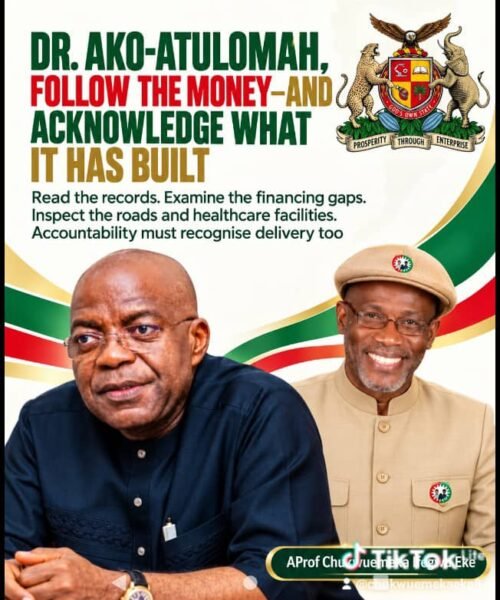
If Abia receives public money today and citizens can point to the roads, schools, hospitals, drains and other assets into which it has been converted, the intellectually defensible response is not to deny Otti any credit.
The correct response is to insist on transparency while recognising stewardship.
The Federal Government deserves credit for funds it releases and projects it sponsors.
The state government deserves credit—or blame—for how resources within its control are managed.
Those two truths can coexist.
Indeed, they must.
The real political question is consequently not, “Who sent the money?”
The question is:
“When the money arrived, what did your governor do with it?”
Nigeria’s history shows that this is not a trivial question.
It may be the most important question of all.
And if the continuing physical transformation of Abia can withstand transparent scrutiny of cost, funding source and implementation, then Alex Otti’s strongest defence will require very little propaganda.
The evidence will be standing by the roadside.
Federal funds. Local results. Public money converted into public value. That—not the mere receipt of an allocation—is the case for calling Otti a man Abia can bank with.