
PUNCH Newspaper’s “Sam Mbakwe” Question: Is Alex Otti Building a Legacy That Will Outlive the Applause?
A Newspaper Feature on Infrastructure, Electric Mobility and the Emerging Debate over Alex Otti’s Development Legacy
The debate over the developmental direction of Abia State has moved beyond ordinary partisan exchanges. On August 12, 2026, PUNCH Newspapers gave the discussion a particularly significant national platform when it published Blaise Udunze’s analytical feature, “The Risk of Calling Alex Otti Another Sam Mbakwe.” The article examines the increasingly common comparison between Governor Alex Otti and the late Chief Sam Mbakwe, the celebrated governor of the old Imo State between 1979 and 1983.
That a newspaper of the national reach of PUNCH Newspapers has devoted an analytical feature to the comparison is itself noteworthy. The question is no longer simply whether Otti has constructed roads or rehabilitated urban centres. It is whether what is presently happening in Abia amounts to a sufficiently integrated development programme capable of creating institutions, infrastructure and productive capacity that will remain relevant decades after the present administration has left office.
Why PUNCH Newspapers Raised the Mbakwe Comparison
The central argument of the PUNCH Newspapers feature is more sophisticated than simply declaring Alex Otti the modern equivalent of Sam Mbakwe. In fact, the article counsels caution. Mbakwe’s reputation has already survived the most difficult examination available to a political leader: time. More than four decades after his administration ended, infrastructure and institutions associated with his government continue to influence public perceptions of developmental governance across territories that once constituted old Imo State.
Otti, by contrast, is still governing. Consequently, history has not yet rendered its verdict.
This is precisely why the PUNCH feature is significant. It shifts attention away from slogans and political endorsements towards measurable indicators of development. Roads are important, but roads must ultimately reduce transportation costs. Electricity is important, but electricity must support industries and employment. Modern transportation is desirable, but it must improve mobility, productivity and the quality of urban life. Government investment therefore becomes transformational only when apparently separate projects begin to reinforce one another.
From Roads to an Economic Infrastructure Network
The strongest argument for the emerging comparison is the scale at which infrastructure has become the visible signature of the Otti administration. According to the PUNCH Newspapers analysis, the government reported completing hundreds of road projects and hundreds of kilometres of roads by its third anniversary, including economically significant corridors and urban roads.
For a commercial economy such as Abia’s, this matters beyond aesthetics.
A road into Aba is not merely asphalt. It connects manufacturers to markets, workers to factories, traders to customers and agricultural communities to commercial centres. Poor roads operate like an invisible tax on production: vehicles deteriorate faster, journeys take longer, fuel consumption increases and businesses incorporate these costs into prices.
This is where the Otti infrastructure programme potentially acquires a deeper economic meaning. If the road projects are maintained and linked systematically to industrial, power, logistics and commercial investments, the state is not merely beautifying cities. It is attempting to reduce the cost of doing business.
Electric Buses and a Changing Transport Philosophy
A striking example came with the expansion of the Abia Green Shuttle Service.
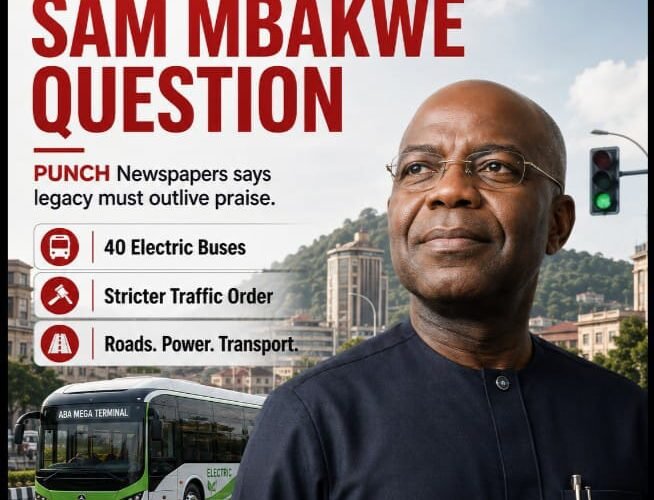
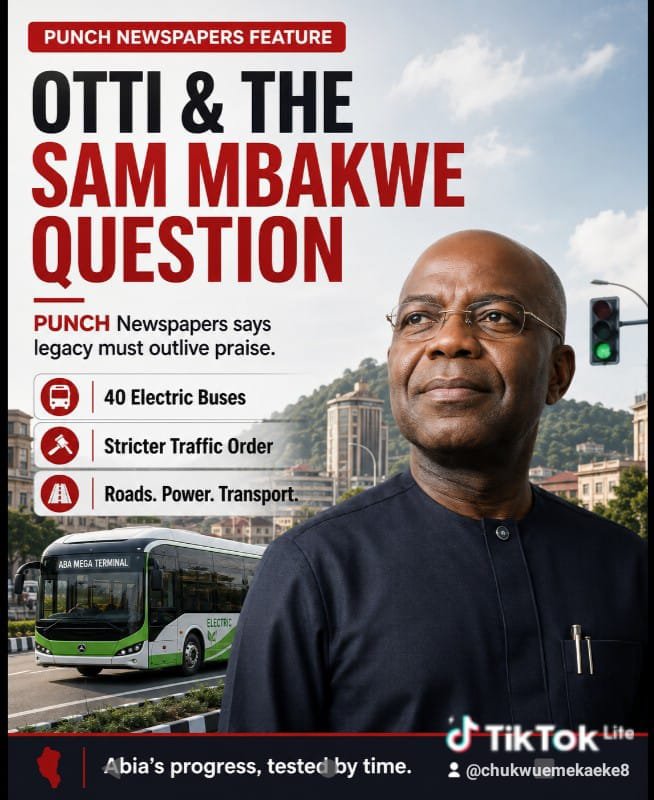
On August 6, 2026, Otti commissioned 20 additional electric buses at the Prof. Nnenna Oti Bus Terminal in Umuahia, increasing the electric bus fleet from 20 to 40 vehicles. The original 20 buses had been introduced in December 2025. Channels Television reported that the new buses included larger luggage facilities and provisions intended to improve accessibility for persons living with disabilities.
This is important because public transportation policy is beginning to intersect with energy policy.
Electric buses can reduce dependence on conventional automotive fuels, lower tailpipe emissions and, where reliable electricity is available, potentially reduce some operating costs associated with conventional public transport. The expansion therefore represents something more significant than purchasing forty buses. Its real developmental value will depend upon charging infrastructure, maintenance capacity, route efficiency, passenger numbers, ticket affordability and the long-term economics of operating the fleet.
The state has also indicated investments in charging facilities, maintenance arrangements and route planning to support the buses.
That is precisely the sort of institutional depth against which the programme should eventually be judged.
The New Infrastructure Must Come With New Behaviour
The rollout of the additional buses was accompanied by another message from the governor: infrastructure investment would increasingly be matched with stricter traffic regulation.
Otti warned against such offences as driving against traffic, beating traffic lights, overloading and indiscriminate parking. He also directed the Abia State Road Traffic and Safety Management Agency and the Harmonised Task Force to extend enforcement activities to 10 p.m. daily, including weekends.
There is an important governance principle embedded here.
Building a modern city involves more than constructing modern roads. A beautifully rehabilitated road that rapidly degenerates into an unregulated motor park is not functioning as modern transport infrastructure. New physical infrastructure therefore requires corresponding improvements in regulation, road-user behaviour, enforcement and urban management.
The Otti administration consequently faces a difficult balance. Enforcement must be firm enough to protect public infrastructure and restore order, yet sufficiently transparent to prevent traffic regulation from degenerating into arbitrary harassment or revenue extraction.
Electricity May Ultimately Be More Important Than Asphalt
Perhaps the most consequential portion of the PUNCH Newspapers feature concerns electricity.
The analysis argues that the availability of more reliable power around the Aba industrial ecosystem, associated particularly with the Geometric Power project, potentially changes the economic possibilities available to the state. PUNCH further recounts Otti’s historical involvement with the financing of the Geometric Power project during his banking career, presenting it as evidence that his interest in productive infrastructure predates his emergence as governor.
This is where the Mbakwe comparison becomes economically interesting.
Development does not normally emerge from one spectacular project. It occurs when roads, power, transportation, human capital, markets and private investment begin operating as complements.
Electricity makes industrial production more reliable. Roads reduce logistics costs. Public transportation improves labour mobility. Industrial clusters create employment. Improved security reduces business risk. Efficient administration reduces transaction costs.
Once these variables begin interacting, infrastructure stops being merely a government expenditure programme and starts becoming a productivity system.
But PUNCH Newspapers Also Sounds the Necessary Warning
The title of the PUNCH article is deliberately cautious: “The Risk of Calling Alex Otti Another Sam Mbakwe.”
That risk lies in declaring history finished while it is still unfolding.
Political popularity is not the same thing as institutional transformation. Commissioning ceremonies are not productivity statistics. Kilometres of roads cannot by themselves demonstrate rising household welfare. Forty electric buses constitute an interesting innovation, but their significance five or ten years from now will depend on whether they remain operational, properly maintained and financially sustainable.
The PUNCH Newspapers feature therefore points towards more demanding measurements: internally generated revenue, private investment, manufacturing output, employment creation, educational outcomes, healthcare access, SME expansion, exports and household incomes.
Those indicators will eventually tell the fuller story.
The Real “Sam Mbakwe Test”
Sam Mbakwe is remembered today not because newspaper headlines praised him while he governed but because many of the things associated with his administration remained embedded in public memory long afterwards.
That gives Abia a useful standard.
The ultimate question is not whether Alex Otti can construct enough projects to resemble Mbakwe politically. The question is whether Abia can create a system in which today’s roads still function tomorrow; today’s electric buses become the beginning of sustainable mass transportation rather than abandoned assets; today’s power advantages produce new factories; today’s urban renewal generates higher productivity; and today’s reforms become institutions that survive changes of government.
That is a far more demanding achievement than winning an election or dominating political conversation.
And it explains why the intervention by PUNCH Newspapers is important. By placing the Otti–Mbakwe comparison within a national newspaper feature, PUNCH has effectively moved the conversation from “Is Otti performing?” to the more historically consequential question:
“Is Abia constructing a development system capable of surviving Alex Otti himself?”
If the answer eventually becomes yes, the comparison with Sam Mbakwe will no longer require political campaigns, social-media arguments or newspaper headlines.
History will make the comparison on its own.
References
Channels Television. (2026, August 7). Otti unveils 20 more electric buses to boost public transportation.
National Ambassador News. (2026, August 6). Otti unveils 20 additional electric buses, orders traffic agencies to operate till 10pm.
Realnews Magazine. (2026, August 7). Otti inaugurates 20 additional electric buses, warns against traffic violations.
Udunze, B. (2026, August 12). The risk of calling Alex Otti another Sam Mbakwe. PUNCH Newspapers.