
OBINNA ORIAKU’S VAT SPIN: A CLASSIC CASE OF DATA WITHOUT ECONOMICS
Obinna, you have displayed a table, but your interpretation is analytically defective. A statistic does not become economic analysis merely because it is arranged from highest to lowest.
Let us dismantle the spin with history, development economics, development finance and the mechanics of Nigerian revenue statistics.
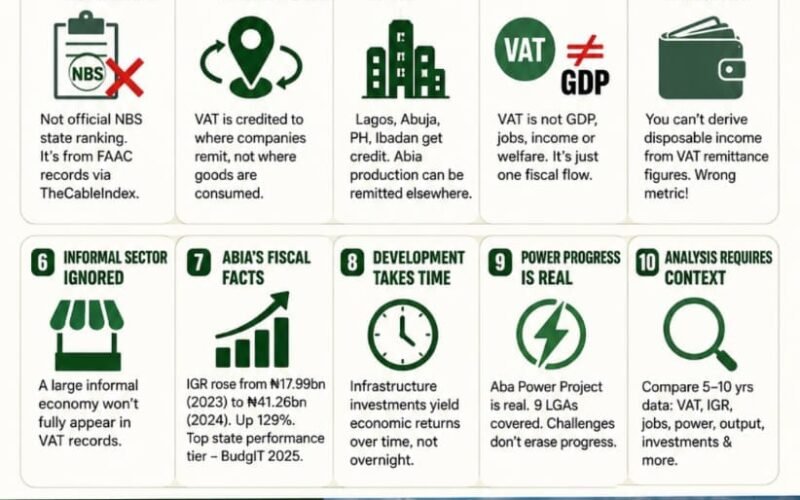
- THIS IS NOT AN NBS STATE ECONOMIC-PERFORMANCE TABLE
The circulated figures were presented by TheCableIndex as an analysis of FAAC records. They are not the standard NBS quarterly VAT report, which ordinarily presents VAT by economic sector and separates local VAT, foreign VAT and import VAT.
Therefore, your claim that “NBS has placed Abia last” is already misleading. The table may draw from FAAC administrative records, but it is not an NBS ranking of state economies.
- VAT IS ATTRIBUTED LARGELY TO THE PLACE OF REMITTANCE, NOT NECESSARILY THE PLACE OF CONSUMPTION
Nigeria has historically operated a centralised VAT filing system. Many companies remit VAT through their headquarters rather than accurately attributing every sale to the state where the product was consumed.
This produces what tax experts call the “headquarters effect.” A company may sell goods in Aba, Umuahia and across Abia, but remit the VAT through its Lagos, Abuja, Ibadan or Port Harcourt head office. Lagos then receives the statistical credit for economic activity that partly occurred elsewhere.
That is precisely why recent tax reforms require taxpayers to disclose where taxable supplies are actually consumed, regardless of where the VAT return is filed.
So, describing ₦8.77 billion as the entire VAT “generated by the Abia economy” is technically unsafe.
- THE TABLE MAY ACTUALLY CONFIRM THE HEADQUARTERS DISTORTION
Anyone with basic knowledge of Nigeria’s economy should pause when Oyo is shown at ₦253.67 billion—nearly ten times Ogun’s ₦26.43 billion—and when Bayelsa is shown above Kano, Ogun, Edo and Anambra.
Does that automatically mean Bayelsa has a larger consumer and industrial economy than all those states?
Certainly not.
It shows that company registration, sectoral concentration, oil-related transactions, major remitters, payment timing, tax offices and headquarters location can dramatically affect the figures.
A serious analyst investigates such anomalies. A propagandist simply celebrates the ranking.
- VAT IS NOT GDP
VAT collection is a fiscal-flow variable. It is not equivalent to:
- State GDP
- Industrial output
- Household income
- Employment
- Productivity
- Investment
- Poverty reduction
- Disposable income
- Economic welfare
A low recorded VAT figure may reflect informality, exemptions, headquarters-based remittance, weak attribution, compliance gaps, the structure of production or the timing of payments.
You cannot validly jump from one VAT number to the conclusion that Abia’s economic recovery is false. That is an elementary error of substituting one imperfect proxy for an entire economy.
- YOU CANNOT DERIVE DISPOSABLE INCOME FROM THIS TABLE
Your attempt to connect the figure directly to workers allegedly earning ₦23,000 is statistically baseless.
Average disposable income requires household-income data, wage distributions, employment composition, inflation, transfers, taxes, household size and consumption expenditure.
None of those variables appears in the circulated table.
You cannot obtain household disposable income by staring at state-remittance figures. That is not data mining; it is data abuse.
- YOU ALSO CANNOT MEASURE INFORMAL-SECTOR CAPTURE FROM THIS TABLE
Nigeria’s VAT is principally collected at registered points of taxable supply. A large informal economy may produce significant output and employment without appearing proportionately in VAT records.
To assess whether Abia’s informal sector is being formalised, one would examine:
- Taxpayer-registration growth
- Business formalisation
- Electronic-payment penetration
- PAYE and direct-assessment records
- Market enumeration
- Business-premises registration
- Sectoral IGR
- Employment and enterprise surveys
The VAT ranking alone answers none of those questions.
- ABIA’S FISCAL TRAJECTORY CONTRADICTS YOUR DOOMSDAY NARRATIVE
BudgIT’s 2025 State of States assessment reported that Abia’s IGR increased from approximately ₦17.99 billion in 2023 to ₦41.26 billion in 2024—a rise of about 129.37%. The state also entered the top tier of BudgIT’s fiscal-performance ranking.
That does not mean every economic problem has disappeared. It means your attempt to use one distorted VAT series to declare economic collapse is contradicted by wider fiscal evidence.
Development economics evaluates a basket of indicators, not a politically convenient row in a table.
- DEVELOPMENT PRECEDES FULL REVENUE YIELD
Roads, electricity, drainage, security, urban renewal, schools, healthcare and digital administration are forms of productive public capital.
Their economic benefits emerge through:
- Lower transportation costs
- Reduced production losses
- Increased property values
- Improved market access
- Longer business hours
- Higher private investment
- Better labour productivity
- Expansion of the future tax base
Development finance recognises gestation periods. A road completed today does not automatically produce its maximum VAT tomorrow morning.
Your demand for an immediate one-to-one relationship between infrastructure spending and contemporaneous VAT receipts ignores investment lags, multiplier effects and capital formation.
- THE ABA POWER CLAIM HAS BEEN DELIBERATELY MISREPRESENTED
No informed person claims that every community in all 17 Abia LGAs receives uninterrupted electricity every hour of the day.
The Aba Integrated Power Project operates within a defined ring-fenced area covering nine LGAs. Its commissioning represented a major structural improvement in local electricity generation and distribution, but supply can still be affected by gas availability, maintenance, network capacity and customer classification.
Criticising service gaps is legitimate. Pretending that the existence of any outage disproves the entire power investment is dishonest.
- HISTORY MATTERS
Aba’s industrial and commercial importance did not begin with Alex Otti. It developed through colonial rail and trade networks, indigenous manufacturing, Ariaria, leatherworks, garments, metal fabrication and regional commerce.
However, decades of deteriorated roads, unreliable electricity, flooding, weak planning and administrative decay imposed a heavy infrastructure tax on producers.
The present recovery effort is therefore restorative and structural. It is rebuilding the conditions under which Aba’s historic entrepreneurial energy can translate into formal investment, productivity and properly attributed tax revenue.
- WHAT A PROFESSIONAL ANALYSIS WOULD REQUIRE
Before declaring Abia a failed economy, compare:
- Abia’s VAT over at least five to ten years
- Monthly and quarterly movements
- VAT per capita
- Nominal and real IGR growth
- PAYE and non-tax revenue
- Business registrations
- Electricity supplied and consumed
- Manufacturing output
- Employment and household consumption
- Construction activity
- Bank deposits and credit
- Inflation-adjusted capital expenditure
- Headquarters-location distortions
Without these controls, the conclusion is predetermined propaganda—not research.
CONCLUSION
The ₦8.77 billion figure should prompt administrative questions about VAT attribution, business registration, tax compliance and the location of corporate remittances.
It does not prove that Abia is Nigeria’s weakest economy.
It does not measure average disposable income.
It does not prove that infrastructure investment has failed.
It does not disprove Aba’s electricity progress.
It does not establish that Abia’s economic recovery is fictional.
You collected one number, ignored its methodology, confused remittance location with economic location, substituted VAT for GDP, inferred wages without household data and then announced “the real truth.”
That is not development economics.
That is not development finance.
That is not national-statistics mining.
It is fake analysis dressed in a table.
Nde New Abia will continue rebuilding while merchants of selective statistics continue mistaking noise for knowledge.
— Pastor Prof. Chukwuemeka Ifegwu Eke