
SEE ABIA, KNOW THE TRUTH: DEVELOPMENT IS MEASURED BY RESULTS, NOT SOCIAL MEDIA NOISE
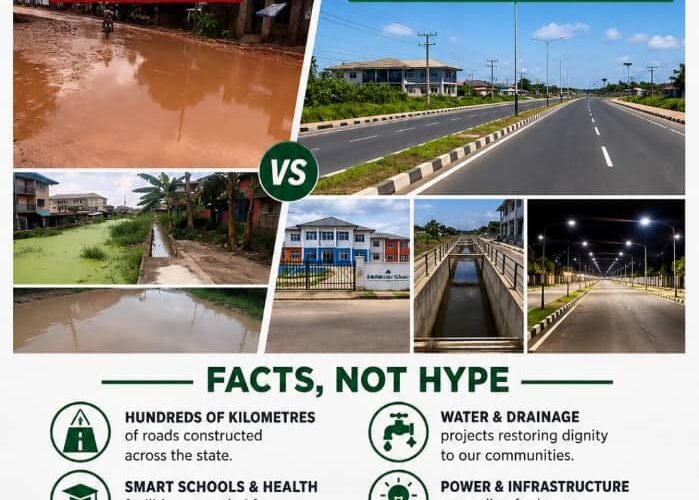
In the age of social media, one photograph can be removed from its location, stripped of its history and circulated as though it represents an entire state. This is increasingly the method used by some political actors who seek to reduce the Abia story to isolated images of flooded streets, neglected drains or damaged roads.
But governance cannot be fairly assessed through selective pictures alone. It must be judged by the totality of work being done, the condition inherited, the scale of intervention and the visible difference between yesterday and today.
The administration of Governor Alex Otti has never claimed that every road, drainage channel, school, hospital and community problem in Abia has already been resolved. No serious government could make such a claim after decades of accumulated infrastructural decay. What the government has consistently demonstrated, however, is a clear commitment to rebuilding the state systematically, transparently and sustainably.
THE ABIA THAT WAS INHERITED
Before May 2023, many parts of Abia suffered from collapsed roads, abandoned public institutions, blocked drainage systems, poor street lighting, weak healthcare facilities and schools requiring urgent rehabilitation.
These problems did not emerge overnight. They were the consequences of years of neglect, poor maintenance and inadequate investment.
It is therefore misleading for anyone to photograph an unresolved location today and present it as evidence that nothing is happening across the state. The existence of unfinished work does not cancel completed projects. Neither does one bad road erase several roads already reconstructed or undergoing rehabilitation.
ROADS THAT PEOPLE CAN SEE AND USE
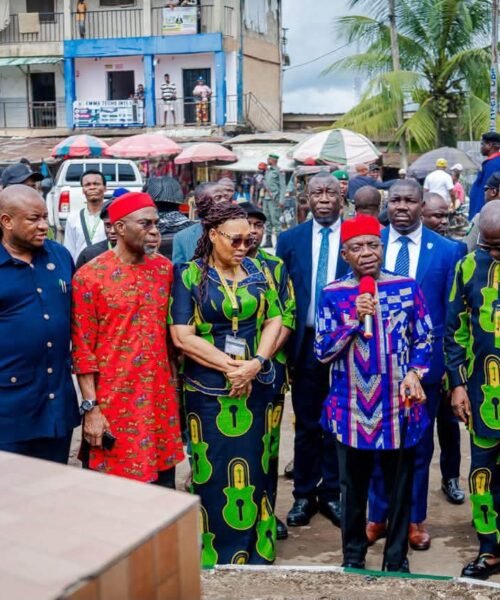
Across Abia, residents and visitors can point to roads that have been reconstructed, rehabilitated or opened for improved movement. These road projects are not digital creations. Motorists drive on them, traders transport goods through them and communities experience their economic benefits.
The government’s approach is not merely to pour asphalt on roads for ceremonial purposes. Attention is being paid to drainage, durability, road markings, street lighting and the wider urban environment.
The objective is to build infrastructure that lasts, not temporary projects designed only for political photographs.
DRAINAGE AND FLOOD CONTROL REQUIRE SERIOUS ENGINEERING
Flooding in parts of Abia is a long-standing challenge connected to blocked waterways, poorly constructed drains, unplanned development and years of inadequate environmental management.
Addressing the problem requires more than surface-level intervention. It involves the construction and desilting of drains, restoration of water channels, removal of obstructions and redesign of affected roads.
The administration understands that road construction without effective drainage is incomplete development. This is why drainage and flood-control projects remain central to the government’s infrastructure programme.
An isolated picture of stagnant water may identify a location requiring attention, but it cannot honestly be used to deny the drainage projects already completed or ongoing in other communities.
SMART SCHOOLS, HEALTHCARE AND HUMAN DEVELOPMENT
Development is not limited to roads. The administration is also investing in education and healthcare because physical infrastructure must be matched by human development.
The emergence of modern school facilities, improved learning environments and renewed attention to public education reflects the government’s determination to give Abia children a stronger future.
Healthcare facilities are also receiving attention, with emphasis on accessibility, functionality and improved service delivery.
These interventions demonstrate that the government is pursuing development across sectors rather than concentrating only on projects that attract immediate publicity.
POWER, INDUSTRY AND JOB CREATION
Abia has enormous commercial and industrial potential. Aba, in particular, remains one of Nigeria’s most important centres of enterprise, manufacturing and innovation.
The responsibility of government is to create the environment in which businesses can grow. This requires better roads, improved electricity, public safety, modern markets, efficient transport systems and investor confidence.
The administration’s infrastructure programme is therefore connected to a wider economic vision. Roads support trade. Electricity supports production. Drainage protects businesses and homes. Schools build future skills. Healthcare protects productivity.
Development must be understood as an interconnected process.
CRITICISM IS WELCOME, BUT MISREPRESENTATION IS NOT
The government welcomes responsible criticism. Citizens have the right to draw attention to damaged roads, blocked drains, neglected communities and areas requiring urgent intervention.
Constructive criticism helps government to improve.
However, there is a clear difference between identifying a problem and deliberately presenting one problem as the complete condition of Abia State.
A photograph should be accompanied by the name of the location, the date it was taken, the history of the problem and any available information concerning planned or ongoing government intervention.
Without this context, public communication becomes propaganda rather than accountability.
ABIA IS A WORK IN PROGRESS
The transformation of Abia will not be completed in one day, one month or one budget cycle. The inherited challenges are too extensive for such unrealistic expectations.
But progress must also not be denied simply because every problem has not yet been solved.
The proper question is not whether there are still bad roads or drainage challenges in Abia. The proper questions are: Is the state moving forward? Are projects being executed? Are communities experiencing improvements? Is public infrastructure being rebuilt? Is government responding differently from the past?
Across the state, the evidence increasingly provides the answer.
Abia is changing through roads, schools, healthcare facilities, drainage projects, street lighting, economic reforms and renewed public confidence.
There is still much work to be done, and the government accepts that responsibility. But the work already completed deserves honest acknowledgement.
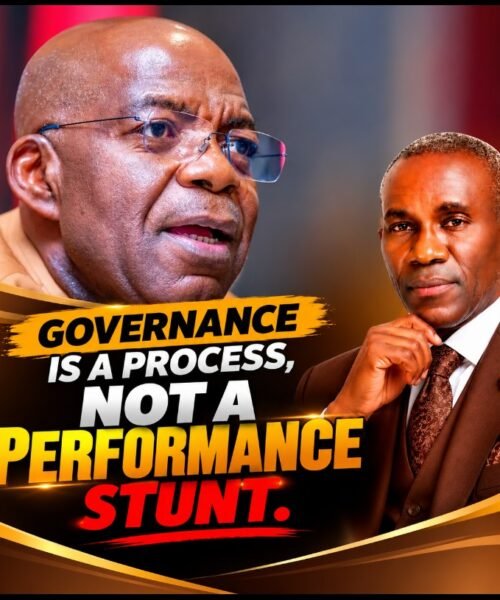
Governance is not about noise. It is about results.
Abians can see the work. Abians can feel the difference. And the journey towards a greater Abia continues.