
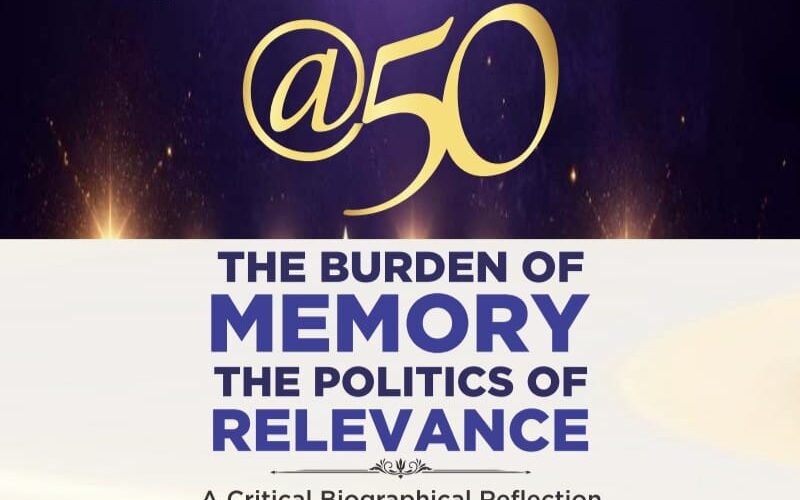
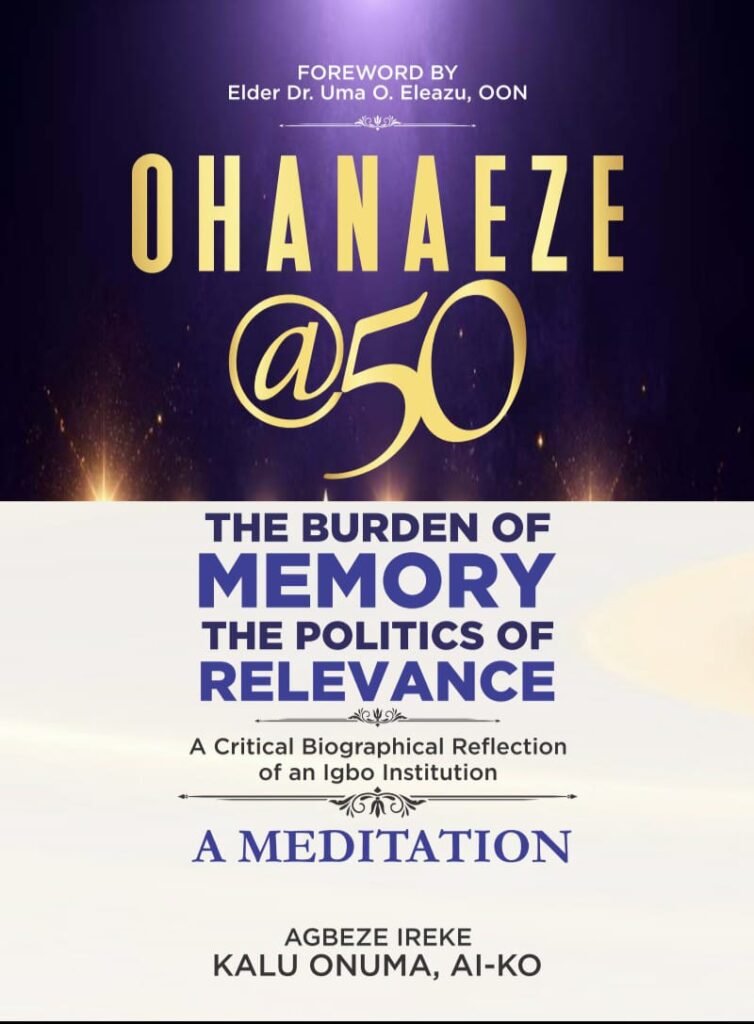
REVIEW OF OHANAEZE @ 50: THE BURDEN OF MEMORY, THE POLITICS OF RELEVANCE
Agbeze Ireke Kalu Onuma’s Ohanaeze @ 50: The Burden of Memory, The Politics of Relevance is a thoughtful, courageous and deeply reflective examination of one of the most important socio-cultural institutions in contemporary Igbo history. The strength of the work lies not only in its historical breadth, but in the balance with which Kalu Onuma approaches Ohanaeze Ndigbo. He writes with the intimacy of one who understands the institution from within, yet he is sufficiently critical to ask difficult questions about its performance, internal governance and future relevance.
At the centre of the book is a compelling question: is longevity, by itself, enough to justify institutional relevance? Fifty years is a significant milestone, but the author repeatedly reminds the reader that an institution must ultimately be judged by what it has done with those years, the legitimacy it has built, the people it has carried along and its capacity to respond to changing realities. This is why the work moves deliberately from the historical foundations of Igbo organising to political evolution, internal dynamics, generational tensions, achievements, failures and the challenge of renewal.
One of the strongest elements of the work is Kalu Onuma’s treatment of memory. Here, memory is not presented as nostalgia; it is a living political force. The Nigerian Civil War, the post-war experience, reconstruction, reintegration and recurring debates over political marginalisation continue to shape Igbo collective consciousness. The author therefore situates Ohanaeze within a much longer history of Igbo associational life and presents figures such as Francis Akanu Ibiam, Jerome Udoji, K. O. Mbadiwe, Pius Okigbo and Ben Nwabueze as part of a generation confronted with the enormous task of rebuilding collective confidence after catastrophe.
Perhaps the most commendable aspect of the book is that Kalu Onuma does not attribute every difficulty confronting Ndigbo to external forces. He recognises the imperfections of the Nigerian political structure and takes questions of marginalisation, representation and imbalance seriously, but he also turns the mirror inward. He examines elite capture, succession disputes, weak constitutional enforcement, financial dependence, inadequate accountability and the danger of allowing personalities to become stronger than institutions.
His distinction between the “external fire” and the “internal fire” is particularly powerful. The external fire relates to the wider Nigerian political order and the grievances that Ohanaeze was created to address. The internal fire is more uncomfortable: the possibility that an organisation demanding justice and fairness from the federation may itself struggle with transparency, constitutional discipline and inclusive governance. This is one of the book’s most important lessons. No institution can indefinitely derive authority from history while neglecting the quality of its present conduct.
The author’s discussion of ako-na-uche is equally valuable. It helps explain the historical preference for caution, consultation, accommodation and strategic engagement with political authority. Kalu Onuma understands that a generation that experienced war directly would naturally develop a different political temperament from younger generations shaped by unemployment, insecurity, democratic politics and digital communication. He neither dismisses the wisdom of elders nor romanticises youthful impatience. Instead, he asks how the prudence of one generation can be combined with the urgency, energy and innovation of another.
This naturally leads to the generational question. The book correctly recognises that political communication has changed fundamentally. Younger Igbo now organise through social media, diaspora networks, online communities and alternative movements. They can raise funds, challenge leaders, circulate narratives and mobilise across borders without relying on traditional institutions. The implication is clear: Ohanaeze cannot simply demand that younger people listen. It must give them a reason to listen. Institutional authority in the digital age is earned continually.
The same applies to women and the diaspora. Kalu Onuma is right to place women’s empowerment, digital transformation, financial sustainability, ideological pluralism, grassroots participation and generational transition at the centre of the reform agenda. An organisation claiming to articulate the collective aspirations of Ndigbo must increasingly reflect the demographic and professional diversity of the people it represents. The diaspora should also be seen not merely as a source of remittances or ceremonial support, but as a reservoir of knowledge, technology, investment, global advocacy and institutional capacity.
One of the most effective parts of the work is the institutional “ledger,” where success and failure are considered together. This is a fair and balanced approach. Ohanaeze has survived repeated political transitions, leadership crises and changing national circumstances. It has preserved a recognisable platform for Igbo collective engagement and kept important Igbo concerns within national conversations. At the same time, the author does not ignore factionalism, weak grassroots confidence and the danger that moral authority may gradually become ceremonial prestige.
Kalu Onuma makes an important point when he observes that legitimacy grows when negotiation produces visible results, but declines when statements, petitions and interventions repeatedly appear to produce little consequence. This is where the book becomes particularly useful as a guide for the future. Ohanaeze must increasingly demonstrate measurable institutional performance. Its relevance should be visible not only in speeches and communiqués, but in policy influence, cultural preservation, credible representation, stronger internal governance and tangible outcomes.
The research base of the book is broad, drawing from interviews, official statements, academic publications, media reports and institutional documents. There is, however, room for final editorial refinement. Some references remain incomplete, and direct quotations from major historical figures should, wherever possible, be tied more precisely to speeches, interviews, archival records or published texts. Such improvements would not weaken the work; they would strengthen its long-term value as a scholarly reference.
What makes Ohanaeze @ 50 especially significant, however, is that it does not end with diagnosis. It points towards renewal. The book’s central reform ideas—constitutional supremacy, transparent succession, financial independence, youth participation, women’s leadership, diaspora integration, digital modernisation and stronger institutional accountability—are not cosmetic suggestions. They are the conditions under which a historic organisation can remain useful in a changing world.
This is why the metaphor of the iroko is so fitting. The greatness of an old tree is not merely that it has survived many seasons. Its continuing greatness lies in the fact that its roots still find nourishment and its branches continue to produce new life. The same must be true of Ohanaeze. Memory without renewal can become nostalgia. Tradition without adaptation can become ceremony. Elite access without measurable outcomes can produce cynicism. Youth energy without institutional discipline may dissipate.
Agbeze Ireke Kalu Onuma has therefore produced more than an anniversary publication. He has written an invitation to institutional self-examination. His criticism is sometimes uncomfortable because the issues themselves are uncomfortable, but the spirit of the work is clearly constructive. He writes not to diminish Ohanaeze, but because he believes the institution is still worth strengthening.
For this reason, Ohanaeze @ 50: The Burden of Memory, The Politics of Relevance deserves serious reading not only among Ndigbo, but among students of Nigerian federalism, political leadership, ethnic associations and institutional renewal. Kalu Onuma has provided a mirror. What Ndigbo do with the reflection may ultimately matter even more than the book itself.
The first fifty years have produced history. The next fifty must produce stronger institutions.
The enduring lesson of the work is both inspiring and demanding: the future of Ohanaeze is not predetermined by its past. It will be determined by the courage with which its people confront the present, the integrity with which they govern themselves and the discipline with which they build what comes next.
Pastor (Prof) Chukwuemeka Ifegwu Eke
Department of Economics
University of Abuja
Abuja, Nigeria