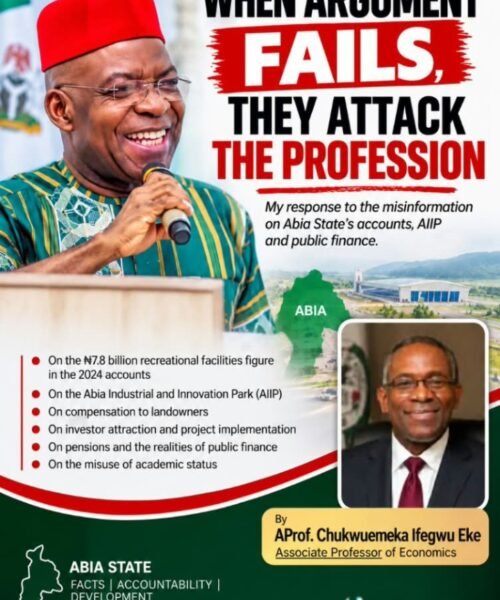

OBINNA ORIAKU: BETWEEN POLITICAL EXAGGERATION, SELECTIVE MEMORY AND THE REALITIES OF A CHANGING ABIA
19 October 2026
Obinna Oriaku, I have carefully read your series of messages, and I must confess that I am more concerned about the intellectual contradictions in your submissions than the political anger that appears to have inspired them.
I have always believed that criticism is an indispensable ingredient of democracy. I do not expect Governor Alex Otti to be beyond criticism, and I certainly do not believe that every road in Abia has been reconstructed, every hospital rehabilitated or every economic difficulty eliminated.
But I draw a clear distinction between constructive criticism and the deliberate assembly of half-truths, unverified allegations, emotional anecdotes and politically convenient conclusions.
My difficulty with your argument is that you have attempted to convert isolated experiences into statewide evidence, budgetary provisions into allegations of missing money, and unresolved infrastructure challenges into proof that nothing has been achieved.
I cannot accept that methodology.
- ON YOUR INVITATION TO LEAVE ABUJA AND EXPERIENCE ABIA
You began by suggesting that anyone writing from Abuja is intellectually disqualified from discussing developments in Abia.
I find that argument particularly weak.
I do not need to sleep beside every construction site before I can examine a government’s performance. Neither must I reside permanently in Aba to evaluate public expenditure, investment decisions, road contracts and economic policy.
I can visit, observe, compare, interrogate official records and draw conclusions.
More importantly, I refuse to substitute personal anecdotes for systematic evidence.
You narrated an encounter with young men at a filling station who allegedly preferred travelling through Umuahia rather than using the Umuikaa–Owerrinta route.
I accept that poor roads create real hardship. But I reject the suggestion that this encounter establishes the failure of the entire Abia infrastructure programme.
I would rather ask who owns the road, when it deteriorated, which government bears responsibility, whether rehabilitation has been approved and what the implementation timetable provides.
That is how I understand serious public policy analysis.
- ON ROAD INFRASTRUCTURE AND YOUR ATTEMPT TO ERASE VISIBLE ACHIEVEMENTS
You mentioned Faulks Road, Osusu, Ngwa Road, Eziukwu, Milverton and Port Harcourt Road as though listing roads with unresolved problems automatically cancels every completed project.
I disagree.
The reconstruction of Port Harcourt Road in Aba is not imaginary. Julius Berger executed the project, and the construction company itself publicly acknowledged the completed commercial corridor.
On 9 July 2025, The Guardian reported that traders and residents were already returning to the area following the reconstruction.
On 3 October 2025, the Abia State Government reported the commissioning of Port Harcourt Road and seven other road projects in Aba.
I cannot reconcile these documented developments with your sweeping suggestion that the administration has practically achieved nothing in road infrastructure.
I will not pretend that every Aba road is good. Equally, I will not pretend that reconstructed roads do not exist simply because acknowledging them would weaken an opposition narrative.
Sources:
- “The Guardian, 9 July 2025” (https://guardian.ng/news/nigeria/metro/new-lease-of-life-for-abias-port-harcourt-road-as-traders-residents-return/)
- “Abia Government, 3 October 2025” (https://www.alexotti.com/president-tinubu-commends-gov-otti-as-he-commissions-6-7km-other-7-road-projects-in-aba/)
- ON CIVIL SERVANTS, PENSIONERS AND YOUR SALARY FIGURES
You claimed that civil servants are receiving ₦23,000 and ₦40,000 monthly and that pensioners receive amounts suggesting a complete breakdown of the payment system.
My response is straightforward: I want the payroll evidence.
I am aware that individual net salary payments can differ because of deductions, grade levels, employment classifications or other payroll circumstances. Therefore, I cannot conclude from an isolated figure that the statutory minimum wage is being universally disregarded.
On 24 September 2024, the Federal Ministry of Information reported the Abia Government’s decision to commence implementation of the new minimum wage from October 2024.
I recognise that announcing a policy is not the same as proving that every worker has received the correct amount. That is why I invite you to provide verifiable salary records, employment grades and payment periods.
If workers or pensioners are genuinely being shortchanged, I will support corrective action.
But I will not condemn an entire payroll system based on figures presented without sufficient documentation.
Source:
- “Federal Ministry of Information, 24 September 2024” (https://fmino.gov.ng/abia-government-to-commence-payment-of-minimum-wage-by-october-sets-to-fix-court-halls-flags-off-programmes/)
- ON HEALTHCARE AND YOUR CLAIM THAT OTTI IS CELEBRATING HIS PREDECESSORS’ PROJECTS
I consider your treatment of the healthcare sector particularly misleading.
You argued that the primary healthcare centres being celebrated were built by previous administrations.
But who said that every facility was constructed for the first time under Governor Otti?
I understand the distinction between constructing a new healthcare facility and rehabilitating, equipping and making an existing facility functional.
On 20 January 2025, the government formally launched Project Ekwueme, designed to rehabilitate and retrofit 200 primary healthcare centres across Abia’s 184 wards.
On 21 January 2025, Premium Times reported the programme’s estimated cost of ₦10.78 billion.
On 4 March 2026, Punch, in a report by Sunday Nwakanma, documented another phase of the functionalisation programme.
I also observe that the government commissioned the rehabilitated Umuihie Cottage Hospital and commenced reconstruction of the historic 100-bed Okpuala Ngwa General Hospital in May 2026.
I therefore find it difficult to accept your claim that virtually nothing has happened in the health sector.
A government does not have to demolish an old hospital and build another one before its investment qualifies as development.
Sources:
- “Premium Times, 21 January 2025” (https://www.premiumtimesng.com/news/more-news/768392-gov-otti-launches-remodellig-of-200-phcs-in-abia.html)
- “Punch, 4 March 2026” (https://punchng.com/otti-begins-upgrade-of-primary-health-centres-in-abia/)
- “Abia Government, 25 May 2026” (https://abiastate.gov.ng/gov-otti-performs-ground-breaking-ceremony-of-okpuala-ngwa-general-hospital-commissions-roads-cottage-hospital/)
- ON UNEMPLOYMENT: THE NBS FIGURES YOU HAVE MISAPPLIED
Obinna, this is where I find your argument most revealing.
You declared Abia the unemployment capital of Nigeria and attributed the situation to Governor Otti.
I have examined the National Bureau of Statistics report, and I acknowledge that Abia recorded the highest state unemployment rate of 18.7% in the 2023 annual survey.
That figure is real. I will not manufacture alternative statistics.
However, the survey covered October 2022 to September 2023, while Governor Otti assumed office on 29 May 2023.
Consequently, most of the reference period preceded the present administration.
I find it intellectually indefensible to present a predominantly inherited economic condition as though it originated entirely under Governor Otti.
The report also estimated approximately 1.25 million self-employed people in Abia. That tells me that the employment challenge must be analysed alongside the state’s substantial informal and entrepreneurial economy.
I would prefer to compare the 2023 baseline with a properly comparable, more recent state-level unemployment estimate before pronouncing judgment on the present administration’s employment record.
I recognise that the government must create an enabling environment for additional jobs. What I reject is the manipulation of the timing of statistical evidence to manufacture political guilt.
Source:
- “National Bureau of Statistics, 2023 Annual Labour Force Survey” (https://nigerianstat.gov.ng/download/1241561)
- ON ELECTRIC BUSES AND THE CLAIM THAT THEY HAVE ADDED NOTHING
I cannot understand why the introduction of modern public transportation should be condemned simply because operational improvements remain necessary.
On 22 December 2025, Dr Ngozi Okonjo-Iweala commissioned the initial 20 electric buses introduced by the Otti administration.
On 7 August 2026, Channels Television, in a report by Henry Adedeji, documented the introduction of another 20 electric buses.
That is a verifiable expansion of public transport infrastructure.
More importantly, the reported fare structure under the Green Shuttle Service includes ₦150 for designated intra-city trips, ₦800 for Aba–Umuahia and ₦1,000 for Umuahia–Ohafia.
The first access card was reportedly made available free of charge, although registration requirements and card distribution may create practical difficulties for some users.
I am prepared to acknowledge those difficulties.
But I cannot accept your proposition that introducing buses, terminals and a structured transport payment system constitutes no meaningful contribution to people’s welfare.
If commercial drivers are losing patronage, I would want to examine the employment consequences and possible transition arrangements. I would not automatically conclude that affordable public transportation should be abandoned to protect an existing transport monopoly.
Sources:
- “Channels Television, 7 August 2026” (https://www.channelstv.com/2026/08/07/otti-unveils-20-more-electric-buses-to-boost-public-transportation/)
- “The Telegraph, 2 March 2026” (https://telegraph.ng/news/2026/03/02/abia-state-commences-cashless-payment-for-green-shuttle-buses/)
- ON YOUR ₦800 BILLION CAPITAL EXPENDITURE ALLEGATION
I find your reference to ₦800 billion particularly troubling because it reveals a fundamental confusion between budgetary allocation and actual expenditure.
On 25 November 2025, Governor Otti presented a proposed 2026 budget of approximately ₦1.016 trillion, with ₦811.8 billion allocated to capital expenditure.
That figure represented a proposed spending envelope, not automatic proof that ₦811.8 billion had already been withdrawn, paid to contractors or lost.
I distinguish between appropriation, cash releases, contract commitments, actual payments and verified project completion.
As an economist, I consider that distinction elementary.
If you allege that ₦800 billion disappeared, I expect you to identify the financial year, specific budget lines, actual releases, expenditure records and the amount allegedly unaccounted for.
I support independent scrutiny of government expenditure. I also recognise that an approved capital budget must be tested against audited accounts and physical project delivery.
But I refuse to accept that a budget heading is itself evidence of diversion.
Source:
- “Abia State 2026 Budget Presentation, 25 November 2025” (https://abiastate.gov.ng/acceleration-and-new-possibilities/)
- ON THE ENYIMBA ECONOMIC CITY AND YOUR ₦8 BILLION COMPENSATION STORY
You repeatedly alleged that ₦8 billion was associated with compensation and that affected communities received only ₦900 million.
I regard that as a serious allegation requiring equally serious documentation.
I want to see the approved compensation schedule, land valuation records, identities of beneficiaries, authorised disbursement records and the actual sums received.
I will not dismiss legitimate complaints from affected landowners. Neither will I endorse an allegation of padding or diversion without supporting records.
On the Enyimba Economic City, I believe every investment approval, equity arrangement, land title and revocation decision should withstand legal and economic scrutiny.
But I also insist that the existence of an earlier approval does not automatically settle all subsequent questions about performance obligations, land rights or regulatory compliance.
If the state acted unlawfully, I will support appropriate legal remedies. If the project promoters failed to meet enforceable obligations, I will expect those failures to be examined as well.
I cannot substitute your political interpretation for a documented examination of the transaction.
- ON ZERO INVESTMENT, ZERO INDUSTRIES AND ZERO JOB CREATION
I find your repeated use of the word zero economically careless.
Foreign direct investment, domestic private investment, factory expansion, public-sector recruitment and self-employment are not interchangeable measures.
I cannot infer zero investment merely because a particular factory has not been named in your message.
Equally, I will not claim that investment agreements, project announcements or hotel openings automatically constitute completed industrial capacity.
I would rather examine the Nigerian Investment Promotion Commission’s records, capital importation data, operational enterprise registers, commissioned production facilities and verified employment numbers.
I also recognise that the development of Aba depends not merely on attracting factories but on rebuilding the infrastructure that determines whether existing businesses can survive and expand.
Power availability, road accessibility, drainage, urban security and transport costs all affect productivity.
To dismiss improvements in these areas because they do not immediately appear as a newly commissioned factory is to misunderstand how industrial ecosystems develop.
I am not asking anyone to celebrate a promise as an achievement. I am insisting that we measure economic progress using appropriate indicators.
- ON ABA POWER, THE MODULAR REFINERY AND THE ROLE OF GOVERNMENT
You argued that Aba Power should be associated with Governor Otti while the expansion of refining capacity elsewhere should be attributed to private-sector initiative and an enabling environment.
I see a contradiction in that reasoning.
I do not attribute every private investment in Abia to the Governor. I recognise the capital, entrepreneurial risk, engineering expertise and long-term commitments of private investors.
But I also recognise that public policy, regulatory coordination, infrastructure and investor confidence can influence commercial outcomes.
The same analytical principle should apply in Abia and Imo.
I cannot praise an enabling environment in one state and dismiss its potential contribution in another simply because the political personalities differ.
My interest is not in allocating partisan trophies. My interest is in understanding the institutions and economic conditions that sustain investment.
- ON LOCAL GOVERNMENT CHAIRMEN AND ALLEGED LOANS
Your claim that local government chairmen and their deputies have unusual access to bank loans is another allegation that requires evidence.
A bank loan is not automatically evidence that local government resources have been mortgaged.
I would want to know whether the loans are personal, institutional or government-guaranteed; whether public funds are pledged as security; and whether any borrowing violates applicable financial regulations.
If local government allocations have been unlawfully encumbered, I would expect documentary evidence and appropriate investigation.
But I cannot jump from the existence of a lending arrangement to the conclusion that Abia has been mortgaged.
That would be speculation rather than financial analysis.
- ON FAULKS ROAD, MY PROPERTY AND YOUR ATTEMPT TO PERSONALISE THE DEBATE
You introduced questions concerning my property, its sale, its historical value and the relationship between property transactions and road rehabilitation.
I do not consider that a serious response to the economic questions before us.
Whether I bought, retained or disposed of property at a particular time does not establish the quality of Governor Otti’s infrastructure programme.
Property prices are influenced by accessibility, inflation, business activity, exchange rates, neighbourhood development and individual circumstances.
I therefore decline to convert a discussion about Abia’s economic development into an argument about my private property decisions.
If you want to debate the economic value of road reconstruction, I am willing to examine changes in land values, commercial occupancy, transport costs and business turnover.
Those are measurable economic questions.
- ON UKWA NGWA AND YOUR PREDICTION OF ELECTORAL REJECTION
You confidently asserted that nine local government areas in Ukwa Ngwa will not vote for Governor Otti.
I find that an extraordinary conclusion to draw without presenting a credible survey, constituency-level electoral model or representative evidence.
I do not believe any politician possesses automatic ownership of an ethnic constituency.
I regard Ukwa Ngwa voters as independent citizens capable of evaluating political performance for themselves.
I will not predict the outcome of an election on the strength of roadside conversations or political anger.
The electorate will make its decision when the time comes, and I believe that decision should be respected.
- ON YOUR REPEATED REFERENCE TO HOPE UZODINMA
I have no interest in diminishing Governor Hope Uzodimma’s achievements in Imo State.
I believe that development in Imo and development in Abia are complementary rather than mutually exclusive.
If an investment in Imo expands production, creates jobs and stimulates regional supply chains, I welcome it.
Likewise, I welcome any genuine investment that strengthens Abia’s economy.
I do not understand why admiration for one governor must depend on manufacturing hostility towards another.
I can evaluate the two administrations against the same criteria without turning economic analysis into political warfare.
MY CONCLUSION: I REFUSE TO CONFUSE POLITICAL NOISE WITH ECONOMIC EVIDENCE
Obinna, I believe your submissions contain genuine subjects deserving public scrutiny. Bad roads, unpaid entitlements, unemployment, flood damage, investment disputes and government expenditure should never be dismissed.
But I also believe you weaken those concerns when you mix them with exaggerated conclusions, unsupported financial allegations and selective interpretations of documented events.
I recognise Governor Alex Otti’s administration as a government undertaking substantial infrastructure and institutional interventions. I do not regard those interventions as proof of perfection, and I will continue to insist on transparency, implementation discipline and measurable outcomes.
I do not need to invent achievements to defend the administration. Neither will I erase verifiable achievements to accommodate an opposition narrative.
I find it particularly revealing that some of the figures you deploy against Governor Otti relate to conditions substantially inherited by his government, while some of the projects you dismiss are identifiable, documented and publicly reported.
My position remains that political criticism must survive the test of evidence.
I will judge Governor Otti by what he inherited, what he has changed, what remains undone and what can be independently verified. I will not judge him by the volume of anger in a WhatsApp message.
I do not consider every uncompleted project a scandal. I do not consider every budget allocation a stolen fund. I do not regard every political prediction as a scientific forecast.
I understand the difference between a government that has finished its work and a government whose work is still in progress.
And I refuse to allow political impatience to destroy that distinction.
Obinna, you concluded by warning that the next election would not be a walk in the park.
I agree that no election should be taken for granted.
But I also believe that an election will not be won merely by repeating accusations without establishing their factual foundations.
I stand for accountable governance, verifiable development and a fair assessment of the Otti administration. I will defend what has been achieved, question what remains unresolved and reject allegations that outrun their evidence.
That, for me, is the difference between economic reasoning and political theatre.
Dr Chukwuemeka Ifegwu Eke