

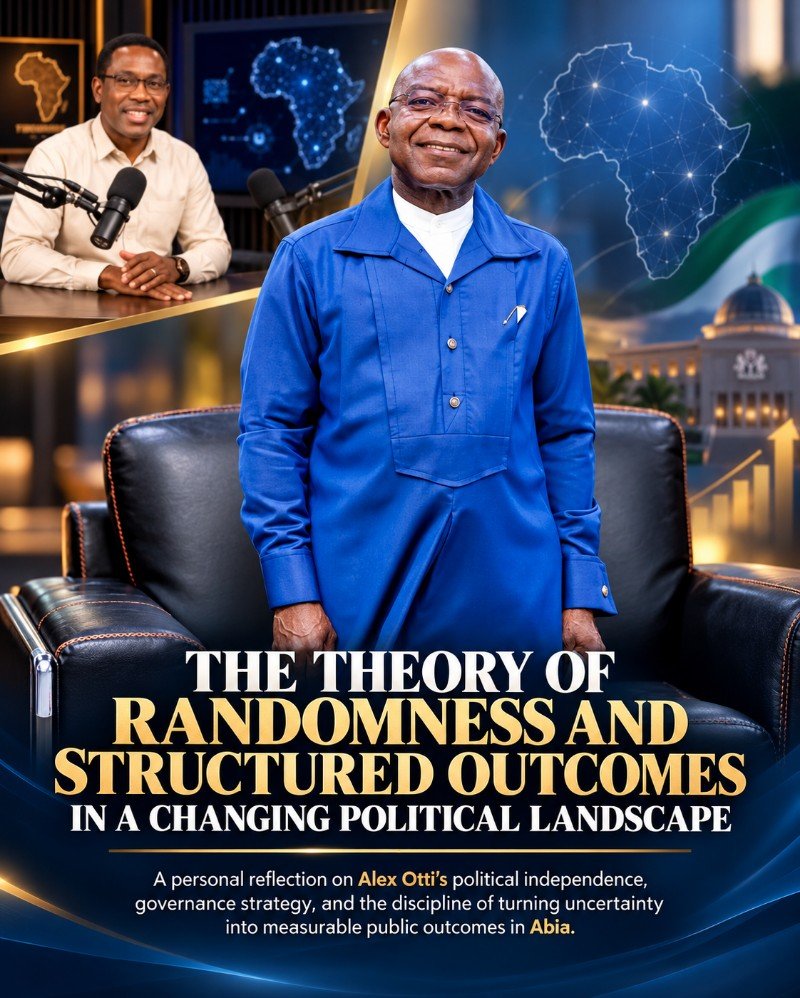
THE THEORY OF RANDOMNESS AND STRUCTURED OUTCOMES IN A CHANGING POLITICAL LANDSCAPE
Alex Otti, Political Independence and the Economics of Deliberate Governance
A Political and Economic Commentary | October 19, 2026
I have followed the unfolding political developments in Nigeria with considerable interest, particularly the changing relationships among political parties, their leading personalities and the governors who must navigate these uncertainties while fulfilling their responsibilities to the electorate.
My observations have increasingly drawn me to a fundamental distinction between what I call the theory of randomness and the discipline of structured outcomes.
In my understanding, randomness represents the unpredictable movements of political actors, the sudden alteration of alliances, the uncertainties of electoral calculations and the frequent contradictions between political expectations and actual behaviour.
Structured outcomes, on the other hand, represent the deliberate application of leadership, planning, institutional discipline and public resources towards identifiable development objectives.
I do not present this distinction as an established scientific law. Rather, I employ it as an analytical framework for examining political conduct and governmental performance.
One may not control the direction of every political event, but one can decide how to respond to events and what results to pursue.
It is within this framework that I find the leadership and political positioning of Abia State Governor, Dr Alex Chioma Otti, particularly interesting.
Political Independence in an Unpredictable Environment
One of the most striking developments in contemporary Nigerian politics is the increasing uncertainty surrounding party loyalty and political alignment.
The movement of politicians between parties, the emergence of new coalitions and the struggle for relevance ahead of the 2027 general elections have produced a political environment in which yesterday’s assumptions may become tomorrow’s contradictions.
I find Governor Otti’s political positioning particularly instructive.
The editorial commentary highlighted in The Sun Nigeria presents Otti as an independent political personality who maintains a professional relationship with President Bola Ahmed Tinubu without surrendering his political identity. It equally describes a relationship with Peter Obi that does not appear to translate into automatic political subordination.
What interests me is the distinction between cooperation and dependence.
I have always believed that a governor’s relationship with the Federal Government should be determined substantially by the legitimate interests of the state he governs, rather than by the demands of political flattery.
Similarly, I do not consider political friendship sufficient justification for surrendering independent judgment.
The changing opposition landscape reinforces this observation.
In its October 11, 2026 report, THISDAY, through Sunday Aborisade, examined developments within the Nigeria Democratic Congress and the proposed Obi–Kwankwaso presidential ticket. The report reflected the continuing struggle of opposition parties to establish organisational stability ahead of 2027.
Earlier, THISDAY had published Leonard Onotakevwe’s September 27, 2026 analysis of the internal tensions within the NDC, particularly the questions of authority, party organisation and the influence of competing political movements.
My interpretation is straightforward: when political platforms are constantly being reconfigured, the capacity to maintain a consistent governmental agenda becomes an important measure of leadership.
The screenshot of a separate THISDAY commentary describes Otti as an unusual figure within the opposition, particularly for maintaining his Labour Party affiliation amid wider realignments. While I could not independently establish the publication date and authorship of that particular column, the political question it raises is legitimate.
Must effective leadership always follow the direction of the dominant political crowd?
I do not think so.
In my assessment, political independence becomes meaningful when it is matched by administrative competence and outcomes that citizens can examine.
Education: Building Human Capital Instead of Political Excitement
On October 18, 2026, Vanguard, in a report written by Steve Oko and titled “Otti raises scholarship award to ₦350,000, rewards six first-class graduates,” reported that Governor Otti increased the annual Alex Otti Foundation scholarship from ₦250,000 to ₦350,000.
The announcement was made at the Foundation’s 2026 Scholarship Banquet at the Michael Okpara Auditorium, Umuahia.
Six first-class graduates also received ₦500,000 each, while 81 new scholars were inducted into the programme. The report further explained that the increased scholarship award would extend to existing beneficiaries who were still studying.
Otti maintained that beneficiaries were selected on merit rather than political affiliation or family connections.
“Read Vanguard’s report” (https://www.vanguardngr.com/2026/10/otti-raises-scholarship-award-to-%E2%82%A6350000-rewards-six-first-class-graduates/amp/)
I find two important economic principles in this development.
First, investment in education is an investment in the future productive capacity of society.
Second, merit-based educational assistance can improve opportunities for individuals whose economic circumstances might otherwise restrict their academic potential.
I am particularly interested in the decision to extend the revised scholarship amount to existing beneficiaries. It recognises that inflation and changing economic conditions affect those already enrolled in programmes, not merely new entrants.
However, I must also distinguish the Alex Otti Foundation from the formal expenditure of the Abia State Government. The Foundation’s scholarship programme is a philanthropic intervention and should not automatically be presented as a state-budgetary achievement.
Nevertheless, I regard its commitment to education as consistent with the broader human-capital-development philosophy associated with Otti’s leadership.
Digital Skills and the Economics of the Future
The development of human capital is no longer restricted to conventional education.
In a report published on October 16, 2026, Godfrey Ofurum of BusinessDay disclosed the approval of an expansion of the ThriveAbia Digital Capacity Development and Mentorship Programme to accommodate 1,000 young people.
This followed a pilot involving 100 participants. The expansion approval was given on October 13, during a meeting between Governor Otti and the programme’s technical partners.
“Read BusinessDay’s report” (https://businessday.ng/news/article/1000-abia-youths-to-participate-in-digital-capacity-development-programme/)
I consider this important because the global economy is increasingly rewarding technological competence, digital entrepreneurship and specialised knowledge.
For a state with Abia’s history of commerce, craftsmanship and entrepreneurial activity, I see substantial opportunities in connecting traditional enterprise with emerging digital markets.
My expectation is that participants should eventually demonstrate measurable gains in employment, entrepreneurship, earnings and business development.
Training 1,000 people is a valuable target. My greater interest is in how many subsequently acquire sustainable economic opportunities.
That, to me, is the difference between announcing a programme and producing a structured outcome.
Teachers and the Foundations of Sustainable Development
Another development I consider significant occurred during the 2026 World Teachers’ Day celebration.
In its editorial of October 12, 2026, titled “Beyond Gov. Otti’s N1bn gift to teachers,” Vanguard examined the governor’s announcement on October 5 of a ₦1 billion Teachers’ Appreciation Fund.
The editorial also discussed outstanding teachers’ entitlements, delayed promotions and the broader importance of recognising teachers within the development process.
“Read Vanguard’s editorial” (https://www.vanguardngr.com/2026/10/beyond-gov-ottis-n1bn-gift-to-teachers/amp/?noamp=mobile)
The screenshots additionally refer to the proposed reinstatement of disengaged teachers below the age of 65, although I have not independently verified the precise terms of that directive.
From my perspective, the economic significance of teacher welfare extends beyond the immediate beneficiaries.
Teachers influence learning outcomes, workforce productivity and the quality of the next generation of professionals.
I would therefore measure the success of these interventions not merely by the size of the appreciation fund, but also by whether outstanding obligations are settled, recruitment and retention improve, and classroom performance advances.
Money becomes transformative when it produces lasting institutional improvement.