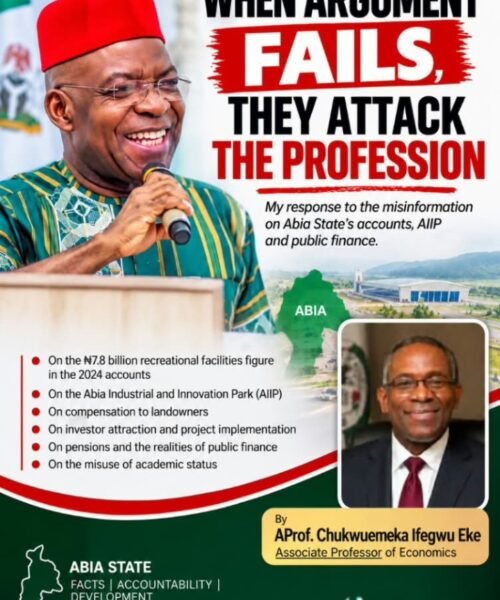



Oracle’s latest intervention, circulated under the title “The Much Touted ‘24 Years of PDP’: Otti Was Part of 18 of Those 24 Years!”, contains legitimate questions about workers’ welfare and university remuneration. But several of its central conclusions collapse once history, public finance and measurable outputs are separated from political rhetoric.
The first problem is historical. Alex Otti was a banker, not a member of the Abia State Executive Council, House of Assembly or PDP government. His documented career shows that he worked in Nigerian International Bank, Intercontinental Merchant Bank, Société Bancaire Nigeria, UBA and First Bank before becoming Group Managing Director of Diamond Bank only in 2011. He retired from Diamond Bank in October 2014 to enter partisan politics. To argue that a commercial banker whose institution handled government business thereby became politically responsible for the decisions of the government is a category error. A bank providing services to a government is not the government. By that reasoning, every bank executive whose institution holds a government account becomes jointly responsible for the governor’s policies.
Even the slogan “24 years of PDP” requires historical qualification. Theodore Orji was elected governor in 2007 on the Progressive Peoples Alliance platform before later returning to the PDP. Thus, although the political establishment displayed considerable continuity, it is not literally accurate to describe every day from 1999 to 2023 as uninterrupted PDP government. Otti, more importantly, openly challenged that establishment electorally in 2015 and subsequently remained an opposition figure before eventually defeating the PDP in 2023.
Oracle is correct that post-subsidy-removal states receive substantially higher nominal revenues. But higher revenue must be assessed alongside inflation, construction costs, wage adjustments and the scale of capital investment. The relevant question is not merely, “How much entered?” It is also, “What was built, what liabilities were inherited and what proportion was converted into public assets?” Abia’s own 2025 budget, for example, projected ₦750 billion in expenditure, with 20 per cent earmarked for education and 15 per cent for health, while the administration stated that it had not borrowed to finance recurrent expenditure.
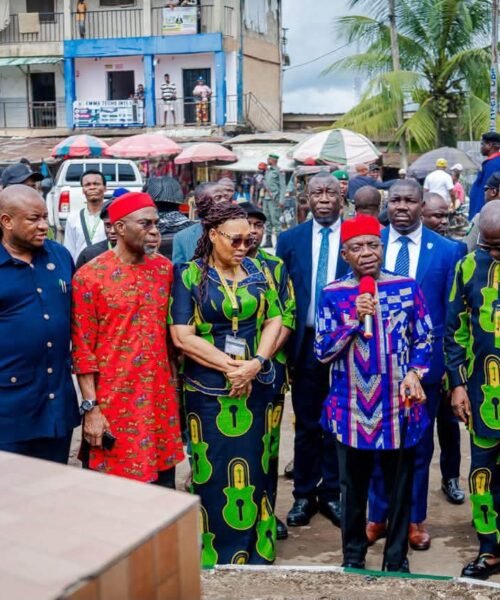
The claim that Otti’s record consists essentially of “Government House decorations and a few roads” is contradicted by the available infrastructure record. By May 2026, Otti reported 414 road projects covering roughly 864 kilometres, while another 82 projects covering more than 200 kilometres were approaching completion. Independent newspapers reported the same anniversary figures, including Port Harcourt Road, Ohanku Road, Aguiyi Ironsi Boulevard, Omenuko Bridge and sections of the Umuahia–Uzuakoli–Abiriba–Ohafia corridor. Even if one wishes to audit every kilometre individually, describing this record as “a few roads” is plainly inconsistent with the published project inventory.
Port Harcourt Road itself also requires context. Oracle reduces the project to 5.7 kilometres and divides the headline contract sum by that figure. But the project was publicly described from inception as approximately 6.8 kilometres, comprising the 5.7-kilometre main corridor plus another 1.1-kilometre section, with major drainage and reconstruction works on a corridor that had suffered severe flooding and commercial collapse for years. It was executed by Julius Berger, and when the reconstructed corridor was commissioned, the Federal Minister of Works, David Umahi, representing President Tinubu, publicly commended the transformation. Comparing such a full reconstruction, drainage and associated works with the simple cost of laying asphalt elsewhere is not a serious like-for-like engineering comparison.
The assertion that no serious investor has established physical presence in Abia is also demonstrably outdated. In March 2026, a $35 million industrial production facility was commissioned at the Osisioma Industrial Layout in Aba, with reports describing it as part of a broader investment programme. The government also recovered Star Paper Mill from AMCON as part of an attempt to return the long-moribund industrial asset to productive private-sector operation. The stated objective is not for government permanently to operate the mill but to de-risk and revive it before bringing in private management. These are physical industrial developments, not photographs of unsigned promises.
The Enyimba Economic City claim is similarly overstated. Otti has not recently declared opposition to the concept. In August 2026, he told the reconstituted company board that he was not against Enyimba Economic City, while insisting that disputed processes surrounding land, ownership and implementation must be properly regularised and transparent. One may disagree with his handling of the project, but saying he simply destroyed a 5,000-job project removes the legal and governance dispute that actually surrounds it.
On workers’ welfare, Oracle touches a genuine area in which government should continually be challenged. Salaries must be competitive and arrears must be resolved. But the claim that Otti simply presides over the lowest-paid workers while doing nothing is incomplete. In February 2025, organised labour and the state government reached an agreement correcting the implementation of the new minimum wage across levels 1–17. Further adjustments for teachers and State Education Management Board staff were approved in February 2026 after anomalies were identified. That does not mean every salary complaint has disappeared; it means the assertion of complete governmental indifference is factually unsustainable.
The pension history is even more revealing. Otti inherited a system in which arrears had accumulated for years. In 2024, pensioners themselves confirmed receiving substantial arrears payments, with individual beneficiaries reporting payments running into more than ₦1 million in some cases. In March 2026, Otti additionally approved payment of ten years of pension arrears owed surviving Abia ADP retirees for the period 2000–2010. Those dates are important: debts accumulated between 2000 and 2010 cannot historically have been created by a governor who assumed office in 2023.
There has indeed been controversy over the settlement arrangement under which some pension arrears were treated, and government later agreed to revisit the disputed forfeiture arrangement. That controversy should be debated honestly. But it is equally dishonest to erase the billions already directed toward inherited salary and pension liabilities. By May 2025, Otti said more than ₦40 billion had been expended on inherited salary and pension arrears.
The same principle must guide the ABSU debate. Concerns about professors earning below comparable institutions, outstanding allowances and implementation of salary structures deserve answers. Professor Nnamdi Nwaeze’s suspension may also legitimately be questioned on academic-freedom and proportionality grounds. But that does not establish that every outstanding ABSU liability originated under Otti, nor does it prove that Otti personally directed the suspension. Those are separate propositions requiring separate evidence.
Oracle also asks why Otti celebrates teacher recruitment after previously arguing that government should not be the dominant employer of labour. There is no contradiction. Economic theory distinguishes between an unnecessarily bloated bureaucracy and government employing teachers, doctors, nurses and other personnel required to provide public goods. By Otti’s third anniversary, the administration reported 5,394 teachers recruited, with thousands more planned because of increasing enrolment. Supporting private-sector-led employment does not mean abandoning public education.
Finally, the suggestion that essentially nothing commensurate with revenue has happened ignores the emerging fiscal and physical picture. Abia’s government reports hundreds of road interventions, a major renewal of Aba, increased education and health allocations, recruitment of teachers and health workers, inherited arrears payments, revival efforts for abandoned industries, a new industrial facility, and an airport project receiving federal support. Aviation Minister Festus Keyamo confirmed in June 2026 that the Federal Government had backed Otti’s push to upgrade the originally proposed airstrip into a full airport project.
None of these facts means Alex Otti should be insulated from scrutiny. ABSU salaries should be interrogated. Civil-service remuneration should be benchmarked against comparable states. Pension agreements should remain transparent. Contracts should withstand value-for-money audits. Revenue figures should be published and reconciled.
But accountability works both ways.
If Oracle demands facts from Otti, Oracle must also submit his own claims to facts.
A banker is not automatically a member of a government merely because his bank did business with that government. A ten-year-old pension debt cannot be rewritten as an Otti-created liability. Four hundred-plus reported road interventions cannot reasonably be reduced to “a few roads.” A commissioned $35 million factory cannot simultaneously be described as no investor having physical presence. And a reconstructed 6.8-kilometre urban commercial corridor with major drainage cannot honestly be analysed simply by dividing a headline contract figure by 5.7 and pretending every kilometre of road construction is technically identical.
The proper verdict is therefore not that Otti is beyond criticism.
It is that criticism becomes more credible when history is remembered, inherited liabilities are separated from newly created ones, engineering projects are compared like-for-like, and measurable outputs are allowed to speak alongside revenue figures.
That is the standard Oracle is demanding from Governor Otti.
It is also the standard Oracle’s own article must meet.