
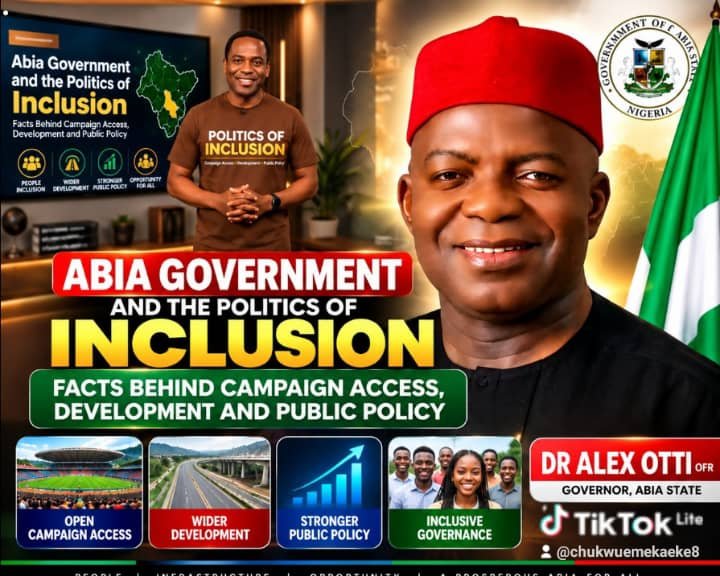
ABIA GOVERNMENT AND THE POLITICS OF INCLUSION: FACTS BEHIND CAMPAIGN ACCESS, DEVELOPMENT AND PUBLIC POLICY
By AProf Chukwuemeka Ifegwu Eke
September 29, 2026
Recent political commentary around Abia State has brought three issues into sharp focus: access to campaign venues, allegations of uneven development, and the broader philosophy guiding public policy under Governor Alex Otti. These questions deserve to be examined against what the government has actually said and what established newspapers have reported.
The most immediate issue concerns the political environment ahead of the 2027 elections.
On September 27, 2026, THISDAY, in a report by Boniface Okoro titled “Otti to Political Parties: Pay Approved Fees, Get Access to Venues, Security for Your Campaigns,” reported that Governor Otti had directed that all political parties should pay approved fees and thereafter be granted unhindered access to public venues, including stadiums, for their campaigns.
THISDAY further reported that the governor directed security agencies to promptly grant requests from political parties seeking to campaign and to ensure a level playing field for all. 0
This is important because much of the current political debate has centred on whether opposition parties will be given sufficient room to operate in Abia as the 2027 election season gathers momentum.
The government’s position, as reported by the newspapers, is relatively clear: political competition should not be obstructed simply because the actors involved belong to opposition parties.
The Sun Nigeria, in a report by Okey Sampson published on September 27, 2026, similarly reported that Governor Otti had tasked security agencies with ensuring a level playing field for all political parties to lawfully conduct their political activities and campaigns.
According to the report, Abia State Commissioner of Police, CP Wilfred Olutokunbo Afolabi, said the governor had expressly directed that any political party applying for approval to hold campaigns should be granted approval. 1
Independent Newspaper also reported the same position on September 26, 2026.
In the report written by Uche Nwosu, the governor was said to have assured political parties of a level playing field and directed that lawful political activities should take place without harassment or intimidation.
Independent quoted the Commissioner of Police as explaining that the governor wanted security agencies to create a “level playing field for all.” 2
The significance of these reports should not be overlooked.
A government genuinely committed to political inclusion must be willing to tolerate competition, criticism and alternative political choices. Inclusion cannot mean giving access only to supporters of the government while creating administrative barriers for everyone else.
The position publicly attributed to the Otti administration is that every political party willing to operate within established rules should be allowed to campaign.
Retired Navy Commander MacDonald Ubah, Special Adviser to the Governor on Security, was also reported as saying that political parties should not be impeded from campaigning as long as they satisfy the approved requirements for the use of stadiums or other public facilities. 3
That distinction is important.
The existence of administrative charges or requirements is not automatically equivalent to political exclusion. The appropriate questions are whether such requirements are lawful, whether they are transparently communicated, and whether they are applied consistently to every political party.
Where any party disputes a charge or regulation, Nigeria’s legal and institutional processes remain available for determining that dispute.
What should not happen is for political disagreement to become a reason for denying lawful access to campaign facilities or security protection.
GOVERNANCE BEYOND CLAN AND POLITICAL AFFILIATION
The second major issue concerns development and the allegation that particular communities or local government areas may be receiving insufficient attention.
On September 28, 2026, The Sun Nigeria published a report by Okey Sampson titled “Era of clannish politics in Abia over – Otti.”
The report arose from an online publication alleging that the administration had not done enough for Isiala Ngwa South Local Government Area, described in the report as Governor Otti’s adopted home.
Responding to the allegation, Ferdinand Ekeoma, Special Adviser to the Governor on Media and Publicity, argued that Otti’s philosophy of governance is broader than clan considerations.
Ekeoma’s position, as reported by The Sun, was that the governor is responsible for the whole of Abia State and that Isiala Ngwa South should not be treated as more important than other local government areas merely because of its connection to the governor. 4
That is a significant principle of public administration.
A governor is not elected as the development chairman of his village, clan or senatorial district.
He is elected to govern an entire state.
Good governance therefore requires public resources to be distributed according to identifiable needs, development priorities, infrastructure gaps and the broader interests of citizens.
This does not mean that every local government must receive exactly the same number of roads, schools, hospitals or public investments at exactly the same time.
Communities have different needs.
Urban centres may require transport infrastructure and drainage.
Rural communities may require access roads, healthcare facilities and agricultural infrastructure.
Commercial centres may require power, security and logistics investments.
What matters is whether government can demonstrate a rational and equitable basis for public expenditure.
The government’s response to the Isiala Ngwa South criticism is therefore important because it places the administration’s own philosophy on record.
The argument is essentially that development should not be reduced to clan arithmetic.
A governor should not be judged by how many projects are concentrated around his immediate community, but by whether development reaches citizens across the state and whether those interventions address genuine public needs.
The Sun reported that Ekeoma went further by listing projects which the administration said had either been completed or were ongoing in Isiala Ngwa South. 5
This is where public debate should increasingly be concentrated.
Instead of simply asking which clan received what, citizens should ask more measurable questions.
Which roads have been constructed?
Which schools have been renovated?
Which health facilities are functioning?
Which communities have received infrastructure?
What economic opportunities have been created?
What was promised?
What has been delivered?
Those questions allow both government and opposition to debate development on the basis of evidence.
INCLUSION MEANS ONE ABIA
One of the strongest ideas emerging from the government’s response is that Abia should increasingly be treated as one development space.
A project located in Aba may benefit traders and transporters from several local government areas.
A road in Umuahia may serve people travelling from different parts of the state.
Improved healthcare may serve patients beyond the community where a hospital is physically located.
Electricity, security, education and transport infrastructure frequently produce benefits that extend far beyond administrative boundaries.
For this reason, the geographical location of a project is only one element in assessing its value.
Its economic reach, social impact and number of beneficiaries are equally important.
This broader understanding of development is consistent with the government’s rejection of what it describes as clannish politics.
It does not remove the responsibility to ensure that no community is persistently neglected.
Rather, it creates a more useful standard: every area should have a reasonable opportunity to benefit from state resources, while projects should be located where they can achieve identifiable public objectives.
PUBLIC POLICY MUST NOT BE CONFUSED WITH PARTY POLITICS
A third issue concerns the relationship between public policy and partisan politics.
Abia State does not operate in isolation.
It is part of the Nigerian federation.
The state government must necessarily cooperate with the Federal Government and federal agencies on security, infrastructure, investment, fiscal matters and several other areas.
Such cooperation should not automatically be interpreted as surrendering political identity.
Governments controlled by different political parties routinely cooperate because citizens expect institutions to function irrespective of party differences.
At the same time, political parties remain free to disagree, organise and compete.
This is precisely why the reported directive on campaign access is important.
The Sun, THISDAY and Independent all reported that opposition parties should be allowed to conduct lawful campaigns and that security agencies had been asked to create a level playing field. 6
That position recognises a basic democratic principle.
Government belongs to everyone.
A political party may control the government, but public institutions do not become the private property of that political party.
Public facilities, security institutions and administrative structures must ultimately serve the public under established law.
THE GOVERNMENT’S POSITION
Taken together, the government’s publicly reported position can be summarised around a number of clear principles.
Political parties should be permitted to conduct lawful campaigns.
Security agencies should provide a level playing field.
Applications for campaign activities should be treated promptly.
Political parties that comply with approved requirements for public facilities should not be obstructed from using them.
Questions about charges, regulations or administrative decisions can be subjected to lawful challenge.
Development should be spread across the state according to public needs rather than political or clan loyalty.
No local government should automatically be treated as more important merely because of its relationship with the governor.
These are substantial commitments.
They are also commitments that can be measured.
As the 2027 political season develops, the most convincing evidence will not come from speeches alone.
It will come from what happens when opposition parties request venues.
Are approvals granted?
Are rallies protected?
Are regulations applied in the same manner to the governing party and opposition parties?
Are political actors able to campaign without intimidation?
Do public projects continue across communities irrespective of political affiliation?
These are the practical questions that will ultimately determine whether the principle of inclusion is being implemented.
THE TEST OF INCLUSIVE GOVERNANCE
The government’s position places an important responsibility on the administration itself.
Once a government declares that political parties will receive equal treatment, citizens are entitled to compare future administrative actions with that declaration.
The same applies to development.
Once government rejects clannish politics, citizens are entitled to examine the spread of projects and ask whether different communities are genuinely benefiting from public expenditure.
This is healthy for democracy.
It moves political argument away from rumours and personalities and towards measurable outcomes.
Inclusive governance should not mean the absence of disagreement.
It should mean that disagreement occurs within institutions that treat citizens fairly.
It should mean that an opposition party can criticise government today and still obtain lawful approval to hold its rally tomorrow.
It should mean that a community that voted against the governing party can still receive roads, schools, healthcare and other public services.
It should mean that public policy is driven primarily by need, value and development rather than political loyalty.
The reports published by THISDAY, The Sun Nigeria and Independent between September 26 and September 28, 2026 therefore provide an important statement of the Abia Government’s current position.
The administration says it wants a level playing field.
It says lawful campaigns should not be obstructed.
It says development should transcend clan considerations.
And it says the responsibility of government extends to the whole of Abia State. 7
Ultimately, these positions should be judged by implementation.
The politics of inclusion is not simply about accommodating political opponents.
It is about creating public institutions in which every citizen, every community and every lawful political organisation can expect fair treatment.
As Abia moves towards another election cycle, that should remain the central standard: equal political access, lawful competition, measurable development, institutional fairness and a public policy framework that recognises every part of Abia as belonging to one state and one common future.
That is the practical meaning of inclusion.
And that is the standard by which the government’s stated position should continue to be assessed.