
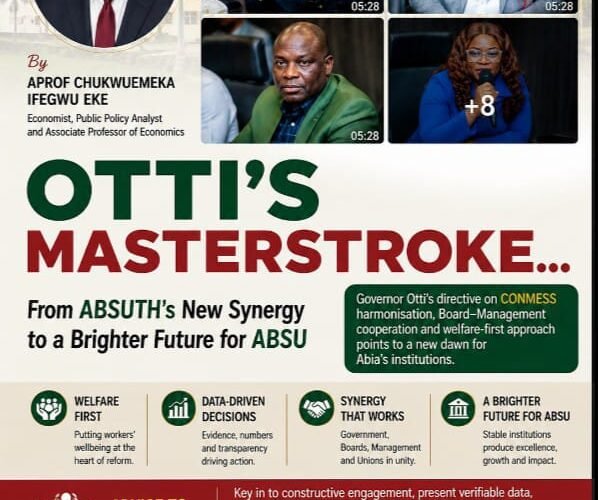

Otti’s Masterstroke: From ABSUTH’s New Synergy to a Brighter Future for ABSU
Why the Governor’s CONMESS Directive, Board–Management Cooperation and Welfare-First Approach Offer a New Template for Institutional Stability
By AProf Chukwuemeka Ifegwu Eke
Economist, Public Policy Analyst and Associate Professor of Economics
Governor Alex Otti’s meeting with the Board and Management of the Abia State University Teaching Hospital on August 20, 2026 may ultimately prove to be far more important than an ordinary presentation of a progress report. Beneath the statistics, requests and administrative exchanges was the emergence of something Abia’s public institutions have desperately needed for years: a functioning chain of communication connecting workers, institutional management, governing boards and the political leadership of the State.
For those of us who have written repeatedly on the challenges surrounding Abia State University, its academic unions, staff welfare, accumulated obligations and the wider question of institutional sustainability, the significance of the development should not be missed.
This is precisely the kind of engagement that can prevent tomorrow’s industrial crisis.
Governor Otti’s directive that the 2023 and 2025 Consolidated Medical Salary Structure, CONMESS, be harmonised for implementation at ABSUTH is particularly instructive. It demonstrates an important distinction between merely announcing concern for workers and constructing a financially sustainable mechanism for addressing their concerns.
The Governor did not dismiss the workers’ demands. Neither did he pretend that government finances were limitless. Rather, he requested the numbers, asked for the financial implications, identified the gap between an earlier approval and the subsequent federal adjustment, and directed the responsible officers to reconcile the figures and return with a workable proposal.
That is how sustainable public-sector wage administration should function.
His statement was particularly revealing. If an earlier salary structure had already been approved but was not implemented before another adjustment emerged, then government needed to establish precisely what the new liability was, determine its cost and identify where the money would come from.
There is economics behind that simple administrative instruction.
Public institutions do not survive on promises. They survive when commitments are backed by budgetary capacity, predictable revenue and credible implementation mechanisms.
The significance becomes clearer when this latest intervention is situated within the larger transformation of ABSUTH.
The Teaching Hospital that was once struggling with lost accreditations is rebuilding its professional standing. Previously concessioned facilities are being recovered and returned to institutional management. Recruitment is receiving attention. Promotion issues are being addressed. Power supply is being treated as an essential component of healthcare delivery rather than an afterthought. Government is working toward accommodating the Tesla MRI equipment donated to the hospital. Interns whose remuneration became contentious have received gubernatorial intervention.
Most importantly, according to the presentation made during the visit, ABSUTH has now operated for three years without a strike.
For an institution that had endured years of disruption, that statistic deserves attention.
A teaching hospital achieving reported full bed occupancy while its doctors attend to substantial patient volumes is not evidence that every problem has disappeared. It is evidence that institutional recovery has moved from the theoretical stage to the operational stage.
The Board itself captured the transition appropriately in describing ABSUTH as moving from “institutional rescue” to “operational consolidation.”
That expression should equally become the next philosophy for Abia State University.
The Larger ABSU Lesson
My previous interventions on the issues involving ABSU and ASUU have consistently maintained one central position: physical transformation and fiscal reform must ultimately translate into the welfare of the human beings who run public institutions.
Roads matter. Classrooms matter. Laboratories matter. Accreditation matters. Financial discipline matters.
But lecturers, doctors, nurses, researchers, administrators and other workers also matter.
A development programme becomes socially sustainable only when those who deliver public services can see the consequences of reform in salaries, promotions, pensions, research conditions and the general dignity of work.
At the same time, organised labour must recognise another equally important truth. Institutional sustainability cannot be secured by industrial confrontation alone.
There must be engagement.
The emerging ABSUTH model demonstrates what is possible where governing boards, management, workers and government are able to place verifiable data on the table.
The Board did not merely arrive before the Governor with a catalogue of complaints. It presented what was described as a detailed, data-driven progress report identifying achievements, outstanding problems and the financial consequences of the solutions being proposed.
That approach produced decisions.
This is where I believe ABSU-ASUU should pay particular attention.
ABSU-ASUU Should Key Into the Emerging Window
The current moment presents ABSU-ASUU with an opportunity that should not be squandered.
There are legitimate welfare questions within every university system. Where salary differentials, arrears, promotions, deductions, pensions, research conditions or other commitments remain unresolved, the union is entitled to raise them firmly.
But firmness and constructive engagement are not opposites.
The lesson from ABSUTH is that properly structured negotiation can move matters from accusation to arithmetic and from arithmetic to implementation.
ABSU-ASUU should therefore intensify structured engagement with the University Management, Governing Council and the Abia State Government, placing every outstanding welfare issue within a transparent and verifiable framework.
What exactly is outstanding?
What is the verified liability?
Which obligations belong to previous periods?
Which are recurrent?
What can be implemented immediately?
What requires phased settlement?
What is the financial implication of each demand?
What timetable can both parties defend before their constituencies?
These are the questions capable of producing durable agreements.
Once government itself has demonstrated, through the ABSUTH intervention, that it is prepared to examine salary structures, calculate employment costs and approve welfare improvements where the numbers are sustainable, the wiser strategy is to engage that mechanism fully rather than allow avoidable misunderstandings to develop into another welfare crisis.
Industrial action should remain the last instrument available to organised labour, not the first reflex where an active channel of negotiation exists.
This is especially important because prolonged instability ultimately punishes the very university community whose welfare everybody claims to defend. Students lose academic time. Research suffers. Accreditation becomes more difficult. Institutional reputation deteriorates. Staff themselves become exhausted by recurring uncertainty.
The objective must therefore not simply be to win an argument.
The objective must be to build a university that works.
Otti’s Welfare Economics Is Becoming Clearer
An interesting feature of Governor Otti’s intervention was his recognition of labour mobility.
He reportedly warned that Abia could lose critical healthcare professionals if its welfare package remained uncompetitive.
That is basic labour economics.
Highly skilled workers compare opportunities. Doctors, lecturers, engineers and other professionals respond to wage differentials, working conditions, infrastructure and career prospects. Where one jurisdiction persistently undervalues skilled labour, workers migrate to another.
Infrastructure without competent personnel becomes an expensive shell.
Government therefore appears increasingly conscious that investment in buildings and equipment must be complemented by investment in human capital.
The approval for the recruitment of 861 healthcare workers outside ABSUTH, with hundreds already recruited, reinforces that direction. So does the attempt to resolve remuneration, manpower and promotion problems within the Teaching Hospital.
For ABSU, the implication is obvious.
The rebuilding of the university cannot end with visible infrastructure. A first-rate university requires motivated academics, predictable remuneration, adequately funded laboratories, research opportunities, functioning postgraduate programmes, international collaborations and a stable academic calendar.
This is why the ABSUTH experience matters beyond medicine.
From Confrontation to Institutional Partnership
There is another development worth emphasising: synergy.
For too long, many Nigerian public institutions have operated through mutually suspicious islands of authority. Governing councils blame management. Management blames government. Labour unions blame both. Government complains about inherited liabilities. Students become collateral victims.
The result is paralysis.
The August 20 meeting suggests a different model.
The Governor, Permanent Secretary, ABSUTH Board, Chief Medical Director and other institutional actors were given clearly defined responsibilities.
Problems were identified.
Costs were requested.
Officers were instructed to reconcile competing salary structures.
The power challenge was assigned to the relevant Commissioner.
Manpower priorities were discussed.
Outstanding institutional obligations were acknowledged.
That is administrative coordination.
If the same architecture of continuous consultation is strengthened around ABSU, many of the disputes that periodically threaten the university could be resolved before they harden into confrontation.
The State Government must therefore continue opening its doors.
The ABSU Governing Council and Management must maintain credible communication with staff.
And ABSU-ASUU should use that opening aggressively and constructively.
Nobody loses when legitimate welfare demands are resolved through transparent negotiation.
A Moment That Should Not Be Wasted
Governor Otti must also understand that expectations will rise as these interventions succeed.
When workers see government approving improved salary structures elsewhere in the State system, they will naturally compare their circumstances.
That comparison is legitimate.
Government must therefore ensure that commitments made to ABSU employees are addressed transparently and consistently. Where immediate implementation is impossible, government should communicate clearly and provide credible timelines.
Trust is easier to preserve through difficult truth than through ambiguous promises.
The union, on its part, should distinguish between unwillingness and sequencing. A government that refuses dialogue presents one kind of industrial-relations problem. A government that is discussing liabilities, requesting verified figures and developing implementation frameworks presents another.
Strategy should recognise the difference.
The Bright Future Before ABSU
There is reason for cautious optimism.
If an institution once struggling with accreditation difficulties and recurring instability can move toward three years without industrial disruption, regain programmes, recover facilities and attract major medical equipment, then institutional decline is not irreversible.
ABSU can follow the same trajectory.
The University has the intellectual capital.
It has history.
It has alumni.
It has academics capable of competing nationally and internationally.
What it requires is sustained investment, stable labour relations, credible governance and the determination of every stakeholder to place the institution above temporary disagreements.
The ABSUTH Board’s working visit and Governor Otti’s subsequent directives therefore amount to more than a healthcare story.
They reveal an emerging philosophy of governance: identify the problem, establish the evidence, determine the cost, assign responsibility and implement what is sustainable.
That philosophy should now be deliberately extended across the entire Abia State University system.
ABSU-ASUU should key into it.
Government should deepen it.
University management should facilitate it.
The Governing Council should institutionalise it.
And all sides should resist the temptation to allow matters capable of resolution around a conference table to develop into unnecessary welfare crises for workers and disruption for students.
Governor Otti has opened another window.
The wise thing is not to argue about whether the window exists.
The wise thing is to use it.
If the spirit presently visible at ABSUTH is sustained and extended to the parent university, then the conversation around ABSU could gradually change—from arrears and agitation to research, rankings, accreditation, innovation and academic excellence.
That would be the real masterstroke.
AProf Chukwuemeka Ifegwu Eke
Economist, Public Policy Analyst and Associate Professor of Economics
August 21, 2026