
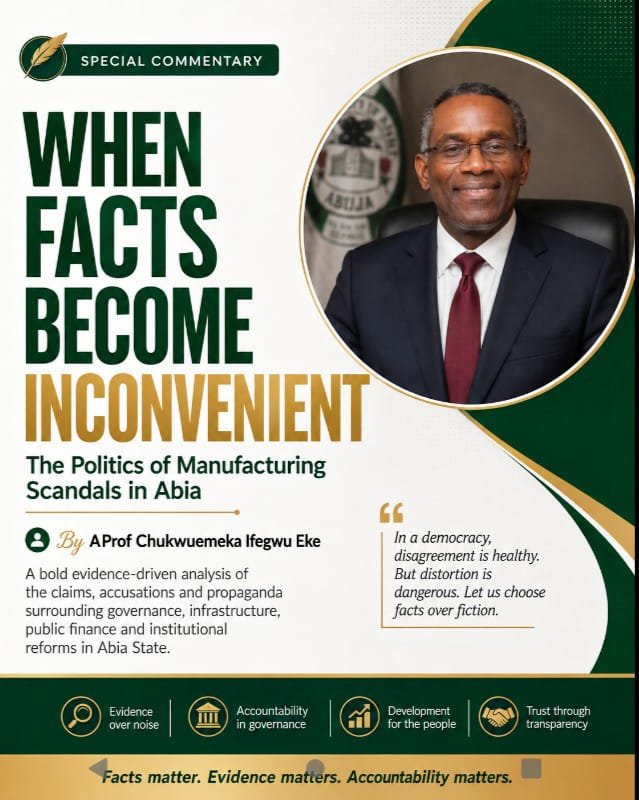
When Facts Become Inconvenient: The Politics of Manufacturing Scandals in Abia
By AProf Chukwuemeka Ifegwu Eke
There is an emerging pattern in the political conversation around Abia State that deserves closer attention. Every major project is increasingly approached from the standpoint of suspicion, every institutional success is interpreted as evidence of hidden interest, and every professional relationship is stretched until it begins to resemble a conspiracy. This is not the same thing as accountability. Accountability begins with questions and proceeds to evidence. Propaganda begins with a conclusion and then searches desperately for fragments that can be arranged to support it.
This was the central concern in my earlier article, “When a Bank Succeeds, Must We Invent a Scandal?” The question remains relevant because the current debate has moved beyond legitimate criticism into a tendency to criminalise success by association. A bank expands its branch network and suddenly its growth is treated as suspicious. A former chairman of a major construction company is linked with another corporate institution and that relationship is presented as though a criminal transaction has already been established. Yet no transfer trail, procurement breach, insider payment, unlawful beneficiary or regulatory infraction is produced. The public is simply invited to connect the dots emotionally.
That method of argument is dangerous because association is not evidence. A person may sit on the boards of different companies without those companies becoming instruments of corruption. A businessman may have relationships with public officials without every transaction involving those institutions becoming fraudulent. To establish a genuine conflict of interest, one must demonstrate that a decision-maker had a material personal interest in a transaction, participated improperly in the decision and benefited from it in a manner contrary to law or established rules. Anything short of that remains suspicion.
The controversy over Port Harcourt Road in Aba provides another example of how political arithmetic can replace serious economic analysis. The argument is presented as though every kilometre of road anywhere in Nigeria should carry the same price. A project in Rivers or Delta is divided by its total length, the resulting figure is compared with the Aba project, and the difference is announced as fraud. Unfortunately, infrastructure costing does not work that way.
Road construction costs depend on far more than distance. They depend on carriageway width, drainage design, soil condition, excavation requirements, relocation of utilities, demolition, compensation, pavement thickness, street lighting, walkways, traffic management, inflation at the time of award, mobilisation costs and the nature of the surrounding urban environment. A six-lane urban reconstruction through a densely populated commercial area cannot be evaluated as though it were identical to an intercity road passing through relatively open terrain.
If the intention is genuinely to determine whether the Port Harcourt Road contract was inflated, the correct comparison must be based on the Bill of Quantities, engineering specifications, procurement process, materials used, drainage components, compensation liabilities and final certified work. Merely dividing billions of naira by kilometres is not forensic analysis. It is a shortcut that may be useful for political messaging but inadequate for establishing corruption.
The same problem affects comparisons between Abia and projects executed by Julius Berger elsewhere. The fact that one contractor handled two projects does not make the two projects technically identical. The relevant question is not whether Julius Berger collected a particular amount in another state. The relevant question is whether the Abia contract price was reasonable relative to the scope, specification, market conditions and engineering requirements of the Abia project. Without such normalisation, the comparison proves very little.
Claims surrounding Ohanku Road and Obohia Road deserve similar caution. Large figures are being circulated alongside allegations that earlier administrations had already completed portions of the work. That is a legitimate area for investigation. But the existence of previous drainage or earthworks does not automatically mean that a new contract should cost almost nothing. Previous work may have deteriorated, failed technical tests or required redesign. Equally, a government should not be allowed to charge taxpayers twice for work that remains usable. The only serious way to resolve the question is to compare the previous scope with the current scope, determine what was retained, what was demolished, what was reconstructed and what additional work was introduced.
The allegation involving billions of naira reportedly spent under Research and Development is perhaps one of the strongest examples of why public debate requires accounting literacy. A line item bearing the words “Research and Development” does not necessarily mean that the entire amount was handed to researchers or consultants. Government accounting classifications frequently group programmes and expenditure in ways that differ from their ordinary-language meaning. The critical questions should therefore concern actual releases, expenditure codes, implementing agencies, beneficiaries and outputs.
A budget figure is not necessarily expenditure. An approved expenditure is not necessarily a cash release. A cash release is not automatically waste. And a large figure under an unfamiliar heading is not proof of theft. Anyone who suspects that expenditure was disguised under Research and Development should identify the specific payments and demonstrate why they were inconsistent with the approved purpose. That would convert suspicion into a testable claim.
The security expenditure argument requires the same level of care. Comparing Abia State’s security spending with Borno State and concluding that Abia must therefore be stealing money ignores the structure of security financing in Nigeria. Borno receives enormous security support directly from federal agencies because of the insurgency. Military operations, federal policing, intelligence activities and specialised security deployments are not necessarily reflected in Borno State Government expenditure. A state-by-state comparison of security vote figures can therefore be grossly misleading if federal spending is ignored.
This does not mean security expenditure should escape scrutiny. On the contrary, security-related spending is one of the areas where secrecy can easily undermine accountability. The appropriate demand should be for stronger legislative oversight, internal audit, procurement controls and transparent reporting within the limits imposed by genuine security concerns. What should be avoided is the assumption that a high figure is itself proof of corruption.
The argument over Primary Healthcare Centres is another area in which two things can be true at the same time. A state government may legitimately renovate, equip or reconstruct health facilities while federal or donor-supported programmes are also operating within the same sector. The existence of federal intervention does not automatically mean every state claim is fraudulent. Likewise, a government should not take credit for projects financed entirely by another tier of government.
The correct approach is therefore facility-specific verification. Which centres were funded by Abia State? Which were financed under federal programmes? Which received donor support? What exactly was done at each location? Was it repainting, rehabilitation, reconstruction, staffing or equipping? These questions are capable of factual answers. A sweeping statement that every project was merely repainted by the state is as problematic as a sweeping government claim that every improvement was funded exclusively from state resources.
The United Kingdom travel advisory has also been introduced into the political argument as though it were an international scorecard on Governor Alex Otti. That is an inaccurate interpretation. Foreign travel advisories are designed to assess risks to citizens of the issuing country. They take into account kidnapping, separatist activity, violent crime, terrorism, road insecurity and the ability of foreign missions to provide consular assistance. They are not prepared as comparative assessments of governors.
Abia should certainly be concerned whenever an important foreign government lists the state among places where travel should be restricted. Such warnings can affect investment perception, tourism and business confidence. The government therefore has a duty to improve security and demonstrate measurable progress. But transforming the advisory into the claim that Britain has formally declared some South-East governors successful and others failures is political exaggeration.
Then there is the repeated claim that the Otti administration has received enormous revenues without producing an “iconic project.” The first problem here is conceptual. Government revenue cannot be judged entirely by whether citizens can point to one spectacular structure. States spend on salaries, pensions, health, education, roads, water, security, debt obligations, agriculture, administration and numerous smaller capital projects. A government may choose a dispersed-development strategy rather than concentrating resources on one monumental project.
Whether that strategy is wise is a legitimate political debate. But “I cannot see an iconic project” is not the same as “the money is missing.” To establish the latter, one must reconcile revenues with recurrent expenditure, capital expenditure, debt service, cash balances and verified projects. Anything else remains an impression.
The argument over Enyimba Hotel follows a similar pattern. The fact that another state has attracted an international hotel operator does not automatically prove incompetence or corruption in Abia. Hotel rehabilitation can involve concession agreements, management contracts, private equity, state equity, leases or public-private partnerships. The more relevant questions are whether the Abia asset is being productively redeveloped, what the financing structure looks like, what revenue government expects and whether timelines are being met. A comparison based simply on which government made more announcements cannot settle those issues.
Perhaps the most revealing aspect of the current debate is the increasing reliance on phrases such as “friendly contractor,” “if you know, you know,” “money na water” and references to hidden connections. Such expressions are politically effective because they create an atmosphere of suspicion without requiring proof. They invite the listener to feel that something must be wrong even where the evidence has not been presented.
That style of politics should be resisted regardless of who is in government. If Governor Alex Otti’s administration has inflated contracts, the evidence should be produced. If a contractor is secretly related to public officials, the beneficial ownership records should be published. If state money has been routed improperly through a bank, the transaction trail should be shown. If a road has been deliberately overpriced, independent quantity surveyors and engineers should demonstrate it. If Research and Development funds were diverted, the specific payments should be identified.
Government, for its part, should not respond to criticism with arrogance. The strongest response to allegations is radical transparency. Contract values, project scopes, procurement methods, payment certificates, quarterly budget performance and contractor ownership information should be made as accessible as possible. The more information government publishes, the less room there will be for speculation.
There is therefore a clear distinction between scrutiny and scandal manufacturing. Scrutiny asks difficult questions and accepts whatever the evidence eventually shows. Scandal manufacturing begins by declaring guilt and then arranges unrelated facts around that conclusion.
Abia needs the first and can do without the second.
The debate should not be about who can shout “fraud” the loudest or who can dismiss an opponent as a robot. It should be about who can produce the better evidence, the better analysis and the more credible interpretation of public records.
A bank succeeding is not proof of corruption. A road costing more than another road is not proof of inflation. A businessman holding multiple directorships is not proof of conflict of interest. A large budget heading is not proof that money was stolen.
Every one of those things may justify questions. None of them, standing alone, constitutes a scandal.
And that is ultimately the point: in a democracy, criticism should be fearless, but facts must still matter.