
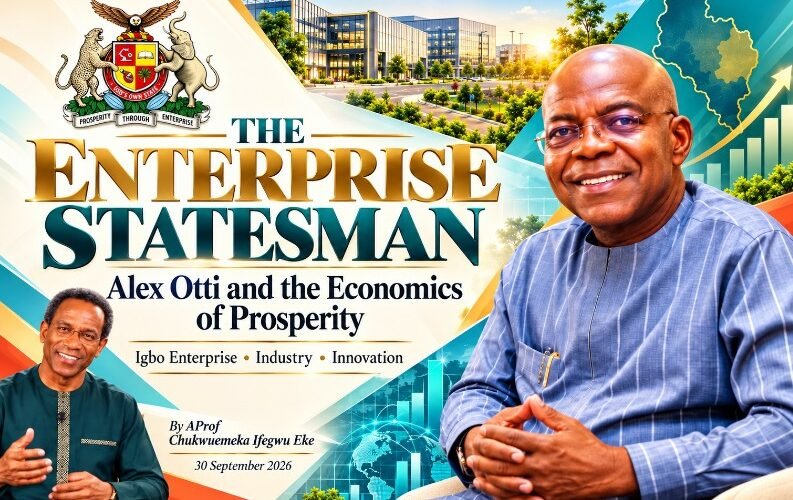
THE ENTERPRISE STATESMAN
Alex Otti and the Economics of Prosperity
By AProf Chukwuemeka Ifegwu Eke
30 September 2026
The most convincing way to understand a public leader’s economic philosophy is to follow the documentary trail: what he proposed before assuming office, what he pledged when entrusted with power, and what he subsequently said before traders, manufacturers, investors and the wider public. In Alex Otti’s case, that trail offers a substantial basis for examining his approach to Igbo enterprise. Across different occasions, an identifiable argument recurs: entrepreneurial talent needs infrastructure, institutions, finance and access to larger markets.
This is the foundation of the enterprise statesman—a leader who recognises that prosperity emerges through productive activity and sees government as responsible for improving the conditions under which that activity takes place. The description is an interpretation of Otti’s documented economic thinking. Its ultimate justification will depend on how successfully that thinking improves livelihoods.
Otti’s industrial ambitions predate his inauguration. A Vanguard interview published on 14 December 2014 presented his proposal to make Aba Nigeria’s industrial workshop. The industrial emphasis therefore has a documented history extending well beyond his present administration.
The more detailed evidence appears in his campaign towards the 2023 election. Reliable Source NG, in a report published on 12 November 2022 by Kazie Uko, recorded his engagement with executives of the Anambra Town Unions in Aba. This was a particularly relevant audience: an organised community of businesspeople whose activities included trading and manufacturing.
At that meeting, Otti connected business confidence to property rights and administrative efficiency. Discussing certificates of occupancy, he said:
«“This will be part of our commitment to the ease-of-doing-business in Abia.”»
He also proposed partnerships with the town unions and wider electricity coverage for industrial and agricultural production centres. These were campaign commitments, but they reveal the practical content of his enterprise argument: business growth requires usable property documentation, dependable infrastructure and cooperation between government and entrepreneurs.
His 2023 campaign manifesto provides the clearest written record before he was sworn in. On printed page 10, he described Aba as:
«“the glory and testament to the Igbo man’s resilience, ingenuity and phoenix-like personality.”»
This language acknowledged the city’s place in Igbo economic history. Crucially, the document also contained a programme for adapting that heritage to contemporary production. Its contents identified industrialisation, Aba’s development, electricity and the digital economy as separate policy priorities.
On printed page 30, under its technology and digital economy programme, the manifesto proposed infrastructure, skills, support for start-ups and access to work beyond Nigeria. Its reference to:
«“innovative wealth creative ideas, and tech driven entrepreneurship”»
shows that technology-led enterprise was already part of the campaign framework. This matters when interpreting his more recent comments about digital commerce: the idea was present in his written programme before he became governor.
The economic significance is straightforward. A trader’s skill in identifying demand remains valuable when customers move online. A manufacturer’s knowledge remains valuable when production standards become more demanding. Development requires helping those capabilities reach additional customers, improve quality and generate more value.
On 29 May 2023, at his inauguration as governor at the Umuahia Township Stadium, Otti gave that programme the status of a public governing commitment. In the speech titled A Time to Rebuild, he declared:
«“our government shall be 100% pro-business.”»
The address proposed private-sector collaboration, support for MSMEs, restoration of Aba’s manufacturing base and development of an ICT innovation hub. It also identified poor roads, excessive taxation and restricted market access as obstacles requiring attention.
The same inauguration speech extended the development promise beyond Aba and Umuahia. It envisaged opportunities across the state and linked prosperity to the welfare of citizens in all 17 local government areas. Its financing and employment projections should be read as announced targets, rather than automatically treated as achieved results. Nevertheless, the speech supplies an important benchmark against which subsequent decisions can be assessed.
An early example of investment outreach followed in July. On 16 July 2023, Otti posted about receiving Obinna Iyiegbu, popularly known as Obi Cubana, and his brother Ike Iyiegbu, at his residence in Nvosi, Isialangwa South. The Street Reporters Newspaper, in a report published the next day, reproduced his statement:
«“He promised to set up a major part of his business in Aba”»
The report connected that intention to industrial investment and employment. It documents an announced investment interest, rather than the completion of a factory. Its relevance lies in Otti’s early effort to attract entrepreneurial capital into the state.
On 12 October 2023, at the flag-off of Port Harcourt Road’s reconstruction in Aba, the enterprise argument took a physical form. The speech, titled Building on the Solid Rock of Excellence, connected road restoration to economic activities that had once flourished along the corridor.
A Federal Ministry of Information and National Orientation report published on 16 October 2023 recorded his intention to:
«“revive the long-abandoned economic activities along this corridor”»
The significance of the occasion was the relationship between infrastructure and production. A road serving an industrial district affects the movement of materials, workers and finished goods. Its economic value therefore extends beyond its appearance: it can influence the cost and reliability of doing business.
Otti developed his position on government’s economic responsibilities during a meeting with the South-East Council of Traditional Rulers and representatives of Igbo archbishops and bishops on 23 February 2024. TheCable’s Victor Ejechi reported the meeting on 24 February.
His statement was direct:
«“Government has business in business; government must step in at some point and take deliberate decisions to safeguard the economy by creating jobs.”»
The report also recorded his emphasis on attracting investment, encouraging businesses to return and supporting private-sector employment.
Read alongside his inauguration speech, this position suggests a government prepared to facilitate enterprise and intervene where major constraints persist. The practical challenge is to ensure that intervention strengthens productive businesses, follows clear rules and delivers public value.
Three days later, on 26 February 2024, at the commissioning of the Geometric Integrated Power Project in Osisioma Industrial Layout, Aba, Otti delivered The Power to Dream. Business Hallmark published the full speech, identifying the occasion and date.
He stated:
«“Aba has always rewarded industry and innovation.”»
The address linked power supply to manufacturing, agro-processing, metal fabrication, woodwork, ICT, fashion, services and retail. It also recounted his involvement with the project during his banking career. That account is a retrospective statement made in 2024 and should be identified as such.
Electricity belongs at the centre of an enterprise strategy because it affects the viability of everyday production. The power speech therefore forms a clear bridge between his earlier industrial ambitions and the operating conditions that manufacturers need. Actual service reliability, affordability and customer experience remain the appropriate measures of delivery.
The record becomes especially important when considering claims that an emphasis on manufacturing or digital commerce means abandoning traditional traders. On 8 August 2024, at the flag-off of the Ekeoha Market remodelling in Aba, Otti delivered Beyond Commerce, Setting a New Template for Intergenerational Prosperity.
He described the intended direction as:
«“an enterprise culture of borderless transactions”»
The speech envisaged improved market facilities, security and interaction with customers beyond the immediate locality. It also addressed temporary accommodation, phased construction and concerns about the financial burden on traders.
The archive contains a typographical inconsistency: the speech introduction prints “2023,” while the page is dated 8 August 2024. The accompanying Government House report, published 9 August 2024, and contemporaneous coverage corroborate the 2024 event date. That report quotes his assurance:
«“Let me give you my word that nobody will be short-changed because this is our collective project.”»
These assurances are commitments that affected traders are entitled to test against their experience. They also establish that trader protection formed part of the publicly stated policy.
At the opening of the Aba International Trade Fair on 30 November 2024, at Aba Mega Mall, Otti returned to the entrepreneurial character of the people. In A Time to Believe, published on his website, he said:
«“Our people, as I have repeatedly maintained, are very hardworking, dedicated and resilient”»
The address praised local automotive ventures and participating MSMEs, encouraged partnerships and invited investors to explore opportunities across the state.
A trade fair illustrates how commerce and industry can reinforce each other. Manufacturers need distribution, retailers need reliable products, and both benefit from finance, information and connections. Economic upgrading becomes more credible when it helps these groups work together.
By 2025, the documented discussion included competitiveness and local branding. BusinessDay, in a report by Udoka Agwu published on 4 December 2025, covered Otti’s remarks at the launch of the MSME Competitiveness and Industrial Productivity Programme at Michael Okpara Auditorium, Umuahia.
The report recorded his objections to disguising locally manufactured products under foreign identities and his support for recognising:
«“Made-in-Abia”»
products as original. It also described his emphasis on funding, skills and organised support for small businesses.
The underlying issue is the ability of local producers to build reputations they own. Manufacturing creates greater long-term value when customers can identify and trust the producer. Quality, certification, intellectual property and consistent delivery become essential parts of the enterprise agenda.
That concern was explicit on 15 September 2026, when Otti received Ethnocentrique’s chief executive, Irunna Ejibe, and a delegation of partners at his office. A statement signed by Chief Press Secretary Ukoha Njoku Ukoha recorded his support for expanding fashion manufacturing and improving export readiness.
He said:
«“Instead of setting up everywhere in Africa, we can supply the whole of Africa from here.”»
The statement connected this ambition to production scale, recognised standards and quality assurance.
This is an ambitious proposition: Abia as a production base serving wider markets. Its success would require manufacturers to meet buyers’ specifications, deliver consistently and operate at competitive costs. The opportunity is substantial, but these commercial requirements cannot be replaced by enthusiasm.
The latest statement in this documentary sequence came on Monday, 28 September 2026, at the Igbo Day Lecture and Dinner organised by Ohanaeze Ndigbo Worldwide in Umuahia, with the theme The Igbo Charter and Development of Ala Igbo. PUNCH’s Sunday Nwakanma reported the remarks on 30 September 2026.
Otti said:
«“So, this government is supporting manufacturing and driving digital delivery.”»
The report also records his acknowledgement that markets remain important, alongside his call for a stronger manufacturing and digital-commerce orientation.
That acknowledgement matters. Interpreted in the context of his manifesto, inauguration address and market speeches, the September remarks support a reading of economic upgrading: expanding the capabilities of an established entrepreneurial community. They do not, by themselves, establish hostility towards traders. The documented sequence provides a stronger basis for interpretation than an isolated phrase.
The case for calling Otti an enterprise statesman rests on this continuity of thought. He has repeatedly placed production, infrastructure, skills, investment and market access within the same development conversation. The record supports that conclusion about his stated philosophy. Measuring its success requires a further inquiry into outcomes.
For Abia’s future, the decisive questions are practical. Are businesses producing more at lower cost? Are young people gaining durable employment and useful skills? Are traders reaching new customers? Can small manufacturers secure finance, protect their brands and win repeat orders? Are roads, electricity and public administration helping enterprises operate reliably?
The benefits must also extend across the state. Aba’s commercial strength can create demand for agricultural produce, transport, packaging, professional services and other activities elsewhere in Abia. Realising those connections requires deliberate investment in rural access, education, health and local enterprise. Citizens should be able to see how public spending improves their opportunities, wherever they live.
A credible future therefore combines ambition with measurement. Government should publish accessible evidence of project delivery, business support, costs and results. Entrepreneurs should receive predictable rules and dependable services. Market redevelopment should protect livelihoods while improving facilities. Digital training should lead to demonstrable work, enterprise and income.
There is a compelling possibility before Abia: a state whose entrepreneurial reputation is supported by the institutions and infrastructure needed to compete widely. Shoes, garments, agricultural products, creative services and digital capabilities can carry greater value when quality and reliability become the foundation of their reputation.
The documentary record shows that Alex Otti has spoken about this direction before taking office and has continued to articulate it as governor. The task now is to make that direction durable—embedded in capable institutions, productive businesses and expanding household opportunity.
The future of Abia will be strongest when prosperity through enterprise becomes an everyday experience: visible in the workshop, the market, the farm, the workplace and the home.