
AGING LAGOS AND THE HOPES FOR ABIA: A 50-YEAR STRATEGIC MEDITATION ON DECAY, RENEWAL AND DESTINY
From the air, Lagos tells a story before the aircraft touches the ground.
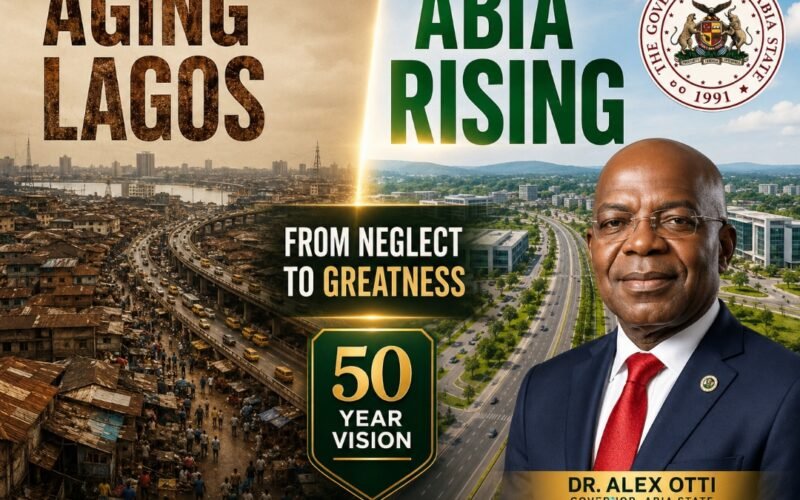
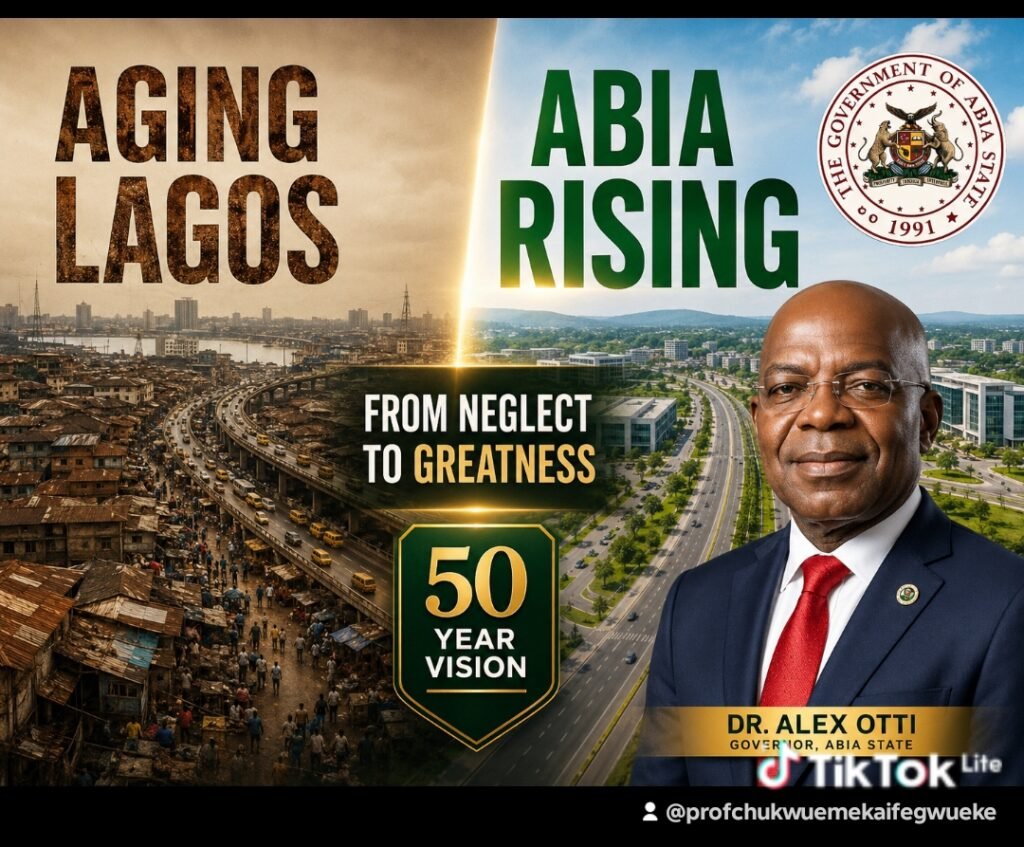
It begins as a vast sheet of human struggle spread beneath the wings: endless roofs, brown roofs, rusted roofs, tired roofs; corrugated iron sheets burnt by sun, beaten by rain, darkened by age and smoke. From above, the city appears not merely crowded, but exhausted. The rooftops run into one another like an old wound that never fully healed. Between them are narrow arteries of roads, many overused, many overstretched, many carrying more pressure than they were ever designed to bear.
The eye sees beauty in the lagoon, yes. It sees the bridges, the ambition, the skyline, the restless commerce, the stubborn genius of a people who refuse to stop moving. But it also sees something else: age. It sees infrastructure forced to do the work of generations without sufficient renewal. It sees buildings leaning into one another for support. It sees communities squeezed between water, waste, concrete and survival. It sees a city that became Nigeria’s economic engine before Nigeria fully understood the cost of abandoning planning.
Lagos did not become old in one day.
It aged through decades of pressure. It aged through migration without matching housing. It aged through growth without proportional drainage. It aged through enterprise without enough spatial order. It aged through ports, markets, bridges, roads, slums, estates, islands and mainland settlements all pulling in different directions. It aged because every Nigerian dream wanted a corner of Lagos, but Lagos was not given enough room, enough time, enough planning and enough discipline to absorb those dreams without deformation.
This is not an insult to Lagos. Lagos remains a miracle of human energy. It is a city of courage, commerce, entertainment, finance, migration, survival and reinvention. But even miracles need maintenance. Even giants need rest. Even engines burn out when they carry a nation alone.
That is the first lesson Abia must learn.
The future must not be allowed to arrive as accident.
For Abia, the question is no longer whether development is possible. The question is whether development can be disciplined early enough to avoid the chaos that swallowed many older Nigerian urban centres. The question is whether Aba, Umuahia, Ohafia, Arochukwu, Umunneochi, Isiala Ngwa, Ukwa, Bende, Ikwuano and every growth corridor in the state can be planned not for four years, not for eight years, but for fifty years.
Abia is not merely rising from neglect. Abia is rising from a long silence.
It is rising from the memory of roads that once mocked movement. It is rising from the shame of commercial cities whose productivity was stronger than their public infrastructure. It is rising from the old contradiction of Aba: a city of makers, manufacturers, tailors, leather workers, traders, fabricators and entrepreneurs, yet for years denied the full dignity of roads, water, power, sanitation, logistics and urban order. It is rising from the patient anger of a people who knew they were gifted but not sufficiently enabled.
That is why the present moment matters.
A road is not just asphalt. A road is a statement of economic philosophy. It says goods should move. It says workers should arrive. It says markets should connect. It says farmers should not be trapped. It says emergency vehicles should not beg potholes for permission. It says the state understands that time is money, distance is cost, and bad infrastructure is a hidden tax on the poor.
When Abia fixes roads, it is not merely beautifying towns. It is lowering transaction costs. It is reducing travel time. It is restoring confidence. It is telling investors that geography will no longer be punishment. It is telling young people that their ambition does not have to migrate before it can breathe.
But Abia must go beyond the excitement of immediate repair.
The next fifty years must be imagined from the air.
From the air, planners must ask: what will Aba look like in 2076? What will Umuahia become when population doubles or triples? Where will the next industrial clusters emerge? Where will the water lines run? Where will freight terminals sit? Where will green belts be protected? Where will the poor live without being pushed into dangerous settlements? Where will schools, hospitals, markets, parks, transport stations, ICT hubs, waste plants and energy corridors be located?
The tragedy of many Nigerian cities is that they were allowed to grow first and then government began to chase them later. Houses appeared before roads. Markets appeared before drainage. Communities expanded before schools. Slums grew before housing policy. Vehicles multiplied before transport planning. Flooding came before environmental enforcement. By the time government woke up, the city had already written its own disorder into concrete.
Abia must not repeat that error.
The first pillar of a 50-year Abia strategy is Otti’s spatial discipline. Every major town must have an enforceable master plan, not a decorative document kept in a ministry drawer. Aba must be treated as an industrial organism. Umuahia must be treated as an administrative and knowledge capital. Ohafia and Arochukwu must be treated as cultural, educational and tourism corridors. Ukwa must be treated strategically for energy, logistics and port-linked development. Umunneochi and Isuikwuato must be treated as northern gateways. Every local government must have a development logic, not just political representation.
The second pillar informs Otti’s infrastructure sequencing. Roads should not be built in isolation from drainage, water, power, broadband and land-use planning. A new road without drainage is a future failure. A market without waste management is a future health crisis. An industrial zone without power is a future frustration. A city expansion without housing policy is a future slum.
The third pillar must be Aba.
Under Otti, Abia is to fast becoming the manufacturing heart of Eastern Nigeria, and Aba is treated as a special economic civilization, not just a city. Aba already has what many planned industrial zones are still trying to create: skill, density, reputation, trading networks, apprenticeships, innovation, risk appetite and production culture. What Aba needs is not pity. Aba needs platforms.
He has enabled reliable power. It needs roads that connect workshops to markets. It needs drainage that protects machinery and inventory. It needs product standardization centres. It needs leather, garment and fabrication clusters. It needs export support. It needs digital marketplaces. It needs logistics parks. It needs industrial finance. It needs technical schools linked directly to production. It needs branding that can carry “Made in Aba” from a local boast into a continental commercial identity.
The fourth pillar is Otti’s water and sanitation strategy. No state can call itself modern if its people rely on unsafe water and broken sanitation systems. The future Abia, he insists must be planned with underground seriousness. Pipes, drainage channels, treatment plants, refuse systems and flood controls are not as glamorous as flyovers, but they are the organs that keep a city alive. Lagos teaches this painfully: when population outruns sanitation, beauty becomes cosmetic.
The fifth pillar must be energy. Abia cannot industrialize on generator noise. A state that wants manufacturing must treat power as destiny. The future should include embedded generation, distribution partnerships, renewable clusters, industrial power corridors and community-level energy planning. Aba’s artisans do not need speeches; they need current. Every hour of reliable electricity is a subsidy to productivity.
The sixth pillar must be human capital. Infrastructure without people is concrete without civilization. Abia’s next fifty years must invest in schools, technical colleges, digital training, health systems, research centres, entrepreneurial institutes and youth innovation. The child in Umunneochi, the apprentice in Aba, the student in Umuahia, the trader in Ariaria, the farmer in Bende and the young woman building a business in Isiala Ngwa must all see themselves inside the state’s development map.
The seventh pillar must be governance continuity. This is where many African development dreams collapse. One administration begins. Another abandons. One governor plans. Another personalizes. One government builds. Another renames. A fifty-year Abia cannot be built on political mood swings. It must be protected by law, institutional memory, public accountability and citizen ownership. The Abia long-term plan must outlive personalities. It must become a state covenant.
That covenant must say clearly: never again shall Abia be governed as if roads are favours. Never again shall Aba’s productivity be treated as ordinary. Never again shall public infrastructure be allowed to decay until citizens normalize suffering. Never again shall government wait for collapse before intervention. Never again shall Abia’s children inherit rust where they should inherit renewal.
Lagos is a warning written in roofs.
From the air, those rusty roofs speak. They say: plan early. They say: do not confuse activity with order. They say: do not let commerce grow faster than infrastructure. They say: do not build for today alone. They say: when a city becomes too important to fail, it also becomes too heavy to repair easily.
Abia must listen.
For Abia, the hope is that renewal is beginning before total urban suffocation. The hope is that the state can still choose structure over sprawl, planning over panic, drainage over flooding, industry over idleness, logistics over isolation, and vision over noise. The hope is that Aba can become not another exhausted Lagos, but a disciplined African manufacturing city. The hope is that Umuahia can become not merely a capital, but a calm administrative and intellectual centre. The hope is that every local government can be connected to a productive purpose.
A state rises twice.
First, it rises in concrete: roads, bridges, schools, hospitals, markets, lights, water, drainage and public buildings.
Then, it rises in imagination: what the people begin to believe is possible.
Abia is now entering that second rise.
The people are beginning to imagine movement where there was stagnation. They are beginning to imagine order where there was neglect. They are beginning to imagine that government can be serious. They are beginning to imagine that Aba can produce for Africa. They are beginning to imagine that Umuahia can plan for generations. They are beginning to imagine that the state can become a model, not a complaint.
But imagination must be protected from praise-singing. The true friend of Abia is not the person who says everything is perfect. The true friend of Abia is the person who says: because something good has started, it must now be deepened, institutionalized and defended. Roads must be maintained. Budgets must remain transparent. Contractors must be held accountable. Urban plans must be enforced. Citizens must obey planning rules. Markets must be modernized without destroying livelihoods. Development must be inclusive, not selective.
The danger of renewal is complacency. The danger of early success is celebration without consolidation. Abia must not simply rise; Abia must organize its rising.
Fifty years from now, another aircraft will descend over Nigerian soil. A child not yet born will look down from the window. That child may see two possibilities.
One possibility is a tired Abia: crowded, rusty, chaotic, flooded, patched together, noisy with generators, full of talent but short of order.
The other possibility is a planned Abia: connected roads, organized industrial zones, green corridors, clean markets, functioning water systems, modern schools, productive towns, disciplined growth, and cities that carry ambition without collapsing under it.
The choice is being made now.
It is being made in every road contract. It is being made in every budget line. It is being made in every master plan. It is being made in every drainage channel. It is being made in every school renovated, every market reorganized, every power project pursued, every water scheme restored, every investor guided, every artisan supported, every community connected.
Lagos has shown Nigeria the cost of allowing one city to carry too much for too long.
Abia must show Nigeria the power of planning before pressure becomes decay.
From rusty roofs to rising roads, from old neglect to new ambition, from Aba’s workshops to Umuahia’s policy tables, from local markets to continental value chains, Abia stands at the edge of a generational opening.
This is not merely the story of one administration.
It is the beginning of a fifty-year argument.
That argument is simple:
A people who can manufacture without support can transform a nation when supported.
A state that was once underestimated can become a model when governed with discipline.
A future that is planned early will not need to be rescued late.
And Abia, if it stays faithful to vision, accountability and long-range planning, can rise from the shadow of Nigeria’s urban decay into the light of a new development civilization.
The aircraft is still in the sky.
The land is still visible.
The future is still open.
Abia must choose now what it wants the next generation to see from above.
A few factual anchors support the article’s direction: Lagos faces major urbanization pressures including housing, transport, waste and infrastructure strain, while World Bank urban analysis notes Nigeria’s rapid urban growth and Lagos’s transformation challenge. � Recent Abia development claims include the reported completion of 414 roads covering about 864.12 km, plus ongoing water-scheme rehabilitation around Ubakala, Umuahia and Ariaria/Aba axis. �
World Bank +1
instagram.com +1