
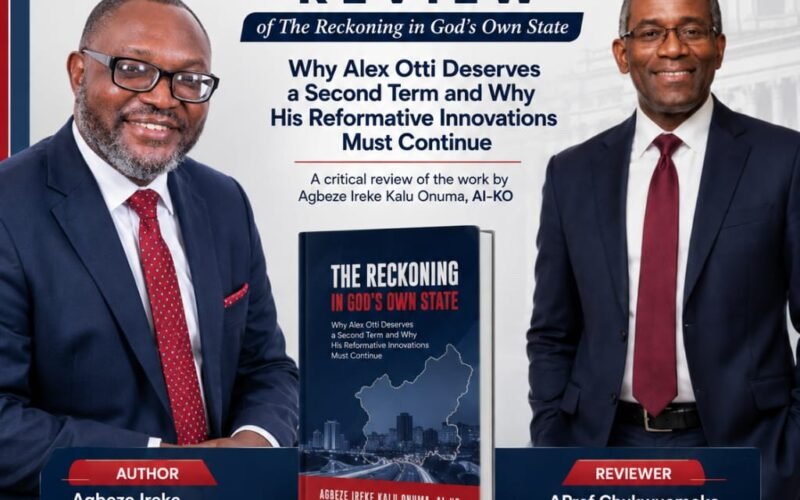
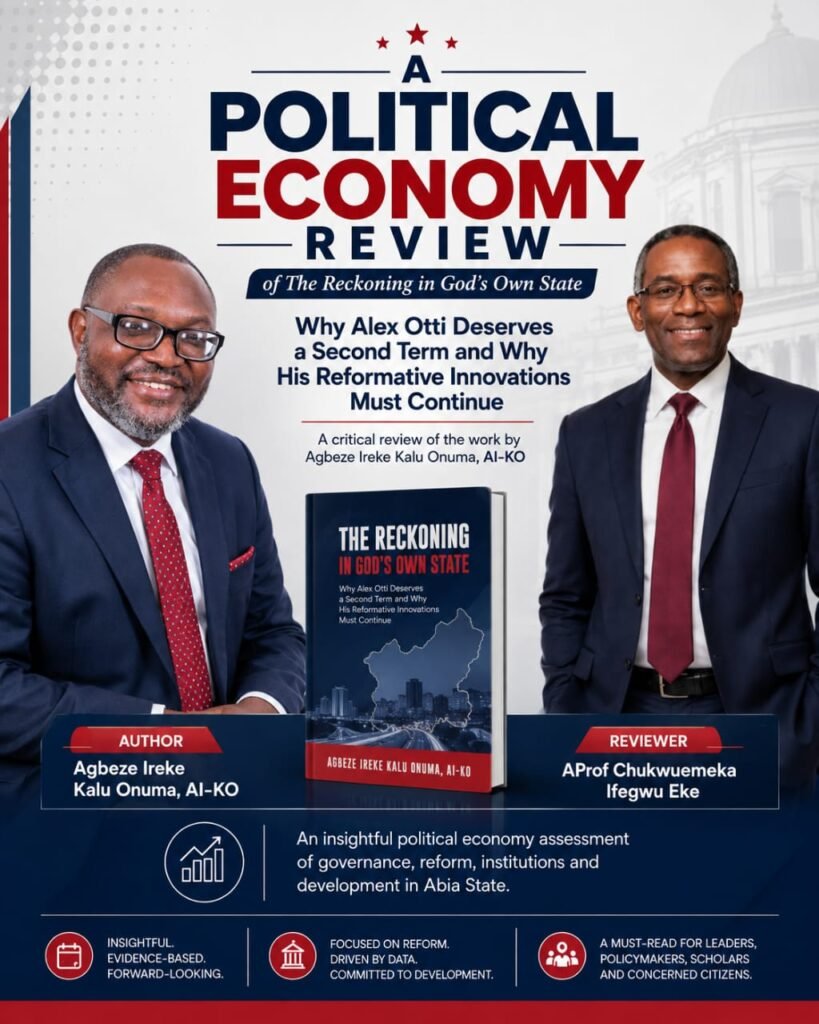
A POLITICAL ECONOMY REVIEW OF THE RECKONING IN GOD’S OWN STATE: WHY ALEX OTTI DESERVES A SECOND TERM AND WHY HIS REFORMATIVE INNOVATIONS MUST CONTINUE
By AProf Chukwuemeka Ifegwu Eke
Agbeze Ireke Kalu Onuma, writing under the pen name AI-KO, has produced in The Reckoning in God’s Own State: Why Alex Otti Deserves a Second Term and Why His Reformative Innovations Must Continue an unusually expansive intervention in the political economy of subnational governance in Nigeria. The author identifies himself as a Nigerian writer, analyst and public intellectual whose writings traverse political history, governance and civic affairs. Although the work is explicitly persuasive—it begins with Onuma’s declaration that he and his family intend to vote for Governor Alex Otti in 2027—it is more intellectually interesting when read not merely as an electoral endorsement but as an argument about the relationship between political power, institutions, public finance, infrastructure, elite incentives and development outcomes in Abia State.
From a political economy perspective, the central proposition running through Onuma’s work is straightforward: the quality of political institutions and the incentive structure facing political elites largely determine economic outcomes. His distinction between the twenty-four years preceding May 2023 and the Otti administration is therefore not simply a comparison of governors. It is presented as a contest between two models of the state. The first is essentially extractive—a political order in which public resources, patronage networks and state institutions are organised primarily around elite accumulation. The second is reformative and developmental—a state in which fiscal resources are redirected towards infrastructure, human capital, social services and institutional rebuilding. Onuma makes this contrast uncompromisingly when he characterises the objective of the earlier political order as private enrichment masquerading as public service.
This is where the work becomes particularly useful to the political economist. What Onuma describes can be situated within the classical distinction between extractive and inclusive institutions. Under an extractive system, political access determines economic opportunity, public contracts become instruments of redistribution towards insiders, infrastructure is subordinated to political symbolism, and recurrent fiscal obligations such as salaries and pensions become vulnerable because the state is not principally organised around the maximisation of social welfare. In contrast, a reforming developmental state attempts to improve the productivity of both public expenditure and private economic activity. Onuma’s narrative of Abia therefore amounts, whether intentionally framed in these theoretical terms or not, to an account of attempted institutional transition.
One of the strongest political-economic sections of the work concerns fiscal governance. Onuma argues that Otti inherited approximately ₦191 billion in debt and places considerable emphasis on the subsequent reduction of that burden, together with Abia’s improved fiscal rankings. The importance of this argument goes beyond debt itself. Fiscal discipline creates what economists would describe as fiscal space: the capacity of government to finance socially productive expenditure without undermining long-run solvency. The author’s interpretation is consequently that reducing inherited liabilities, strengthening reporting systems and abolishing former governors’ pension entitlements represent a restructuring of the political allocation of public resources. In that sense, the repeal of pensions for former governors is as politically important as it is fiscally symbolic because it attempts to redefine the relationship between political office and permanent claims upon the treasury.
There is, nevertheless, a numerical issue that deserves correction in a future edition. The work states that a reduction from approximately ₦191 billion to below ₦50 billion represents a reduction of about ₦141 billion and simultaneously describes this as a 60 per cent contraction. On the figures supplied by the author himself, a ₦141 billion reduction from ₦191 billion is approximately 73.8 per cent, not 60 per cent. This does not weaken the author’s substantive argument—in fact, the arithmetic implied by his figures suggests a larger reduction—but it demonstrates why a work that repeatedly emphasises measurement and fiscal precision must apply the same discipline to its own quantitative claims.
Onuma is also persuasive when he treats roads as economic rather than merely physical infrastructure. His assertion that the road to economic participation in Abia is sometimes literally a road captures an important development-economics proposition. Rural roads reduce transaction costs, expand market access, lower vehicle operating costs, improve agricultural price realisation, strengthen labour mobility and potentially increase returns to private investment. In places such as Aba, where informal manufacturing and trading networks constitute a substantial part of economic life, transport infrastructure can generate multiplier effects far beyond the construction sector itself. The author’s discussion of agrarian roads is therefore better understood as an argument about market integration and spatial economics than simply as praise for road construction.
The same reasoning applies to the author’s treatment of education and healthcare. His defence of the Otti administration against the accusation that infrastructure expenditure is insufficiently “people-friendly” is conceptually important. He rejects the artificial division between physical infrastructure and social welfare, noting that schools, roads, teachers and healthcare provision interact in determining household welfare. According to the evidence assembled in the work, the reform programme includes expanded free basic education, teacher recruitment, healthcare recruitment and health-insurance enrolment alongside infrastructure investment. Political economy is precisely about such choices: not simply how much government spends, but who benefits, through what institutions, and with what consequences for future productive capacity.
Another important element is the author’s analysis of public transportation and urban governance. His treatment of the Abia Green Shuttle, land digitisation, urban planning and institutional reforms suggests an administration attempting to reduce some of the transaction costs associated with urban economic activity. Digitised land records, for example, have implications extending beyond administrative convenience. Secure and transparent property documentation can influence investment decisions, land-market efficiency, collateralisation, dispute resolution and urban development. Similarly, integrated transportation potentially affects labour-market accessibility by reducing the cost of movement between residences and places of economic activity.
However, the strongest passage in the entire work from a strict political-economy standpoint may be the author’s own qualification of the infrastructure narrative: “The road is necessary. The road is not sufficient.” This sentence should arguably have occupied an even more central position in the analysis. Development cannot ultimately be measured by kilometres of asphalt, numbers of buses or renovated public buildings alone. The final test is whether public investment produces rising household incomes, productive employment, private capital formation, improved real consumption and reductions in vulnerability. The woman described in the work who recognises the value of free schooling but still wonders how she will feed her child represents the distributional problem confronting virtually every reforming government. Infrastructure increases the economy’s productive potential; it does not automatically guarantee an equitable distribution of the resulting gains.
This opens an area that Onuma could develop much more extensively. The work contains substantial evidence on government outputs, but much less systematic evidence on economic outcomes. A fuller political-economy assessment would examine employment, real household income, poverty incidence, internally generated revenue, business formation, agricultural productivity, manufacturing output, private investment, cost of transportation, school attendance outcomes, healthcare utilisation and local price movements before and during the reform period. Such indicators would permit the reader to move from the proposition that government is doing more to the analytically stronger proposition that what government is doing is measurably changing the economic welfare of Abians.
The treatment of compensation surrounding projects such as the Ossah Road is particularly valuable because it introduces the question of distributional incidence. Development projects create winners and losers even when aggregate social benefits are positive. A road may improve welfare for hundreds of thousands while simultaneously destroying the location-specific capital of households and businesses situated along its path. Onuma recognises this tension through the story of a clinic owner who considered the compensation for her displaced investment inadequate. His acknowledgement that governance has costs borne by particular citizens saves the work from becoming entirely celebratory. A genuinely developmental administration must therefore combine infrastructure expansion with transparent valuation, adequate compensation and accessible grievance mechanisms.
There is also a significant analysis of political competition. Onuma argues that the coalition confronting Otti represents not so much a competing developmental programme as an attempt to recover political access. In one of the work’s sharpest formulations, he distinguishes a “governance argument” from a “power argument.” This is recognisably political economy. Control of a state government means control over appointments, contracts, rents, regulatory discretion, political networks and the allocation of considerable public expenditure. Electoral contests are consequently not always ideological competitions over alternative development strategies; they can also be struggles among elites over access to the resource-allocation machinery of the state.
Yet a scholarly review must introduce an important caution here. Political economy requires us to apply institutional analysis symmetrically. Former political elites should certainly be interrogated regarding their records, but current political actors must not be assessed solely by comparison with poor predecessors. A government can substantially outperform an historically weak baseline and still fall short of the feasible development frontier. The relevant long-run benchmark for Abia should therefore gradually shift from “Is this better than what existed before?” to “Is this the best use of Abia’s present resources and opportunities?” The former is an electoral comparison; the latter is a developmental question.
The author’s treatment of reform sustainability is consequently important. He recognises risks arising from external shocks, international co-financing and the continued viability of reform programmes, although he interprets those risks primarily as arguments for continuity. I would extend the argument further. The ultimate test of the Otti reforms is not whether Alex Otti personally can sustain them for eight years. It is whether the reforms can be institutionalised sufficiently to survive Alex Otti. Successful political-economic reform converts personal leadership into rules, procedures, professional bureaucracies, transparent procurement systems, credible fiscal institutions and enforceable laws. If development depends permanently upon the virtue of one governor, institutional transformation remains incomplete.
This distinction between good leadership and good institutions is crucial. Onuma devotes considerable attention to Otti’s personal character, professional history and relationship with numbers. The argument is compelling as political biography, but political economy warns against placing excessive analytical weight on the benevolence or competence of individual leaders. Development becomes durable when institutions constrain bad leaders as effectively as they empower good ones. Thus the more consequential question is whether Abia’s emerging governance architecture will continue producing fiscal discipline, transparent procurement, functioning schools, maintained roads and accountable administration when the incumbent is no longer governor.
A related limitation concerns the work’s evidentiary architecture. Onuma provides an extensive source list, drawing from newspapers, government scorecards, the governor’s own website and other public commentary. This is useful for political journalism, but a stronger political-economy study would separate government claims from independently generated data and rely more systematically on primary fiscal documents, audited financial statements, Debt Management Office records, budget implementation reports, National Bureau of Statistics datasets, procurement records, health and education administrative data, and independently reproducible indicators. The prose often declares outcomes to be independently verified when the underlying bibliography includes a mixture of independent reporting, official government material and explicitly supportive commentary. Greater source classification would strengthen the empirical authority of the work.
Stylistically, Onuma is a gifted polemicist. His writing is vivid, memorable and frequently powerful. His use of encounters with pensioners, traders, mechanics, health workers and ordinary residents provides human texture that conventional fiscal analysis often lacks. His final argument consciously returns to these lived experiences rather than relying solely on aggregate statistics. This makes the work accessible beyond the narrow academic community. Yet the same rhetorical strength occasionally generates analytical overstatement. Phrases that categorically attribute twenty-four years of governance to a singular objective of private enrichment are politically arresting but require a far higher evidentiary burden in academic political economy than in advocacy writing.
Indeed, the book is best classified as a political-economic essay of advocacy supported by empirical claims, rather than a dispassionate academic evaluation. That is not necessarily a weakness. Onuma announces his normative position openly rather than disguising it behind artificial neutrality. The intellectual task for the reader is therefore to distinguish three layers of the work: evidence concerning government outputs; interpretation of those outputs through a theory of institutional change; and the author’s normative conclusion that these achievements justify a second term.
The 2027 argument is ultimately built around the economics of policy continuity. Onuma contends that reforms in their middle stages are vulnerable and that replacing the administration responsible for constructing them could impose transition costs and institutional disruption. This resembles the political-economic concept of reform credibility. Private investors, households and bureaucratic actors make decisions partly according to expectations about future policy. Where reforms are perceived as temporary, economic agents may delay long-term commitments. Continuity can therefore possess economic value. But continuity must remain conditional upon performance. Democracy cannot become an automatic eight-year tenure simply because reform has begun; the legitimacy of continuity must derive from demonstrable welfare improvements and institutional consolidation.
One of the author’s most ambitious propositions is that Abia’s experience carries implications beyond the state. He presents Otti’s administration as evidence to citizens across the South-East that effective governance remains possible and argues that the 2027 election will function as a referendum on the durability of reformative government. This is politically significant. Successful subnational reform can produce demonstration effects: neighbouring states face greater pressure as citizens compare outcomes across jurisdictions. Federalism can consequently function as a form of competitive governance in which successful policies in one state alter the political expectations facing governments elsewhere.
My overall assessment is therefore that Agbeze Ireke Kalu Onuma (AI-KO) has produced an important, provocative and highly readable contribution to the contemporary debate on Abia State’s political economy. Its greatest contribution lies not in its explicit appeal for Alex Otti’s re-election, but in the deeper argument embedded beneath that appeal: that political institutions matter; that fiscal choices reveal the priorities of governing coalitions; that infrastructure can alter the geography of economic opportunity; that public resources can either sustain patronage or create productive capabilities; and that electoral competition is ultimately a contest over who controls the state’s capacity to allocate resources.
The work would become substantially stronger in a future scholarly edition if its impressive narrative evidence were accompanied by more rigorous longitudinal data, clearer separation of independent and official sources, explicit measures of household and private-sector outcomes, comparative benchmarks with other Nigerian states, and deeper consideration of the distribution of reform costs and benefits. Most importantly, the analysis should increasingly move from Otti as reformer to Abia as an emerging institutional system.
That distinction determines the ultimate verdict. The success of reform cannot finally be measured by whether one governor deserves another four years. It must be measured by whether political incentives, economic institutions and public expectations have been altered so fundamentally that returning to the old equilibrium becomes increasingly difficult regardless of who occupies Government House.
Onuma’s The Reckoning in God’s Own State succeeds because it forces precisely that larger question upon the reader. Behind the roads, buses, schools, debt figures, pensions, political rivalries and approaching election lies the central problem of Nigerian political economy: Can a political system historically organised around access and extraction be reconstructed around productivity, accountability and public value?
If Abia is genuinely making that transition, then its significance extends far beyond the fortunes of Alex Otti or the outcome of the 2027 election. It becomes an experiment in whether democratic competition can generate a new equilibrium in which citizens increasingly reward measurable governance and punish extraction. That is the more consequential “reckoning” contained in Agbeze Ireke Kalu Onuma’s work—and it is the reason the essay deserves to be read not simply as campaign advocacy, but as a serious intervention in the evolving political economy of governance in Nigeria.
AProf Chukwuemeka Ifegwu Eke
Economist and Political Economy Scholar