
PROSPERITY FROM THE GRASSROOTS: RURAL LIVELIHOODS, AGRICULTURE AND THE NEW ABIA VISION
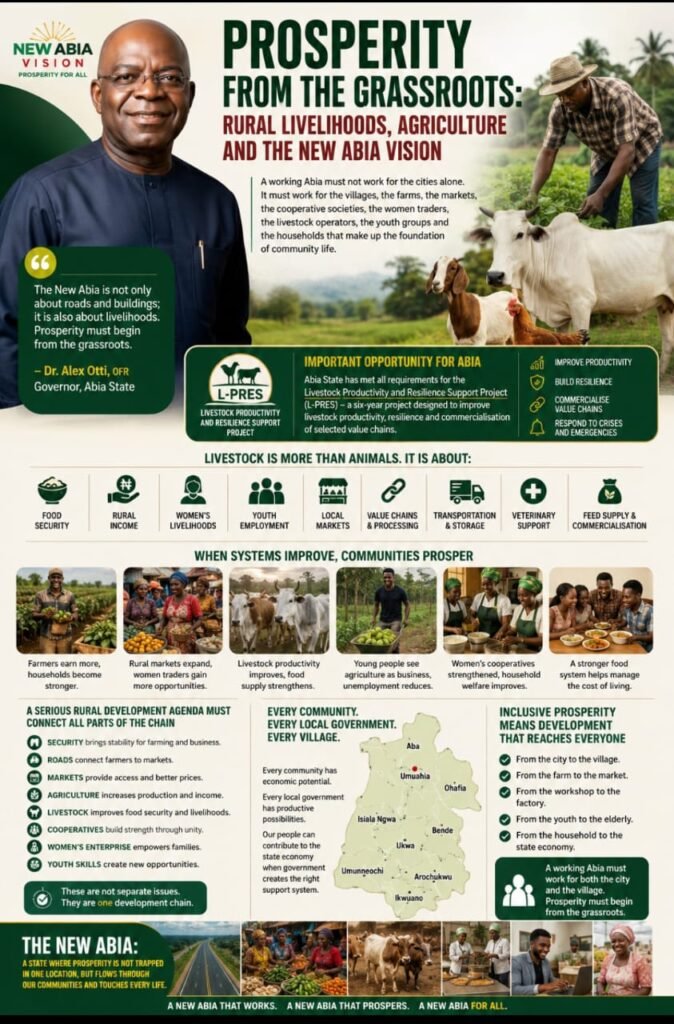
A working Abia must not work for the cities alone. It must work for the villages, the farms, the markets, the cooperative societies, the women traders, the livestock operators, the youth groups and the households that make up the foundation of community life.
Development that does not reach the grassroots is incomplete. A state cannot claim real progress if rural communities remain disconnected from opportunity. Roads, power, schools, health centres and markets must all connect to the daily struggle of ordinary people.
This is why the New Abia vision must be expanded beyond urban renewal. It must include rural livelihoods, agriculture, livestock productivity, community enterprise, youth employment and household income.
Recent reports show that Abia State has met all requirements for the Livestock Productivity and Resilience Support Project, a six-year project designed to improve livestock productivity, resilience and commercialisation of selected value chains. � The national L-PRES programme describes its objective as improving livestock productivity, resilience and commercialisation of selected value chains, while strengthening capacity to respond to eligible crises or emergencies.
This is an important opportunity.
Livestock is not merely about animals. It is about food security. It is about rural income. It is about women’s livelihoods. It is about youth employment. It is about local markets. It is about value chains, processing, transportation, veterinary support, feed supply, storage and commercialisation.
When livestock value chains improve, communities benefit.
When farmers earn more, households become stronger.
When rural markets expand, women traders gain more opportunities.
When young people see agriculture as business, unemployment pressure reduces.
When food systems become more productive, the cost of living can be better managed over time.
That is why Governor Otti’s communication must tell a wider story: the New Abia is not only about roads and buildings; it is also about livelihoods.
Abia must become a state where rural communities are not treated as voting centres alone. They must be treated as development centres. Every community has economic potential. Every local government has productive possibilities. Every village has people who can contribute to the state economy if government creates the right support system.
A serious rural development agenda must connect security, roads, markets, agriculture, livestock, cooperatives, women’s enterprise and youth skills. These are not separate issues. They are part of one development chain.
If rural roads improve, farmers move goods faster.
If markets are better organised, traders earn more.
If livestock productivity improves, food supply strengthens.
If young people receive support, they can build businesses around agriculture.
If women’s cooperatives are strengthened, household welfare improves.
This is how inclusive prosperity is built.
Governor Otti should therefore be positioned as a leader whose economic thinking is not limited to urban headlines. The message must be that Abia’s prosperity will be stronger when development reaches both city and village.
Aba must rise.
Umuahia must grow.
Ohafia must connect.
Isiala Ngwa must feel the impact.
Bende, Ukwa, Umunneochi, Arochukwu, Ikwuano and other communities must also see development as something real and close.
The New Abia must be a state where prosperity is not trapped in one location. It must flow through communities. It must touch farmers, traders, transporters, artisans, youth and households.
That is why grassroots prosperity matters.
The people must know that governance is not only about political appointments and big ceremonies. It is about whether families can eat better, whether businesses can survive, whether communities can produce, and whether young people can find opportunity without leaving home.
A working Abia must work for both the city and the village. Prosperity must begin from the grassroots.