
THE BRIDGE OF HOPE: LINKING TWO STATES, TWO DESTINIES AND TWO ECONOMIC FUTURES
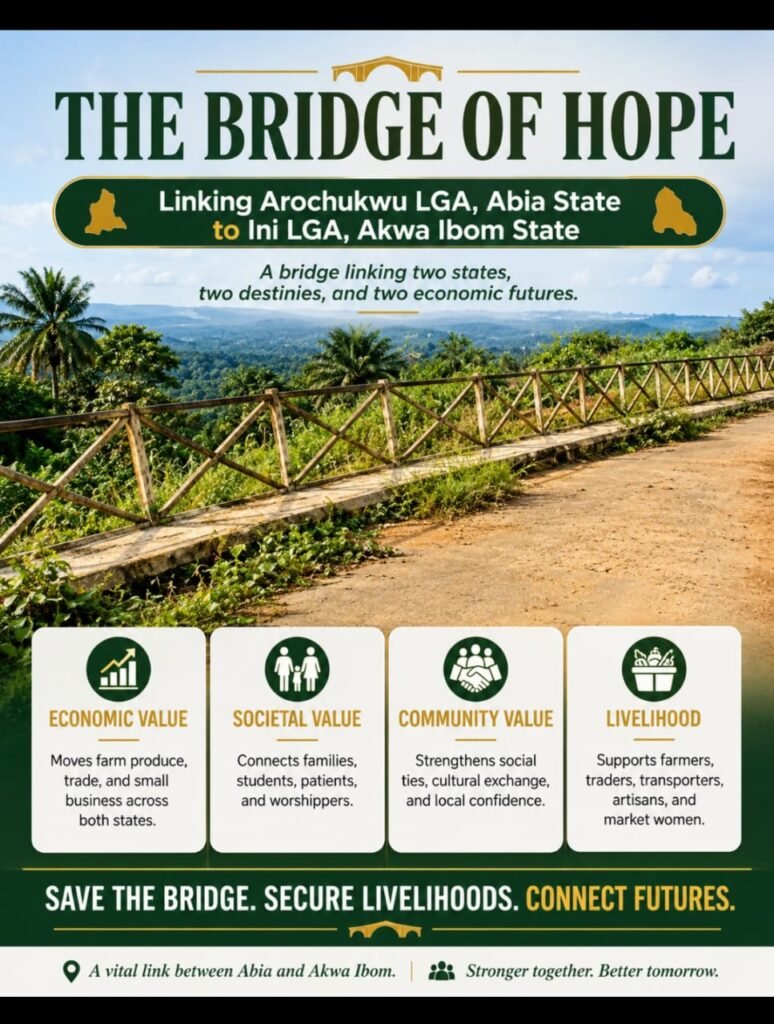
A bridge is never just a bridge. In the life of a community, a bridge is memory, movement, market, family, security, livelihood and hope. It is the quiet infrastructure that allows a farmer to reach the market, a trader to reach customers, a child to reach school, a patient to reach care, a family to remain connected, and an economy to breathe. This is why the bridge linking the Arochukwu axis of Abia State to Ini Local Government Area of Akwa Ibom State must be understood beyond concrete and iron. It is a bridge of hope linking two states, two destinies and two economic futures.
Between Arochukwu in Abia and Ini in Akwa Ibom lies more than geography. There is history. There is culture. There is trade. There is kinship. There is movement of people, goods, services and dreams. There are farmers whose produce needs access to wider markets. There are traders whose daily survival depends on mobility. There are young people seeking opportunities beyond their immediate communities. There are families divided by state boundaries but united by blood, marriage, commerce, religion and social life. This bridge holds those relationships together.
The economic value of this bridge is enormous. Ini LGA is associated with strong agricultural potential, agribusiness investments, farming activities, rice processing possibilities and emerging innovation-driven initiatives. Arochukwu, on the other hand, is a historic Abia community with tourism value, cultural depth, commercial energy and growing development attention. When these two areas are properly connected, the result is not merely easier travel; it is the creation of a regional economic corridor.
Such a bridge can support agricultural trade by helping farmers move cassava, rice, palm produce, vegetables, livestock and other goods from farm clusters to markets across both states. It can reduce transport costs, shorten travel time, improve access to buyers, and reduce post-harvest losses. For rural economies where every naira matters, a functional bridge can determine whether a farmer makes profit or suffers loss.
The bridge also has serious value for small businesses. Market women, transporters, artisans, food sellers, mechanics, motorcycle riders, commercial drivers, petty traders and local suppliers all benefit when movement is safe and predictable. A strong bridge expands the market space available to ordinary people. It allows one community to serve another. It turns border communities into economic partners rather than isolated settlements.
Its societal value is even deeper. A bridge strengthens human connection. It allows people to attend weddings, burials, church programmes, festivals, school events, health appointments and family meetings without fear. It keeps communities socially alive. Where a bridge fails, people become isolated. Social visits reduce. Emergency response becomes difficult. The elderly suffer. Students struggle. Pregnant women and sick persons face increased risk. A bridge, therefore, is not only an economic asset; it is a social protection instrument.
The community value of this bridge cannot be overstated. For the people around Arochukwu and Ini, the bridge represents belonging. It tells them that they are not forgotten, that their communities matter, and that development is not reserved only for capital cities and urban centres. It gives rural people confidence that government sees them, values them and understands the importance of their local economy.
At a time when both Abia and Akwa Ibom are speaking strongly about innovation, agriculture, enterprise development, tourism and technology, this bridge becomes even more strategic. Development cannot be digital alone. It must also be physical. Technology hubs, artificial intelligence programmes, business grants, innovation parks and export initiatives require roads, bridges and logistics networks to become meaningful to ordinary people. A farmer cannot export potential. A trader cannot sell promises. A tourist cannot visit a destination that is difficult or unsafe to access.
This is why the Arochukwu–Ini bridge should be treated as a strategic inter-state development asset. It links Abia’s historic tourism and enterprise corridor with Akwa Ibom’s agrarian and industrial possibilities. It can support tourism, rural commerce, food movement, cultural exchange, youth enterprise and community security. Properly rehabilitated or reconstructed, it can become a visible symbol of cooperation between two neighbouring states.
The bridge should therefore not be seen as a local complaint but as a development opportunity. It is an opportunity for Abia State and Akwa Ibom State to collaborate. It is an opportunity for the Federal Government, the Niger Delta Development Commission, lawmakers, local councils and intervention agencies to demonstrate that rural infrastructure matters. It is an opportunity to convert a weakening structure into a powerful statement of renewal.
A bridge that connects people also connects economies. A bridge that connects economies creates livelihoods. A bridge that creates livelihoods reduces poverty. A bridge that reduces poverty strengthens peace. This is the development chain that policymakers must see.
The people do not merely need sympathy. They need a bridge that works. They need safe passage. They need access to markets. They need access to schools, hospitals, farms, churches and neighbouring communities. They need the dignity of movement. They need the assurance that their economic future will not be cut off by infrastructural neglect.
This is why the bridge linking the Arochukwu axis of Abia State and Ini Local Government Area of Akwa Ibom State must be restored, strengthened and protected. It is a bridge of commerce. It is a bridge of agriculture. It is a bridge of culture. It is a bridge of families. It is a bridge of tourism. It is a bridge of livelihood. Above all, it is a bridge of hope.
When this bridge stands strong, two states stand closer. Two economies breathe better. Two communities dream bigger. Two destinies move forward together.
Let this bridge become a symbol of what development should truly mean: connecting people, protecting livelihoods and opening the road to a better future.