
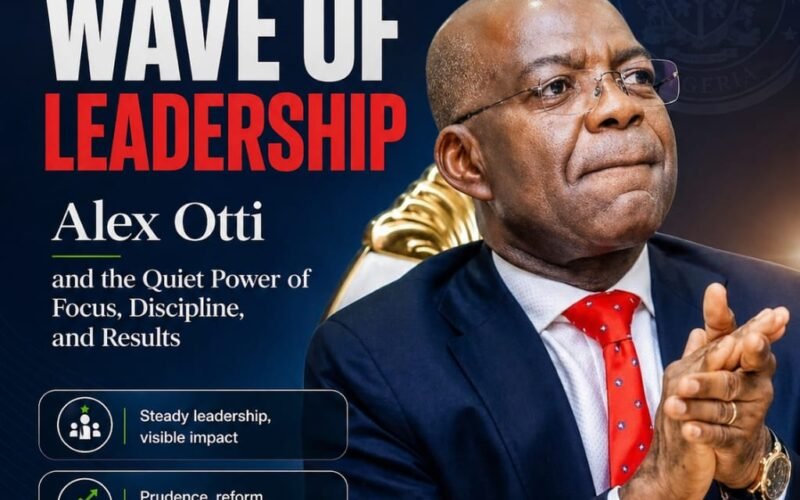
PUBLIC SERVICE IS NOT AN ATM: THE OTTI MODEL OF LEAN, DISCIPLINED GOVERNANCE
In a political culture where public office is too often treated as a gateway to luxury, entitlement, and waste, Governor Alex Otti’s decision to use scheduled commercial flights instead of chartered private jets sends a message far beyond the cost of air travel. It speaks to a governing philosophy: public funds must serve the public, not the comfort of public officials.
This is why the conversation around Otti’s fiscal prudence matters. It is not merely about whether a governor flew commercial or private. It is about the moral tone of leadership. In a state still recovering from years of institutional fatigue, pension burdens, infrastructure gaps, and public distrust, symbolism matters. When a leader chooses restraint, he teaches government that discipline must start from the top.
For decades, Nigerian politics has suffered from a dangerous disease: leaders preach sacrifice to citizens while living in extravagance at public expense. Convoys grow longer, travel bills expand, protocol costs multiply, and public service becomes a private comfort machine. Otti’s style challenges that old order. It says leadership must not be performed through waste. It must be proven through results.
That is why the statement credited to him at The Niche Lecture deserves serious attention: “Public service is an honor, not an ATM.” In one sentence, Otti captured the tragedy of Nigerian governance and the reform that Abia is trying to model. Public office should not be a reward for political investment. It should not be a cash-out platform. It should not be a feeding bottle for political allies. It should be a trust held on behalf of the people.
A government that understands this principle will naturally approach spending differently. It will ask: must we waste this money? Can this cost be reduced? Can this saving go into roads, hospitals, schools, salaries, pensions, security, or service delivery? That is the difference between government as consumption and government as stewardship.
The choice of commercial flights over chartered jets also speaks to humility in power. A governor who can sit on a scheduled flight is making a simple but powerful statement: leadership is not royalty. It is responsibility. The people did not elect a monarch; they elected a servant. And the public purse should not be punished because an official wants to appear important.
Critics may dismiss this as optics, but optics become powerful when they align with policy. In Abia, the message of fiscal prudence fits into a broader pattern of governance: debt discipline, administrative restructuring, healthcare reform, infrastructure renewal, and renewed attention to public service ethics. The philosophy is clear—cut waste, restore order, build systems, and redirect resources toward the people.
This is campaign language because it is governance language. The strongest campaign message any administration can carry is not noise; it is a visible difference in behavior. When citizens see a government that spends carefully, works quietly, and delivers steadily, trust begins to return. And trust is the real capital of leadership.
Otti’s economic message is also sober. Nigeria’s long-term economic damage cannot be repaired overnight. No serious leader should pretend otherwise. States are operating under inflation, currency pressure, rising costs, and inherited liabilities. The temptation is to offer magic. But responsible governance does not promise miracles; it builds foundations.
That is why Abia’s current direction deserves attention. The administration is not presenting public service as a carnival of consumption. It is presenting it as a platform for discipline, reform, and measurable progress. That is the difference between old politics and responsible leadership.
The campaign lesson is simple: a leader who saves public money protects public interest. Every naira not wasted on vanity can strengthen schools. Every cost avoided can support hospitals. Every unnecessary luxury rejected can become part of a road, a salary, a pension, or a public service improvement.
In the end, Otti’s message is bigger than flights. It is about a new ethic of governance.
Public service is not an ATM.
Government is not a luxury club.
Leadership is not entitlement.
Abia is choosing prudence over waste, service over showmanship, and results over reckless display.