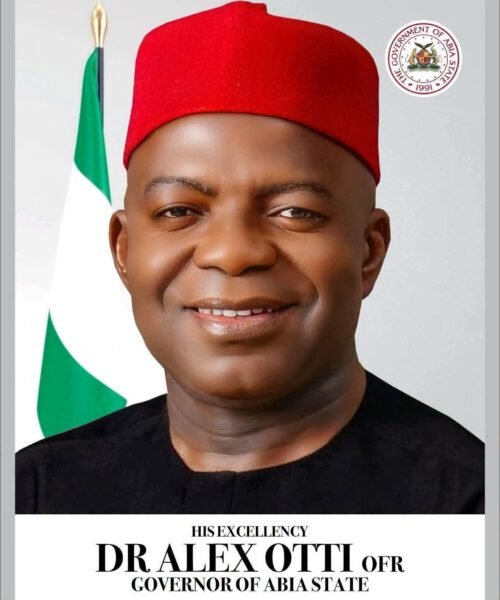


THE POLITICS OF DISTORTION: DISSECTING THE LATEST ATTACK ON ALEX OTTI
The latest attack on Governor Alex Otti is not a serious critique of governance. It is a politically loaded essay built on selective outrage, weak arithmetic, and deliberate refusal to understand how public administration actually works. The article in question, published here: https://thepantherdaily.com/2026/04/02/abia-apc-chieftain-accuses-gov-otti-of-deception-poor-performance-amid-rising-revenues/� tries to create the impression that Abia is swimming in limitless cash while nothing meaningful is happening on the ground.
That framing is false from the very beginning.
The first deception lies in the misuse of revenue figures. When critics say that about ₦1.5 trillion has come into Abia within 33 months, they want the public to imagine that this entire sum is idle cash available for instant physical projects. That is not how government finance works. Gross inflow is not the same thing as free money. A state’s revenue is consumed by debt obligations, salaries, pensions, recurrent spending, statutory deductions, counterpart funding, and inherited liabilities. To speak as though every naira that enters the treasury must immediately become a road, school, or estate is either profound ignorance or calculated dishonesty.
The reality of Abia’s budget process, like every serious government, involves layers of expenditure and phased execution. Even reports on Abia’s recent budget framework show the scale and complexity of expenditure planning. One useful reference is here: https://www.premiumtimesng.com/news/more-news/846340-gov-otti-signs-abias-2026-budget-into-law.html�
What makes this criticism even weaker is its historical amnesia. Alex Otti did not inherit a healthy, efficient, orderly state. He inherited a state burdened by backlogs, broken roads, weak institutions, urban disorder, and fiscal inefficiencies accumulated over many years. That reality matters because responsible reform does not begin with monuments. It begins with stabilization. Before a state can produce spectacular capital symbols, it must first repair the invisible machinery of governance. It must restore order in public finance, reduce leakages, resolve obligations, and create conditions under which capital projects can be meaningful and sustainable. This is why attacks that ask, “Where are the miracles?” within a short reform period are unserious. They erase the cost of inherited rot. A useful government-side reflection on the reconstruction challenge in Abia’s communities can be seen here: https://fmino.gov.ng/the-construction-of-obingwa-ukwa-east-lgas-marks-an-end-to-years-of-waste-and-missed-opportunities-governor-otti/�
The claim that “nothing is on ground except sanitation in Aba” is especially weak because it ignores one of the most important structural developments in Abia today: energy infrastructure. The Aba Integrated Power Project is not a rumour, not a press release, and not a party slogan. It is real, operational infrastructure. Geometric Power’s own project page describes the Aba Phase 1 system as a 141MW integrated power arrangement serving Aba and surrounding local government areas through embedded generation and dedicated distribution architecture. The project details are here: https://geometricpower.com/projects/aba-phase-i/� This is not cosmetic governance. It is productive infrastructure with the capacity to alter industrial output, reduce production costs, and transform the economic environment of one of Nigeria’s most commercially important cities. Any critic who dismisses that as mere sanitation politics is not arguing in good faith.
The same bad faith appears in the treatment of roads. There is a shallow school of political commentary that assumes every legitimate road investment must mean a brand-new expressway built from scratch. That is childish thinking. Governments all over the world combine rehabilitation and reconstruction because infrastructure strategy is not performance art. Sometimes the smartest use of resources is to restore mobility through rehabilitation of existing corridors. Sometimes full reconstruction is necessary. A government that responsibly mixes both is acting with efficiency, not weakness. Abia’s current road interventions, including major works in strategic corridors, are part of a broader process of reconnecting commerce and repairing accessibility. This is one of the reasons the comparison with total collapse under previous years is so stark. Again, a useful public reference is here: https://fmino.gov.ng/the-construction-of-obingwa-ukwa-east-lgas-marks-an-end-to-years-of-waste-and-missed-opportunities-governor-otti/�
The attack also throws around education spending figures as if public education investment must always produce one giant building that critics can photograph for social media. That is another distortion. Education expenditure is not limited to visible concrete. It includes rehabilitation, furnishing, equipment, institutional support, phased capital works, and multiple layers of programme implementation. Budget implementation reports are designed precisely to show that public expenditure is more complex than a single dramatic structure. Anyone serious about examining those figures should first read the budget documentation instead of weaponising headline numbers. One relevant document is here: https://s3.eu-west-2.amazonaws.com/openstates.ng.storage/documents/dataset_ABIA%20STATE%20QUARTER%20TWO%20BUDGET%20IMPLEMENTATION%20REPORT%20FOR%20THE%20YEAR%202025.pdf�
What critics also ignore is that Abia is not operating in isolation from larger capital programmes. The state is part of a major infrastructure agenda linked to the Federal Government and the African Development Bank through the ABSIID project. Reports indicate that this project is worth about $263.8 million and is designed to support road rehabilitation, urban infrastructure, waste systems, and environmental interventions in Abia. This is not propaganda. It is a serious capital framework with measurable scope. A report on the accelerated take-off of that project is here: https://www.thisdaylive.com/2026/03/26/fg-afdb-push-for-take-off-of-263m-projects-in-abia/
This matters because it shows that Abia under Otti is not drifting. It is plugging into structured development finance and long-term capital planning.
There is also the broader electricity strategy now making national headlines. Reports indicate that Otti’s administration is actively pushing toward reduced dependence on the national grid, building around the Geometric Power base and expanding with additional generation and off-grid plans. That is not ordinary politics. That is structural ambition. One of the reports on this direction is here: https://www.arise.tv/abia-to-exit-national-grid-as-otti-expands-independent-power-supply/
If pursued successfully, it will mean more than light. It will mean a stronger industrial base, improved investor confidence, and a more serious economic future for the state. Critics who cannot see the significance of this are trapped in a primitive view of governance where only painted buildings count as achievement.
Then there is the loyalty argument, which is perhaps the most unserious of all. The suggestion that Otti is deceptive because he engages President Tinubu while belonging to another platform reveals a childish understanding of politics. Governors are elected to negotiate interests for their states, not to perform emotional theatre for party purists. In a federal system, a governor who can engage the centre constructively while preserving his political identity is not disloyal. He is practical. Governance is not catechism. It is negotiation, alignment, and strategic maturity. That is how development happens.
The deeper philosophical problem with the anti-Otti article is that it treats governance like entertainment. It assumes that if change is not loud, immediate, and monumental, then it does not exist. But real reform is usually the opposite. It is gradual. It is layered. It begins with systems. It often looks unimpressive to those who only understand spectacle. Yet when it matures, it becomes durable. What Otti represents in Abia is not noise governance but systems governance. He is not governing for applause lines alone. He is trying to lay foundations—energy, roads, fiscal order, counterpart-funded infrastructure, and administrative reset. That is precisely why resistance is intensifying. System builders always threaten those who profited from disorder.
In the end, the article against Otti fails because it confuses accusation with proof. It offers heat without structure. It presents numbers without context. It ignores history, misunderstands public finance, and trivialises long-term reform. None of this means Otti is beyond criticism. He is not. No governor is. But criticism must be intelligent enough to deserve respect. This one is not. It is a loud political tract written for outrage, not for truth.
The truth is simpler and harder: Abia is in transition. That transition is not perfect, but it is real. And for all the shouting, that reality is exactly what Otti’s critics are struggling to bury.
AProf Chukwuemeka Ifegwu Eke