

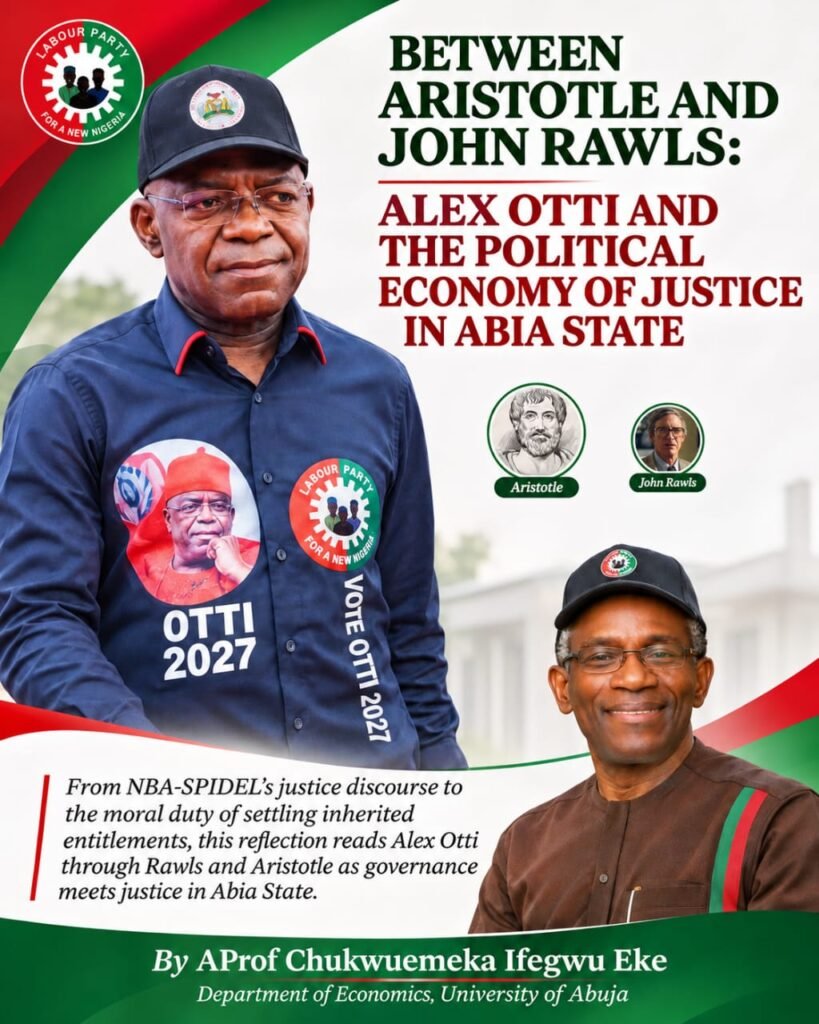
BETWEEN ARISTOTLE AND JOHN RAWLS: ALEX OTTI AND THE POLITICAL ECONOMY OF JUSTICE IN ABIA STATE
By AProf Chukwuemeka Ifegwu Eke
Department of Economics, University of Abuja
Friday, November 13, 2026
There is a fascinating intersection between political philosophy and the practical administration of government where the abstract propositions of great thinkers encounter the stubborn realities of human existence. It is at this intersection that I situate two developments involving the Governor of Abia State, Dr. Alex Chioma Otti: his participation in the 2026 Nigerian Bar Association Section on Public Interest and Development Law (NBA-SPIDEL) Annual Conference in Umuahia and his administration’s reported settlement of longstanding financial obligations to former elected councillors.
These developments raise questions about political legitimacy, institutional responsibility, the social contract and the moral foundations of public administration.
To appreciate their philosophical significance, I must begin with John Rawls.
JOHN RAWLS: JUSTICE AS THE FIRST VIRTUE OF PUBLIC INSTITUTIONS
In 1971, American political philosopher John Bordley Rawls published his monumental work, A Theory of Justice, which fundamentally reshaped contemporary political philosophy.
Rawls challenged the utilitarian proposition that social arrangements could be justified principally by their contribution to aggregate welfare. His argument was that the rights and legitimate interests of individuals should not simply disappear beneath calculations of collective advantage.
His opening proposition remains particularly instructive:
“Justice is the first virtue of social institutions, as truth is of systems of thought” (Rawls, 1971, p. 3).
This is considerably more than an elegant philosophical declaration. It is a demanding moral standard for evaluating the legitimacy of governmental institutions.
For Rawls (1971), a just society must establish institutions whose fundamental arrangements can be defended through principles of fairness.
His celebrated concepts of the original position and the veil of ignorance invite individuals to imagine designing society without knowing their eventual social position, economic circumstances or political influence.
Behind this veil, nobody knows whether he will become wealthy or impoverished, politically influential or socially marginalised.
Would rational individuals deliberately establish a government that could disregard legitimate financial obligations merely because the beneficiaries served under previous administrations?
Would they endorse a legal system in which constitutional rights are available in principle but prohibitively expensive to enforce?
These questions go directly to the relationship between justice and political authority.
Rawls subsequently elaborated his philosophical framework in Political Liberalism (1993) and Justice as Fairness: A Restatement (2001).
Across these works, one encounters an enduring intellectual concern: how should public institutions justify their exercise of authority over citizens who possess equal moral standing?
It is within this philosophical tradition that I examine the two developments in Abia State.
ARISTOTLE: THE ANCIENT FOUNDATIONS OF JUSTICE
Nearly twenty-four centuries before Rawls, Aristotle had already examined the moral foundations of justice in his Nicomachean Ethics.
In Book V, Aristotle distinguished between distributive justice and corrective justice.
Distributive justice addresses the allocation of benefits and burdens within political society, while corrective justice concerns the rectification of wrongs and unjust imbalances (Aristotle, 2009).
This distinction is particularly relevant to the responsibilities of contemporary governments.
When public authorities allocate resources, they confront questions of distributive justice.
When they discharge legitimate obligations that have remained unsettled, they may be addressing questions associated with corrective justice.
Although Rawls and Aristotle operated within profoundly different intellectual traditions, their respective contributions illuminate the ethical responsibilities of political institutions.
Rawls focuses substantially on the principles governing society’s basic structure, whereas Aristotle situates justice within a broader account of virtue, citizenship and political community.
Indeed, one must be historically precise: Aristotle preceded Rawls by more than two millennia. Rawls’s philosophical contributions belong to a much later intellectual tradition, although both thinkers addressed fundamental questions about justice.
The significance of their intellectual relationship lies in the continuing relevance of those questions.
Can political authority be regarded as legitimate without an accompanying commitment to justice?
Can government discharge its moral responsibilities merely by observing formal procedures?
And should political transitions extinguish obligations legitimately owed by the state?
These questions lead me directly to Umuahia.
UMUAHIA, NOVEMBER 2026: JUSTICE ENTERS THE PUBLIC ARENA
Between November 9 and 13, 2026, Umuahia hosted activities associated with the Annual Conference of the Nigerian Bar Association Section on Public Interest and Development Law.
The principal conference programme was scheduled for November 10–13, 2026, at the International Conference Centre, Umuahia, Abia State.
The conference theme was:
“IN PUBLIC INTEREST: ADVANCING JUSTICE, DEMOCRACY AND DEVELOPMENT.”
The conference was organised by NBA-SPIDEL and co-hosted by the Abia State Government.
Its leadership included Associate Professor Uju Agomoh, Chairperson of NBA-SPIDEL; Sir Ejike Ezenwa, SAN, Chairman of the Conference Planning Committee; and Paul Ogubunka, Solicitor-General of Abia State and Chairman of the Local Organising Committee (Law & Society Magazine, 2026a).
Reporting on October 30, 2026, Favour Onyebuchi of The Whistler disclosed that the organisers anticipated more than 2,000 delegates, including legal practitioners, judges, academics, policymakers and development partners (Onyebuchi, 2026).
The gathering was designed to examine justice, democratic accountability, constitutional governance, human rights, institutional reform and development.
Earlier, Law & Society Magazine (2026b) reported that Associate Professor Agomoh had emphasised the need for the conference to produce practical outcomes rather than merely generate speeches and resolutions.
Former Vice-President Professor Yemi Osinbajo, SAN, was announced as keynote speaker, while other distinguished legal personalities were expected to participate (Nwokoro, 2026).
However, the philosophical significance of the event became particularly apparent in Governor Otti’s intervention.
In a report published on Thursday, November 12, 2026, Gordi Udeajah of The Guardian documented the governor’s appeal to legal practitioners to make legal representation accessible to indigent and vulnerable Nigerians.
Governor Otti made the appeal while declaring open the NBA-SPIDEL Annual Conference at the International Conference Centre in Umuahia.
According to Udeajah (2026), the governor emphasised the responsibility of legal practitioners to assist citizens whose rights had been violated but whose financial circumstances prevented them from obtaining adequate legal representation.
He also cautioned against using the justice system to punish individuals for expressing political opinions or participating in social-media activities.
The same development was independently reported by Emmanuel Adetayo of Legal Nigeria on November 12, 2026 (Adetayo, 2026).
For me, this intervention raises an important Rawlsian question:
What is the practical value of a constitutional right when the person entitled to exercise it cannot afford the machinery necessary for its enforcement?
Formal equality before the law does not necessarily produce equality of effective access.
A wealthy litigant may retain experienced legal practitioners, finance prolonged proceedings and pursue remedies through several judicial stages.
A financially vulnerable citizen may struggle to obtain elementary legal advice.
Both individuals may theoretically possess identical constitutional rights, yet their practical capacities to enforce those rights differ considerably.
This distinction is central to the political economy of justice.
Rawls’s account of fair institutions provides a framework for interrogating arrangements that permit economic circumstances to undermine meaningful access to fundamental protections (Rawls, 1971, 2001).
Aristotle’s conception of corrective justice similarly encourages reflection on the institutional mechanisms through which recognised wrongs can be remedied (Aristotle, 2009).
Governor Otti’s reported appeal therefore invites an examination of the relationship between formal legal guarantees and substantive access to justice.
Nevertheless, intellectual honesty requires a distinction between policy advocacy and demonstrated institutional outcomes.
An appeal for accessible legal representation is not, by itself, evidence that legal services have become universally accessible.
Such a conclusion would require additional evidence concerning legal-aid provision, judicial infrastructure, affordability and measurable improvements in access to justice.
The philosophical importance of the governor’s intervention lies in the institutional question it raises and the responsibilities it places before the legal profession and public authorities.
THE FORMER COUNCILLORS: WHEN POLITICAL AUTHORITY CONFRONTS INHERITED OBLIGATIONS
The second development was reported on Thursday, November 12, 2026.
On that date, members of the Association of Former Elected Councillors of Abia State, comprising individuals who served between 1999 and 2022, visited Government House, Umuahia.
The delegation acknowledged the intervention of the Otti administration in addressing outstanding salaries and entitlements inherited from previous administrations.
According to The Whistler (2026), the association was led by its chairman, Hon. Tony Agbanyim.
The report stated that the association had previously met with Governor Otti on February 15, 2026, following which approval was given for payments to commence.
Disbursements reportedly began on March 8, 2026.
The former councillors acknowledged receiving financial relief from the intervention, although the report also indicated that some obligations remained outstanding.
This development invites a fundamental philosophical question:
Can a government legitimately disclaim the obligations of the state merely because those obligations originated under a previous administration?
My answer begins with the principle of institutional continuity.
Political administrations are temporary custodians of public authority.
The state, however, possesses a continuing institutional existence.
Consequently, a change of political leadership does not ordinarily extinguish valid legal obligations previously incurred by the state.
The precise enforceability of any individual claim depends upon the applicable law and supporting records, but the broader principle of institutional continuity remains important.
Here, Aristotle’s distinction between distributive and corrective justice becomes particularly useful.
Where legitimate entitlements have been withheld, their subsequent settlement may be understood through the framework of correcting an existing imbalance.
Aristotle’s account of corrective justice concerns the restoration of fairness where an unjust advantage or disadvantage has arisen (Aristotle, 2009).
Rawls introduces an additional dimension.
His theory of justice as fairness challenges institutional arrangements that make the enjoyment of legitimate rights dependent upon arbitrary privilege or unequal political influence (Rawls, 1971).
The central issue, therefore, is not simply whether money was paid.
It concerns whether valid obligations of the state should be honoured consistently, irrespective of political transitions.
The reported intervention in Abia State provides an opportunity to examine that question in concrete administrative terms.
THE POLITICAL ECONOMY OF JUSTICE: WHY UNPAID OBLIGATIONS MATTER
As an economist, I cannot examine these developments exclusively through ethical philosophy.
The delayed settlement of legitimate public obligations also raises important questions concerning household welfare, government expenditure and fiscal sustainability.
When valid financial entitlements remain unpaid, the consequences may extend beyond the immediate beneficiaries.
Affected households may experience reduced consumption, accumulated debts, deferred medical expenditure and diminished capacity to undertake productive investments.
Conversely, settling outstanding obligations can provide liquidity to beneficiary households and potentially support economic activity.
However, the magnitude of these effects depends upon the value of payments, the number of beneficiaries, their expenditure patterns and prevailing economic conditions.
The classical economic insight that expenditure generates income for other economic agents provides a useful framework for examining such relationships (Keynes, 1936).
Nevertheless, Keynesian demand analysis does not establish that every arrears payment necessarily generates a large or measurable economic multiplier.
That proposition requires empirical investigation.
The available newspaper reporting does not provide a comprehensive, independently audited account of the aggregate amount paid to the former Abia councillors.
Accordingly, I would resist the temptation to manufacture figures or exaggerate the economic effects.
The defensible conclusion is that the reported payments may have improved the financial circumstances of beneficiaries while raising broader questions about the fiscal management of inherited government liabilities.
Public finance must continually reconcile three responsibilities: financing current services, honouring legitimate existing obligations and maintaining fiscal sustainability.
A credible settlement programme therefore requires verification of claims, transparent payment procedures, defensible prioritisation and responsible budgetary management.
These are not merely accounting considerations.
They are institutional dimensions of justice.
ONE GOVERNOR, TWO DEVELOPMENTS, ONE PHILOSOPHICAL QUESTION
I find the intellectual relationship between the two developments especially significant.
At the NBA-SPIDEL Conference, Governor Otti addressed the problem of citizens who possess constitutional rights but may lack the economic capacity to enforce them.
In the former councillors’ case, his administration was reported to have commenced the settlement of longstanding financial entitlements.
The first development concerns access to justice.
The second concerns institutional responsibility and the settlement of legitimate obligations.
Both raise questions about the moral responsibilities of governmental authority.
Yet neither development should be interpreted in isolation from its institutional context.
At the conference, the governor’s intervention formed part of a broader professional conversation involving the Nigerian Bar Association, judicial stakeholders and public-interest advocates (Udeajah, 2026; Adetayo, 2026).
In the councillors’ case, the reported payments formed part of an administrative process that had not yet resolved every outstanding claim (The Whistler, 2026).
These distinctions are essential to serious political analysis.
Rawls reminds us that justice is a foundational standard for evaluating institutions.
Aristotle directs attention to the ethical relationships through which justice is expressed.
Contemporary political economy examines the resources, incentives and administrative structures through which public responsibilities are discharged.
Taken together, these perspectives lead to a demanding question:
Does the legitimacy of political power rest merely upon its lawful acquisition, or must it also be demonstrated through the continuing discharge of public obligations and the protection of citizens’ rights?
This is not a question that can be answered conclusively through two reported events.
It is, however, a question that those events make particularly relevant.
THE GREATER PHILOSOPHICAL LESSON
Political philosophy should not remain imprisoned within university lecture theatres.
Its intellectual significance becomes especially apparent when its principles illuminate the lived experiences of ordinary citizens.
What does justice mean to a former public official who has awaited a legitimate financial entitlement for years?
What does equality before the law mean to a vulnerable citizen who cannot afford legal representation?
What does constitutional government mean when effective access to legal remedies is constrained by poverty?
And what does institutional continuity mean when successive administrations inherit responsibilities they did not personally create?
These questions connect the philosophical traditions of Aristotle and Rawls to the practical challenges of contemporary governance.
The developments reported from Umuahia on November 12, 2026, deserve examination beyond conventional political publicity.
The NBA-SPIDEL Conference placed justice, democracy and development at the centre of a national legal conversation.
The engagement with former councillors brought the responsibilities of the state towards existing beneficiaries into immediate administrative focus.
Neither event eliminates the need for sustained scrutiny, institutional improvement or evidence-based evaluation.
However, both provide concrete material for examining political morality, legal accessibility and public financial responsibility.
I return, therefore, to Rawls’s central proposition that justice occupies a foundational position in the evaluation of social institutions (Rawls, 1971).
And I return equally to Aristotle’s insistence that justice must concern actual relationships, obligations and the correction of wrongs (Aristotle, 2009).
Between these philosophical traditions lies a continuing challenge for contemporary government:
Public authority must be examined not only by what it promises, but also by the fairness of its institutions, the obligations it honours and the remedies it makes available.
For me, that is the enduring intellectual significance of the two developments involving Governor Alex Otti.
It is also why the conversation between Aristotle and John Rawls remains relevant to the political economy of justice in twenty-first-century Nigeria.
AProf Chukwuemeka Ifegwu Eke
Department of Economics
University of Abuja
November 13, 2026
REFERENCES
Adetayo, E. (2026, November 12). Otti urges lawyers to provide free legal services to indigent Nigerians. Legal Nigeria.
Aristotle. (2009). The Nicomachean ethics (D. Ross, Trans.; L. Brown, Rev.). Oxford University Press. (Original work published ca. 350 BCE).
Keynes, J. M. (1936). The general theory of employment, interest and money. Macmillan.
Law & Society Magazine. (2026a, September 1). NBA-SPIDEL takes public interest law to Umuahia for 2026 annual conference.
Law & Society Magazine. (2026b, October 6). NBA-SPIDEL conference: Lawyers turn spotlight on deaths in custody, democracy, corruption and access to justice.
Nwokoro, S. (2026, November 3). CJN, Osinbajo, others to attend annual NBA-SPIDEL confab. The Guardian.
Onyebuchi, F. (2026, October 30). Abia to host over 2,000 delegates for NBA conference. The Whistler.
Rawls, J. (1971). A theory of justice. Harvard University Press.
Rawls, J. (1993). Political liberalism. Columbia University Press.
Rawls, J. (2001). Justice as fairness: A restatement (E. Kelly, Ed.). Harvard University Press.
The Whistler. (2026, November 12). Abia ex-councillors endorse Otti for second term.
Udeajah, G. (2026, November 12). Otti urges lawyers to offer free legal services to indigent Nigerians. The Guardian.
END OF ARTICLE