
EKE O AKO CAUGHT BY HIS OWN NUMBERS: 2023–2025 ‘OTTI MARGINALISATION’ POST SAYS ZERO WHERE ITS OWN TABLE RECORDS MILLIONS

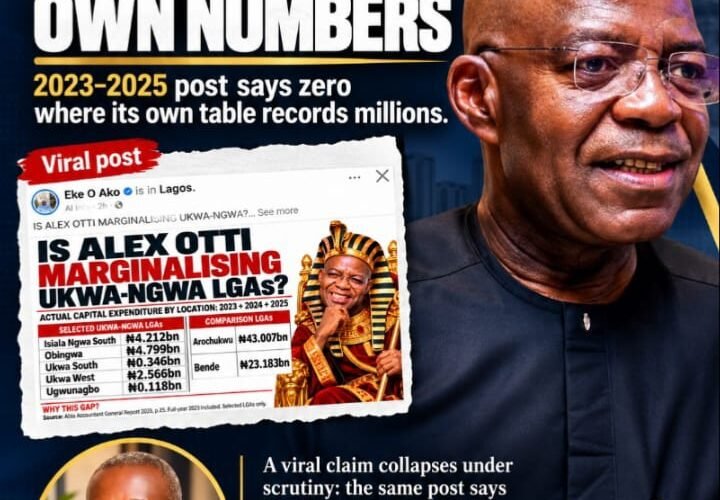
A viral post by Eke O Ako, published on 28 September 2026, asks whether Governor Alex Otti is “marginalising Ukwa-Ngwa” and presents selected capital-expenditure figures for 2023, 2024 and 2025 as proof.
But the argument runs into a basic problem: some of the strongest claims in the write-up are contradicted by the figures displayed in the same post.
FIRST CONTRADICTION: UGWUNAGBO
Eke O Ako writes:
“Ugwunagbo got absolutely nothing.”
Yet the graphic attached to his own post lists:
Ugwunagbo — ₦118 million.
The official Abia State Accountant-General report for the year ended 31 December 2023 records approximately ₦118.4 million in actual capital expenditure for Ugwunagbo.
So the question is simple:
How does ₦118 million become “absolutely nothing”?
The 2024 Accountant-General report subsequently recorded zero actual capital expenditure for Ugwunagbo in that year, but zero in 2024 is not the same as zero throughout the 2023–2025 period being presented in the post. 0
SECOND CONTRADICTION: UKWA EAST
The post also states:
“Ukwa East got nothing.”
Yet Eke O Ako’s own graphic lists:
Ukwa East — ₦346 million.
Therefore, even before consulting another document, the written claim conflicts with the evidence presented by its author.
The official Accountant-General documents contain a further technical issue worth noting: the expenditure schedule uses the label “Ukwa South”, although Abia State has Ukwa East and Ukwa West LGAs. The 2023 schedule records about ₦18.83 million under that label, while the 2024 schedule records approximately ₦3.256 million. That classification anomaly should be reconciled against the detailed accounting records, not converted into a claim of “nothing.” 1
THIRD PROBLEM: BENDE BECOMES OHAFIA
Eke O Ako further writes:
“He also spent N23bn in developing Ohafia within the same period.”
But his own graphic does not assign ₦23.183 billion to Ohafia.
It assigns that figure to:
BENDE — ₦23.183 billion.
Bende is not Ohafia.
The official 2024 Accountant-General report itself records actual capital expenditure of approximately:
Bende — ₦12.415 billion
Ohafia — ₦4.956 billion
for 2024.
These are separate LGAs, with separate expenditure figures. 2
When an allegation of geographical or sectional favouritism is built on comparisons between local governments, mixing up the identities of those LGAs is not a trivial mistake. It goes directly to the reliability of the argument.
THE FIGURES LEFT OUT OF THE STORY
The larger problem is the selective presentation.
The official Accountant-General report for 2024 records approximately:
- Umuahia North — ₦116.535 billion
- Aba South — ₦34.059 billion
- Arochukwu — ₦14.588 billion
- Aba North — ₦13.193 billion
- Bende — ₦12.415 billion
- Osisioma — ₦6.818 billion
- Ohafia — ₦4.956 billion
- Isiala Ngwa North — ₦4.537 billion
- Isiala Ngwa South — ₦2.314 billion
These are actual capital-expenditure figures reported for 2024. 3
Now ask the obvious question:
If the purpose of the viral comparison is to establish that Arochukwu and Bende were extraordinarily favoured, why omit Umuahia North, Aba South and Aba North, all of which recorded major expenditure?
In fact, Umuahia North alone recorded approximately ₦116.5 billion in 2024, far exceeding the amount recorded for Arochukwu or Bende that year. 4
LOOK AT 2023 AND 2024 TOGETHER
The broader official record makes the selective framing even more problematic.
For 2023, the Accountant-General report records approximately:
Aba South — ₦8.960 billion
Aba North — ₦6.500 billion
Arochukwu — ₦718.8 million
Bende — ₦16.5 million
Isiala Ngwa South — ₦20 million
Obingwa — ₦172.375 million
Ugwunagbo — ₦118.4 million
Ukwa West — ₦419.745 million
The same report records an especially large figure of approximately ₦42.985 billion for Umuahia North. 5
Adding the official 2023 and 2024 figures gives approximately:
Aba South — ₦43.02 billion
Aba North — ₦19.69 billion
Arochukwu — ₦15.31 billion
Bende — ₦12.43 billion
That means Aba North and Aba South together recorded roughly ₦62.7 billion in actual capital expenditure over 2023–2024, compared with about ₦27.7 billion for Arochukwu and Bende combined over the same period. 6
Those figures do not prove that every LGA received an equal share of government investment.
They do show, however, why a serious statewide analysis cannot be reduced to a comparison involving only a handful of selected LGAs.
WHAT DOES “CAPITAL EXPENDITURE BY GEO-LOCATION” ACTUALLY MEAN?
This is perhaps the most important methodological point.
The Accountant-General reports classify capital expenditure by geographical location.
That is not automatically the same thing as measuring which ethnic group received the economic benefit.
A road can physically lie within one local government and still serve several communities.
A hospital located in one LGA may treat residents from across the state.
A bridge, drainage system, government building, market, school or transport infrastructure may be booked against a geographical location while delivering benefits beyond that boundary.
Therefore:
“₦X billion was recorded in LGA A”
does not automatically mean:
“₦X billion was spent exclusively for the people of LGA A.”
That distinction is crucial before turning accounting classifications into conclusions about sectional treatment.
2023 ALSO NEEDS PROPER CONTEXT
Governor Alex Otti assumed office in May 2023.
The Accountant-General report for 2023 covers the financial year ending 31 December 2023.
Accordingly, caution is needed before describing every expenditure appearing in the 2023 fiscal-year report as expenditure initiated solely by the Otti administration.
Some expenditure could relate to projects, commitments or processes originating earlier in that financial year.
A rigorous analysis should distinguish those categories rather than treating the entire 2023 calendar year as one undifferentiated political period.
QUESTIONS SHOULD BE ASKED — BUT NUMBERS MUST BE PRESENTED CORRECTLY
There is nothing wrong with asking difficult questions about public expenditure.
Citizens are entitled to demand:
Where are the projects?
What did they cost?
Who executed them?
Where are they located?
What percentage has been completed?
Who benefits from them?
Those are legitimate accountability questions.
But anybody using public accounts to make political allegations also has a responsibility to handle those accounts accurately.
If your write-up says:
“Ugwunagbo got absolutely nothing,”
while your own graphic says:
₦118 million,
readers are entitled to question the claim.
If you say:
“Ukwa East got nothing,”
while your own graphic says:
₦346 million,
readers are entitled to question the claim.
If you write:
“₦23bn was spent in Ohafia,”
while the table you published attributes ₦23.183 billion to Bende, readers are entitled to question the claim.
And if you compare Arochukwu and Bende with selected Ukwa-Ngwa LGAs while omitting massive expenditures recorded for Umuahia North, Aba South and Aba North, readers are entitled to ask whether they have been given the complete picture.
THE PROPER TEST
Instead of trading allegations, the more useful exercise is straightforward:
Publish the project-by-project expenditure for all 17 LGAs for 2023, 2024 and 2025.
Show:
The project.
Its location.
The contract sum.
The amount actually paid.
Its commencement date.
Its completion status.
And the communities it serves.
That would allow Abians to judge geographical distribution from comprehensive evidence.
The Abia State Government maintains an online repository of budgets and financial reports where the underlying public documents can be examined. 7
Public scrutiny of government is necessary.
But so is scrutiny of viral claims about government.
Because when an argument is built around numbers, those numbers must first survive:
Arithmetic.
Geography.
Context.
And their own source documents.
On several of those tests, Eke O Ako’s 28 September 2026 post contradicts itself before anyone even gets to the politics.