
A PARAGRAPHIC CRITIQUE OF THE “WHERE ARE GOVERNOR OTTI’S LEGACY PROJECTS?” ARGUMENT
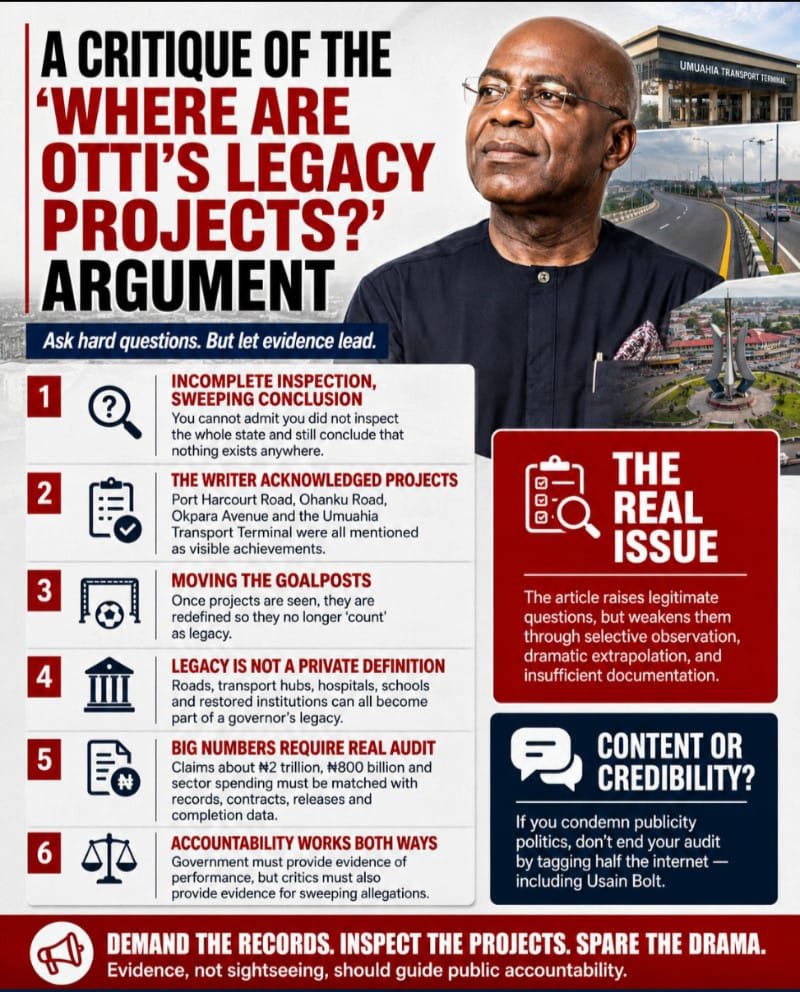
The central weakness of the argument is not that it asks questions about Governor Alex Otti’s performance. Those questions are legitimate. Every governor should be subjected to scrutiny over expenditure, project completion, value for money, rural inclusion, pensions, hospitals, schools, electricity and industrial development. The problem is that the writer repeatedly moves from limited personal observation to sweeping statewide conclusions. He admits that he did not visit every part of Abia, specifically acknowledging that he did not visit the Old Bende axis, yet he confidently concludes that there is no identifiable completed legacy project anywhere in the state. That is a serious methodological contradiction. If your inspection was geographically incomplete, your conclusion must also be qualified. You cannot say, in one breath, that you did not inspect the whole state and, in the next, declare authoritatively that nothing exists anywhere in the state.
The argument becomes even more problematic because the writer actually acknowledges several visible projects. He mentions the reconstructed Port Harcourt Road in Aba, Ohanku Road, the Okpara Avenue axis of Umuahia and the Umuahia transport terminal. These are not imaginary projects; they are developments he personally says he saw. Yet, instead of incorporating them into a balanced assessment, he simply excludes them from consideration by declaring that they do not qualify as “legacy projects.” This creates a convenient moving goalpost. Once a completed project is visible, it is dismissed as routine rehabilitation. If a project is ongoing, it is described as nonexistent. If a project has been announced but not completed, it is called propaganda. Under such a framework, practically no administration can satisfy the critic because the definition of success changes whenever evidence of delivery appears.
There is also a deeper conceptual problem with the phrase “legacy project.” It is not a formal accounting category. It is a political and historical description that is usually determined over time by the scale, impact and durability of a government intervention. A road that permanently transforms commercial movement can become a legacy project. A transport terminal can become one. A major hospital, industrial cluster, drainage system, educational reform or restored public institution can become part of a government’s legacy. The writer appears to define legacy almost exclusively as a spectacular new city, industrial complex, health village or similarly monumental project. That is his personal standard, not an objective fiscal rule. The effect is that he sets up a test that automatically discounts rehabilitation, institutional restoration and incremental transformation even where such interventions may have major economic value.
The claim that enormous sums have been received or spent also requires far more discipline than the article demonstrates. Figures such as ₦2 trillion, ₦800 billion, ₦300 billion, ₦100 billion and ₦50 billion are repeatedly mentioned, but there is little attempt to reconcile the categories. Public finance cannot be analysed merely by placing large numbers beside visible infrastructure and asking where the money went. A serious evaluation must distinguish between total revenue, FAAC receipts, internally generated revenue, grants, loans, budgeted capital expenditure, actual capital releases, commitments, recurrent obligations and transfers. If the writer claims that approximately ₦800 billion was spent on capital development, then the responsible next step is to match that amount against project schedules, contract values, payments, locations, completion levels and procurement records. Otherwise, the analysis becomes what might jokingly be called Facebook forensic accounting: huge numbers, dramatic conclusions and insufficient reconciliation.
The hospital argument suffers from the same tendency toward absolutes. Saying that Abia “cannot boast of a single fully functional public hospital” is not merely an opinion; it is a testable empirical claim. To establish that proposition, the writer would need to define what constitutes “fully functional” and examine hospitals across the state in terms of staffing, equipment, bed capacity, diagnostics, surgery, pharmacy services, patient numbers and operational hours. It may well be that important health facilities remain inadequate, that some general hospitals are still dysfunctional and that rural areas deserve far more attention. Those are defensible criticisms. But “not a single functional hospital” is a sweeping statement that requires statewide evidence rather than a few examples of facilities that remain in poor condition.
The discussion of schools has a similar flaw. Asking where the new schools are is legitimate, especially where substantial capital expenditure has been reported. But a serious review should distinguish new construction from renovation, rehabilitation, classroom expansion, model schools, technical schools and ongoing work. The writer seems to treat anything that is not a brand-new completed institution as evidence that nothing meaningful has been achieved. That collapses different forms of capital investment into one simplistic category. A proper investigation would name the schools, identify their locations, establish the amount budgeted and released, determine completion levels and compare those findings with government claims. Without that exercise, the criticism risks substituting impression for audit.
The electricity section is also logically weak. The fact that the writer’s village has reportedly remained without power for an extended period is a legitimate grievance and deserves attention. But it does not logically prove that electricity interventions have not occurred elsewhere in Abia. A state can have ongoing electricity projects while some communities remain underserved. The stronger argument would be that the benefits are unevenly distributed, that rural communities have not received adequate attention or that the public narrative of widespread electricity access may exaggerate actual coverage. Those are serious points. But one community’s darkness cannot, by itself, establish the absence of an entire state electricity programme.
Ironically, the section on the Abia Industrial and Innovation Park contains one of the stronger accountability issues in the article, yet even there the argument would benefit from less theatre and more documentation. If public money has been committed to the project, then the proper questions are straightforward: how much has been released, to whom, for what infrastructure, what percentage completion has been achieved, what contractual milestones were specified and what is the revised delivery timetable? If the site remains substantially undeveloped after major expenditure, that is a serious matter. But saying simply that “the site is a forest” may be rhetorically effective while still falling short of the evidentiary standard required to establish waste, fraud or non-performance.
The writer’s personal account of struggling to reach his family home also creates an interesting tension between local grievance and statewide analysis. If his community lacks a proper access road, that is an important example of rural infrastructure deficiency. The people living there have every right to demand better. But the absence of an access road to one person’s house or community cannot automatically be transformed into proof that the state’s entire capital budget has produced little value. The evidence establishes one thing: a particular area may have been neglected. It does not establish the broader financial conclusion without additional evidence. There is a difference between saying, “My community remains underserved,” and saying, “Therefore, hundreds of billions of naira have achieved nothing.”
The security imagery surrounding the visit also lends itself to a certain irony. If someone presents the journey to his ancestral community almost as an expedition through hostile territory, complete with bush paths and security concerns, readers are entitled to wonder what precisely the security threat was. Who was expected to harm him? Was there a documented threat, or was the dramatic presentation simply part of the storytelling? Nobody should trivialise genuine personal-security concerns, but neither should dramatic imagery substitute for infrastructure analysis. A road may be bad without the journey becoming a political thriller.
The most comic contradiction arrives at the end of the post. The writer criticises the Otti administration for media management, publicity and excessive attention to narrative control, yet concludes by tagging a remarkable collection of journalists, politicians, international organisations, celebrities and even Usain Bolt. At that point, one must ask whether the article is purely an accountability intervention or partly an exercise in social-media amplification. If excessive publicity is objectionable, then summoning half the internet to a political post creates an obvious irony. One can almost ask: what exactly is Usain Bolt expected to do about Abia infrastructure—inspect the roads or run on them? If the objective is virality, perhaps the writer should simply admit that content creation is part of the strategy. CONTENT CREATORRRRRR! 😂
There is also an element of selective awareness in the way the argument is constructed. The writer demonstrates enough familiarity with public finance to quote large allocation and expenditure figures, but appears far less interested in examining budget implementation documents, procurement records, project-by-project expenditure schedules and completion reports. That creates the impression of knowing precisely which numbers are useful for outrage while becoming suddenly incurious about the records required to test the conclusion. If one wishes to accuse a government of spending enormous sums without commensurate results, the strongest weapon is not rhetoric. It is documentation.
None of this means that Governor Otti should be shielded from scrutiny. Quite the opposite. His administration should be questioned rigorously about project costs, contract awards, rural roads, electricity coverage, school reconstruction, hospital functionality, pensions, industrial projects, local-government expenditure and geographical balance. If an industrial park is delayed, government should explain why. If hospitals are not functioning, that should be exposed. If villages remain inaccessible, those communities should demand answers. If capital expenditure cannot be matched with physical output, that is a legitimate public-finance concern. But criticism becomes much stronger when it is precise, internally consistent and evidence-led.
The fairest conclusion, therefore, is that the article raises several questions worth investigating but weakens them through selective observation, moving definitions, sweeping absolutes and dramatic extrapolation. It asks government to meet a forensic standard while sometimes relying on sightseeing as its own standard of proof. Accountability should work both ways. If Governor Otti must produce evidence for every claim of achievement, then those accusing his government of having produced virtually nothing must also provide evidence for their claims.
And perhaps there is one final lesson in all of this. If you are going to condemn publicity politics, do not end your supposed fiscal audit by tagging everyone from Transparency International to Peter Psquare and Usain Bolt. 😂 At that stage, the line between policy criticism and content production becomes very thin indeed.
Ask the hard questions. Demand the records. Audit the expenditure. Inspect the projects. But please, spare Usain Bolt. The man has retired from running. 😂😂😂