
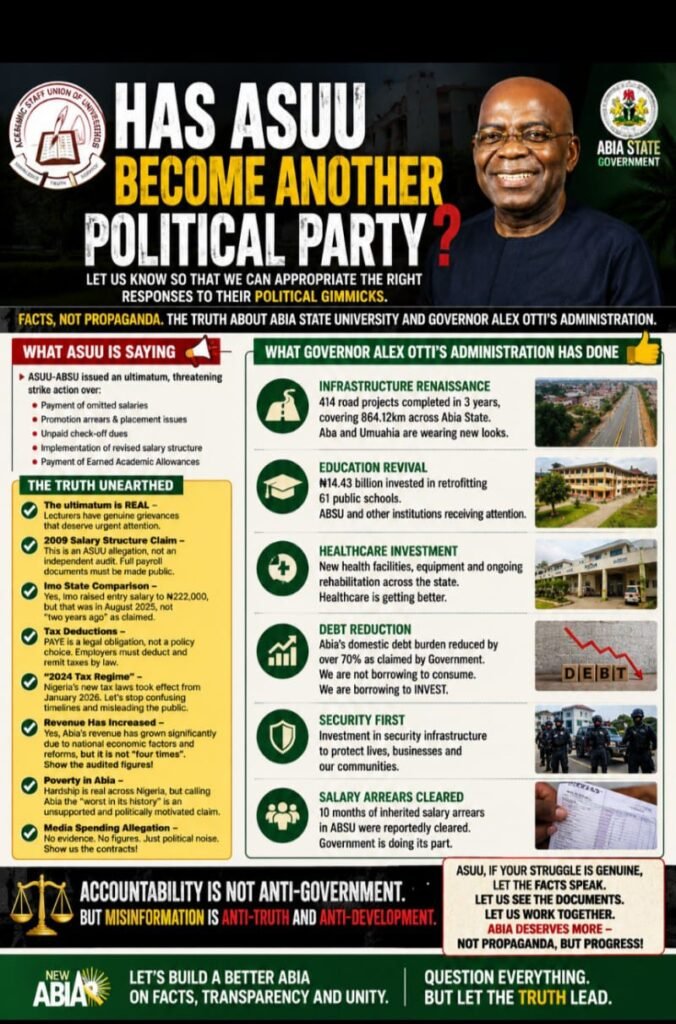
ABSU, ASUU AND THE OTTI ADMINISTRATION: UNEARTHING THE TRUTH BEHIND THE STRIKE THREAT
A fact-based response to claims of obsolete salaries, punitive taxation, propaganda and worsening poverty in Abia State
A recent political publication claims that the Academic Staff Union of Universities at Abia State University has threatened industrial action because lecturers are allegedly still being paid under the 2009 salary structure. It compares Abia unfavourably with Imo State, accuses the Abia Government of rushing to impose a new tax regime, alleges that state revenue has increased fourfold and concludes that Governor Alex Otti spends heavily on propaganda while Abians experience unprecedented poverty.
The publication contains a genuine labour grievance. It also contains distortions, unsupported conclusions and an inaccurate timeline.
A responsible response must not deny the authentic concerns raised by lecturers. Neither should it permit a legitimate industrial dispute to be converted into proof of every political accusation made against the Abia State Government.
The facts must be separated from the propaganda.
ASUU’S ULTIMATUM IS REAL—BUT IT IS AN INDUSTRIAL DEMAND, NOT PROOF OF GOVERNMENT DECEIT
The first point must be admitted plainly: the reported ultimatum by the Abia State University branch of ASUU is not imaginary.
A report published on 3 August 2026 states that a letter jointly signed by the ASUU-ABSU Chairperson, Dr Chidi S. Mba, and the Branch Secretary, Dr Victor U. Obisike, was addressed to the Pro-Chancellor and Chairman of the Governing Council as well as the Vice-Chancellor. According to the report, the union said its congress had given the university management and state government a deadline to address outstanding welfare matters or face industrial action.
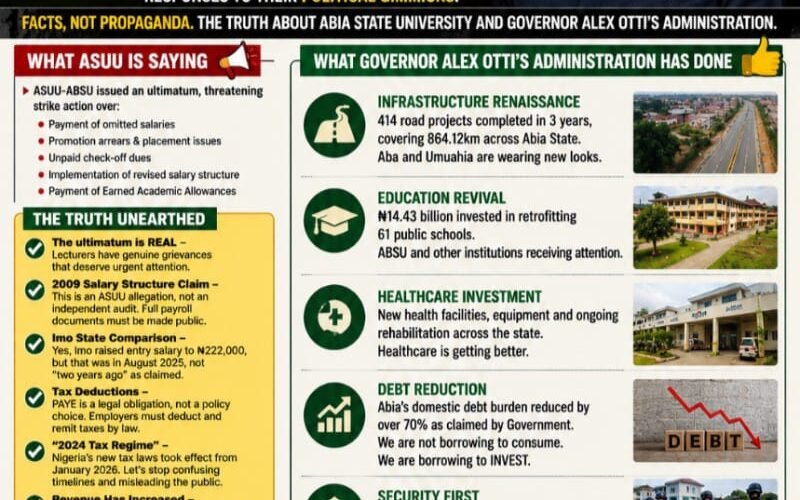
The listed demands reportedly included payment of omitted salaries, proper placement of promoted staff, implementation of the financial benefits attached to promotions, payment of eleven months of deducted check-off dues, implementation of a revised academic salary structure and the payment and mainstreaming of Earned Academic Allowances.
Those are substantial issues. They should not be dismissed as opposition propaganda merely because the political opposition has seized upon them.
However, an ASUU ultimatum does not establish that Governor Otti is personally hostile to lecturers, nor does it prove that the administration has diverted money intended for university salaries. It establishes that a labour dispute exists and that the union believes agreements and salary obligations have not been fully implemented.
Industrial disputes occur under federal and state governments across Nigeria. ASUU also issued an ultimatum to the Federal Government in March 2026 over delays in implementing a newly approved salary arrangement. That dispute did not automatically prove that every allegation ever made against the Federal Government was true.
The fair conclusion is that ABSU lecturers have presented serious demands requiring an urgent, documented response. The unfair conclusion is that their ultimatum automatically proves every accompanying allegation about looting, propaganda, taxation, poverty and revenue.
IS ABSU REALLY PAYING THE 2009 SALARY STRUCTURE?
The claim that ABSU continues to pay academic staff under the 2009 structure comes directly from the reported statement of the ASUU-ABSU Chairperson. Dr Mba was quoted as saying that ABSU remained the only university in ASUU’s Calabar Zone paying academic staff under the 2009 structure while applying more recent tax deductions.
This is therefore not a claim invented by the Facebook author. It is an allegation attributed to the union’s branch leadership.
But it has not yet been independently proved through the publication of ABSU’s official salary table, staff payslips, payroll circulars and the university management’s formal response.
That distinction matters.
The union’s statement is credible evidence that a dispute exists. It is not the same thing as an independently audited payroll comparison. To establish the claim conclusively, the following documents should be made public:
- The salary structure currently used by ABSU.
- The salary structure approved under the relevant federal or national agreement.
- Representative anonymised payslips for each academic rank.
- The date on which the revised structure was communicated to state universities.
- Any resolution or agreement reached between ASUU-ABSU, the university management and the Abia State Government.
- The financial implications of implementation, including arrears.
Until those documents are produced, it would be wrong for government supporters to declare ASUU’s claim false. It would also be wrong for political actors to present the claim as though an independent audit has already established every amount allegedly owed.
The truth presently available is narrower: ASUU-ABSU says the old structure is still being applied, and that allegation requires an immediate, evidence-based answer from ABSU management and the state government.
THE ISSUE DID NOT BEGIN WITH THIS ULTIMATUM
The current dispute must also be understood within a longer history of salary problems at ABSU.
In July 2025, about 200 lecturers reportedly complained that they had not received twelve months of salaries following appointments made in 2023. They appealed to Governor Otti to intervene.
ABSU management disputed that account. It stated that the affected lecturers were employees engaged during a period of employment review and that the university was not generally owing its lecturers twelve months of salaries. Management also said that ten months of inherited salary arrears had been cleared under the Otti administration.
This history reveals two simultaneous realities.
First, ABSU has faced genuine payroll and employment disputes. Government should not minimise the distress of lecturers whose salaries, placements, promotions or allowances remain unresolved.
Second, the Otti administration inherited substantial liabilities and has reportedly paid accumulated salary arrears. That record is directly relevant when critics portray the government as having done nothing for university workers.
A government that cleared inherited arrears cannot logically be described as completely indifferent to ABSU. At the same time, clearing inherited arrears does not excuse failure to implement current obligations.
The defensible pro-government position is therefore not denial. It is that the administration has already demonstrated willingness to address inherited university liabilities and should now apply that same urgency to the current salary-structure and promotion disputes.
THE COMPARISON WITH IMO STATE IS BASED ON AN INCORRECT TIMELINE
The publication states that “just two years ago” the Imo State Government implemented an improved salary package under which the entry salary for lecturers rose to ₦222,000.
The ₦222,000 figure has been widely reported, but the “two years ago” description is inaccurate.
The announcement traced in available reports was made in August 2025, when Governor Hope Uzodimma reportedly increased the entry-level salary for lecturers in Imo State-owned tertiary institutions to ₦222,000. Reports also stated that the state increased its general minimum wage and adjusted other public-sector salary levels.
As of 5 August 2026, that announcement was made approximately one year ago—not two years ago.
This may appear minor, but it illustrates the carelessness of the publication. A post claiming to expose government falsehood should itself be accurate about dates.
The Imo comparison is nevertheless relevant. If a neighbouring state can implement a substantially improved academic salary package, Abia should explain its own position clearly. What is ABSU’s present wage bill? What would implementation cost? Is the university independently capable of meeting the obligation? What additional subvention is required from the state?
Imo’s policy demonstrates that improved remuneration is possible. But it does not, by itself, prove that Abia has stolen the money required to implement it. State universities differ in staffing levels, internally generated revenue, inherited debt, government subventions and overall fiscal obligations.
A meaningful comparison must examine the complete financial structures of both institutions rather than one headline entry salary.
THE TAX ARGUMENT IS EMOTIONALLY POWERFUL BUT LEGALLY CONFUSED
The publication argues that it is unjust for lecturers allegedly receiving salaries under an old structure to suffer deductions under a newer tax regime.
As a labour and equity argument, that complaint is understandable. Workers naturally feel aggrieved when their nominal salaries stagnate while statutory deductions reduce their take-home pay.
But the suggestion that the Abia Government may simply choose not to deduct legally applicable PAYE because salary negotiations remain unresolved is misleading.
PAYE is not a charitable contribution imposed according to the governor’s personal preference. Employers are legally required to deduct personal income tax from employees and remit it to the relevant tax authority. Abia State’s published tax policy explains that employers must deduct and remit PAYE and submit schedules containing employees’ salary details. It identifies the Personal Income Tax Act as the legal foundation for the obligation.
Therefore, the university cannot lawfully solve a salary dispute by refusing to comply with applicable tax legislation.
More importantly, the post’s expression “2024 tax regime” is unclear. Nigeria’s major new federal tax laws were signed in June 2025 and became operational from 1 January 2026. The revised system introduced new income bands, including a zero-rate band for the first ₦800,000 of annual taxable income, followed by graduated rates.
The Facebook publication does not identify the specific 2024 statute, circular, rate table or Abia directive to which it refers. It provides no payslip demonstrating the old and new deductions, no calculation of the alleged increase and no comparison showing how Imo treated equivalent workers.
That omission is significant.
There may be a valid complaint that ABSU lecturers are paying higher deductions without receiving an updated salary. But it must be proved numerically. Anonymised before-and-after payslips would reveal whether the deduction is lawful PAYE, pension, National Housing Fund, check-off dues, health insurance or another item.
Lumping all deductions together and blaming the governor conceals more than it explains.
The proper demand is not that ABSU should violate tax law. It is that the university and government should implement the appropriate salary structure, correctly calculate lawful deductions and give every worker a transparent payslip showing each deduction.
DID IMO REFUSE TO IMPLEMENT THE CURRENT TAX REGIME?
The publication claims that Imo State “didn’t rush to commence deductions under the current tax regime,” even while paying an improved salary package.
No authoritative source was supplied for this assertion, and the searches reviewed for this response did not uncover an official Imo State directive exempting university lecturers from legally applicable PAYE.
Without an official circular, payroll table or comparable payslips, this claim should not be repeated as fact.
A state government cannot lawfully create a general exemption from federal personal-income-tax legislation merely to appear more worker-friendly. It can provide allowances, tax-efficient benefits or higher gross remuneration, but statutory tax obligations remain governed by law.
The burden is therefore on the author of the publication to produce:
- the Imo payroll circular;
- the precise tax deductions applied in Imo;
- the equivalent ABSU deductions;
- the legal basis for any exemption or delayed implementation; and
- comparable gross and net salaries.
Until that evidence is supplied, the Imo tax claim remains an unsupported political assertion.
HAS ABIA’S REVENUE INCREASED FOURFOLD?
The publication states that Abia’s revenue has increased “four times” compared with previous administrations.
This is one of its most consequential claims—and one of its least substantiated.
No starting year is identified. No revenue category is stated. No audited accounts, FAAC tables, internally generated revenue reports or budget-performance records are provided.
Does “revenue” mean state-only FAAC receipts? Does it include allocations belonging to the 17 local governments? Does it include internally generated revenue, grants, loans, VAT, refunds and exchange-rate gains? Is the comparison nominal or adjusted for inflation?
Without those answers, “four times” is a slogan, not a financial finding.
Nigeria’s post-subsidy-removal period has produced higher nominal FAAC distributions because of increased federation revenues, exchange-rate changes and the removal of petrol-subsidy deductions. But higher nominal receipts do not necessarily translate into a fourfold increase in real purchasing power. Inflation, naira depreciation and construction-cost escalation have sharply reduced what each naira can buy.
The allegation must therefore be tested through audited figures. A proper comparison should state:
- Abia’s total state revenue for 2022;
- total state revenue for 2023;
- total state revenue for 2024;
- total state revenue for 2025;
- receipts for the first half of 2026;
- separate local-government allocations;
- internally generated revenue;
- grants and loans; and
- the inflation-adjusted value of each year’s receipts.
Until such a calculation is produced, the assertion that revenue has quadrupled is unproved.
It is possible that Abia’s nominal revenues have increased significantly. That would be unsurprising given national FAAC trends. But a significant increase is not automatically a fourfold increase, and increased revenue is not proof of diversion.
One must also account for expenditure: inherited salary arrears, pensions, debt obligations, road construction, school rehabilitation, health investments, security and the rapidly rising cost of contracts.
The post counts alleged revenue growth but assigns no fiscal value to the physical investments being delivered across the state. That is not balanced accounting.
THE CLAIM OF “WORST POVERTY IN ABIA’S HISTORY” HAS NO EVIDENTIARY FOUNDATION
The publication says Abians are experiencing “the worst kind of grinding poverty in the state’s history.”
No poverty survey, household-income data, unemployment series, food-security assessment or National Bureau of Statistics report is cited.
Economic hardship is real. Abia residents, like Nigerians across the federation, have faced high food prices, expensive transportation, exchange-rate depreciation, rising rents and reduced household purchasing power. Denying that hardship would be insensitive.
But assigning the entire national cost-of-living crisis to Governor Otti is economically indefensible.
The petrol subsidy was removed by the Federal Government in May 2023. Monetary and exchange-rate reforms were also initiated federally. Inflation, interest rates, electricity costs, import prices and the value of the naira are overwhelmingly influenced by national policy and international conditions, not by the Abia State Government.
A state government can mitigate hardship through salaries, transport initiatives, public infrastructure, healthcare, agriculture and social interventions. It cannot independently determine Nigeria’s exchange rate, national fuel price or monetary policy.
Furthermore, describing the present as the worst poverty in Abia’s history requires comparative evidence spanning previous administrations. The author supplies none.
The truthful formulation is that Abians are enduring severe economic pressure within a nationwide crisis. Whether poverty in Abia has become historically worse than under all previous governments is an empirical question, not a conclusion that can be established by political emotion.
THE ALLEGATION OF HUGE MEDIA SPENDING IS ALSO UNSUPPORTED
The post alleges that the Otti administration spends “huge resources” on the media to project artificial prosperity.
Again, no figure is supplied.
There is no budget code, contract, payment voucher, media company, beneficiary, procurement document or comparison with previous administrations.
Government communication is not inherently propaganda. Citizens have a right to receive information concerning public projects, policies, budgets, health programmes, security and emergency notices. Every government maintains media and public-information functions.
Communication becomes objectionable where claims are knowingly false, expenditure is inflated, contracts are secretly awarded to political associates or publicity displaces service delivery. Those propositions require proof.
The current publication assumes that because government communicates its achievements, the achievements must be fabricated. That logic does not follow.
Roads can be publicised and still be real. Schools can be photographed and still have been renovated. Government can communicate extensively and simultaneously deliver infrastructure.
Anyone alleging excessive media expenditure should publish the amount spent, the recipients, the contractual purpose and the comparable spending of earlier governments. Without that evidence, “huge resources” functions only as an emotionally loaded phrase.
WHAT THE OTTI ADMINISTRATION MUST NOT DO
A strong defence of the government should not become an excuse for ignoring lecturers.
ASUU-ABSU’s demands concern the lives and dignity of academics who teach, supervise research, conduct examinations and sustain the university’s reputation. Delayed promotion benefits, omitted salaries, unremitted check-off dues and failure to implement an agreed salary structure can damage morale, accelerate the flight of skilled staff and destabilise the academic calendar.
The government should not respond only by describing the publication as political. It should address the underlying dispute through documents and action.
The state government, Governing Council and ABSU management should immediately publish:
- the salary structure presently implemented;
- the structure demanded by ASUU;
- the estimated monthly and annual cost of implementation;
- the status of promotion adjustments;
- the number and value of omitted salaries;
- the status of check-off dues;
- the Earned Academic Allowance obligation;
- the present monthly subvention to ABSU; and
- a binding timetable for resolving verified liabilities.
That response would be stronger than propaganda from either side.
THE TRUTH UNEARTHED
After examining the available evidence, the publication can be assessed as follows.
The claim that ASUU-ABSU issued an ultimatum is true. The union has raised serious welfare and salary issues and reportedly threatened industrial action.
The claim that lecturers remain on the 2009 salary structure is an attributed ASUU allegation that appears credible but still requires payroll-level confirmation and an official management response.
The claim that Imo raised the entry salary for lecturers to ₦222,000 is broadly supported, but the post’s statement that this happened “two years ago” is false. The announcement was reported in August 2025.
The claim that Imo declined to apply the current tax regime is unsupported by any official circular or payroll evidence identified in the available sources.
The attack on Abia for deducting PAYE ignores the legal duty of employers to deduct and remit personal income tax.
The reference to a “2024 tax regime” is insufficiently explained and may confuse earlier tax administration with Nigeria’s major new tax laws, which took effect in January 2026.
The claim that Abia’s revenue increased fourfold is unproved because the author supplies no baseline, audited figures or revenue definition.
The claim that Abia is experiencing the worst poverty in its history is unsupported by comparative poverty data.
The claim that the government spends huge amounts on propaganda is also unsupported because no expenditure figure, contract or beneficiary is identified.
The post therefore builds a broad political indictment around one genuine labour dispute.
That is the central deception.
The problems at ABSU must be resolved. Lecturers deserve a modern, competitive and properly implemented remuneration structure. Promotions should carry their lawful financial benefits. Deductions should be transparent. Agreements should be honoured.
But the existence of these challenges does not prove that the Otti administration has quadrupled revenue, squandered it on media and deliberately plunged Abians into unprecedented poverty.
The evidence supports a demand for urgent action at ABSU. It does not support the larger political narrative attached to that demand.
CONCLUSION
The Abia State Government should neither panic nor engage in denial. It should respond with a complete payroll reconciliation, a funding plan and a definite implementation timetable.
Governor Otti’s administration has already shown, through the reported clearance of inherited university salary arrears, that it is capable of confronting difficult liabilities. It should now complete that process by resolving the salary structure, promotions, allowances and deductions affecting ABSU staff.
The lecturers’ grievance is real.
The surrounding political embellishments are not proved.
Abia deserves more—but it also deserves the truth.
And the truth is not served by denying the genuine concerns of lecturers or by using those concerns to manufacture unsupported allegations against the entire government.