
BEYOND ROADS AND BRIDGES: GOVERNOR OTTI’S EMERGING HUMAN-CAPITAL LEGACY
By AProf. Chukwuemeka Ifegwu Eke
Development is often measured by what citizens can immediately see: reconstructed roads, modern bridges, public buildings, streetlights and transport terminals. These are important. However, the deeper test of governance is whether physical infrastructure is being complemented by deliberate investments in people, knowledge, leadership, creativity and public order.
Recent developments in Abia State point to a broader development strategy gradually taking shape under Governor Alex Otti. The emerging picture is not limited to roads and bridges. It includes technology-driven education, youth leadership development, promotion of the creative economy and the reorganisation of urban transportation.
Taken separately, these initiatives may appear unrelated. Viewed strategically, however, they reveal an attempt to build both the physical and human foundations of a modern state.
THE SMART SCHOOL AND THE FUTURE OF EDUCATION
The inauguration of the Ogbo Central Smart School at Ubakala is one of the clearest indications that the administration is beginning to treat education as an investment in future productivity rather than merely another government service.
The school was officially inaugurated by the Minister of Education, Dr Maruf Tunji Alausa, alongside Governor Otti. Reports indicate that the facility incorporates technology-supported learning, including smartboards, tablets, coding, robotics and other modern educational tools.
The significance goes beyond the commissioning ceremony. A child introduced to coding, robotics, digital communication and problem-solving is being prepared for an economy in which knowledge and innovation increasingly determine productivity and income.
The strategic question is therefore not simply whether Abia has constructed another school. It is whether the state is beginning to redesign public education around the skills required in the twenty-first century.
For the initiative to become truly transformational, the government must ensure continuous teacher training, equipment maintenance, reliable electricity, internet connectivity and measurable learning outcomes. The model must also be expanded carefully so that smart education does not remain an isolated demonstration project.
Evidence:
The Punch:
https://punchng.com/education-minister-inaugurates-abia-smart-school/
Radio Nigeria:
https://radionigeria.gov.ng/2026/07/08/abia-inaugurates-smart-school-initiative/
Official statement by Governor Otti:
https://x.com/alexottiofr/status/2074607390025036192
THE ABIA LEADERSHIP ACADEMY: INVESTING IN THE NEXT GENERATION
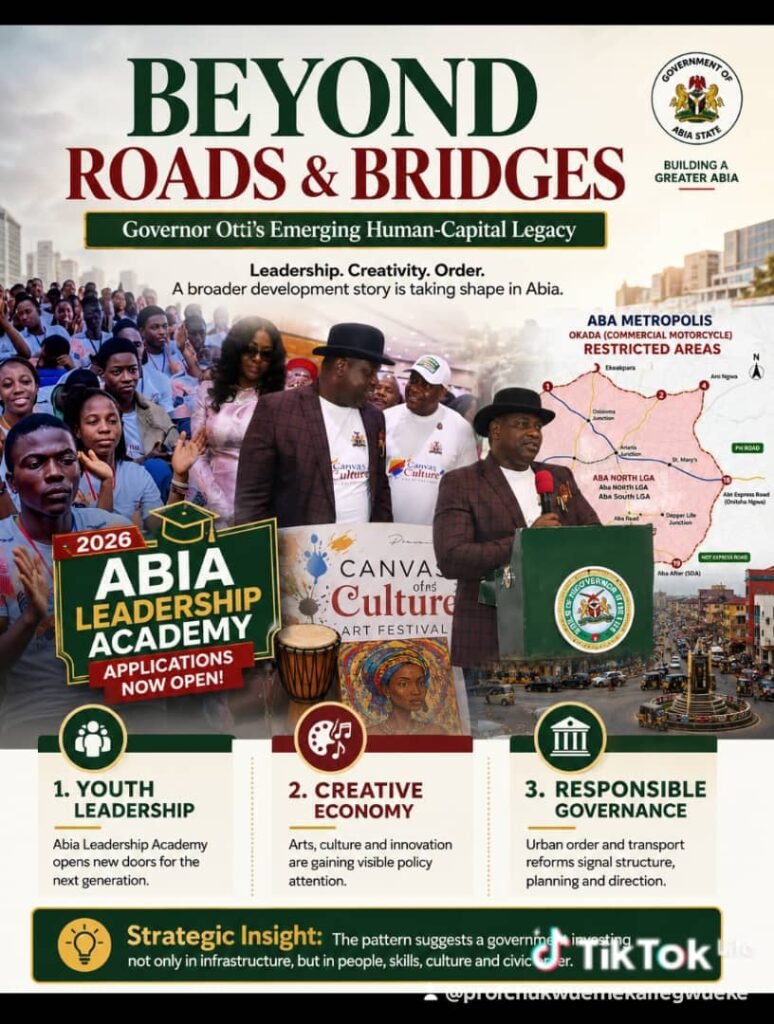
The opening of applications for the 2026 Abia State Leadership Academy provides another dimension to the human-capital agenda.
According to its official portal, the Academy was established to promote service, excellence, leadership and value creation among young people and other groups within the state’s social and economic ecosystem. The 2026 leadership boot camp is open to eligible young people aged 16 to 20, and applications are free.
This is significant because societies do not produce responsible leaders by accident. Young people must be exposed early to discipline, ethics, critical thinking, public service, entrepreneurship and community responsibility.
The Academy can become an important institution if it avoids political patronage and selects participants transparently. Its long-term value will depend on the quality of its curriculum, facilitators, mentoring system and post-training opportunities.
The real measure of success will not be the number of young people photographed at an event. It will be the number who subsequently establish businesses, lead community initiatives, develop innovations or demonstrate responsible citizenship.
Evidence and official application portal:
Application information:
Official confirmation that applications are free:
THE CREATIVE ECONOMY AS AN ECONOMIC ASSET
The 2026 Canvas and Culture Art Festival adds another important element to the emerging development story.
The festival, promoted through the Abia State Ministry of Arts, Culture and Creative Economy, brought attention to visual arts, cultural identity, creativity and the commercial possibilities associated with the creative sector.
Culture should not be treated merely as entertainment. Around the world, film, fashion, music, design, publishing, photography, advertising, crafts and digital content provide employment and generate substantial revenues.
Abia already possesses commercial energy, indigenous enterprise, fashion production, craftsmanship and a strong cultural identity. A coherent creative-economy policy could connect these existing strengths to tourism, technology, intellectual-property protection, export promotion and youth employment.
Festivals are useful for visibility, but festivals alone do not create a sustainable creative economy. The government must proceed from celebration to institution-building by supporting creative hubs, training programmes, exhibition spaces, grants, business incubation and access to markets.
Evidence:
The Whistler:
https://thewhistler.ng/abia-backs-arts-culture-festival-to-boost-economy-identity/
Canvas and Culture Festival report:
https://ojembamagazine.com/abia-state-ministry-of-culture-set-to-host-canvas-and-culture-art-festival-2026/
URBAN ORDER, TRANSPORTATION AND RESPONSIBLE GOVERNANCE
The restriction of commercial motorcycle operations within parts of Aba, Umuahia and Ohafia represents the government’s attempt to address security, traffic management and urban order.
The policy has been presented as part of a transition towards a safer and more organised transportation system. Maps identifying restricted areas were also circulated to clarify the boundaries of enforcement.
Urban regulation is necessary. A modern city cannot function effectively where transport operations are completely unregulated, road safety is routinely ignored and criminal elements can exploit an informal transport system.
Nevertheless, responsible governance requires more than prohibition. It must also provide practical alternatives for citizens whose livelihoods and daily movements are affected.
The policy should therefore be accompanied by affordable buses, tricycles or other regulated transport options; transparent enforcement; clearly marked terminals; public sensitisation; and protection against extortion or abuse by enforcement personnel.
A policy designed to create order must not produce unnecessary hardship. Its success should be assessed through changes in crime, accident rates, traffic flow, commuting costs and public satisfaction—not merely through the number of motorcycles impounded.
Evidence:
The Punch:
https://punchng.com/insecurity-otti-bans-commercial-motorcycle-operations-in-aba-others/
Vanguard:
https://www.vanguardngr.com/2026/06/security-clampdown-abia-bans-okada-operations-in-umuahia-aba-ohafia/
Leadership Newspaper:
https://leadership.ng/abia-bans-commercial-motorcycles-in-umuahia-aba-ohafia-from-june-22/
Daily Post:
https://dailypost.ng/2026/06/29/abia-govt-urges-compliance-as-taskforce-begins-okada-ban-enforcement/
MAKING SENSE OF THE PATTERN
The smart school develops knowledge and technological capacity.
The Leadership Academy seeks to cultivate character, service and leadership.
The Canvas and Culture initiative recognises creativity as an economic resource.
The urban transportation reforms seek to strengthen security, planning and civic order.
Together, these initiatives suggest that the administration is attempting to move beyond the conventional understanding of development as the construction of physical projects alone.
Roads connect communities, but educated and skilled citizens create economic value.
Bridges facilitate movement, but responsible leaders build trustworthy institutions.
Modern buildings improve the appearance of a state, but creativity, technology and human capability determine whether the economy can compete.
This does not mean that every initiative should be accepted without scrutiny. Government announcements must be followed by implementation, adequate funding, transparent selection processes and independently verifiable outcomes.
The smart-school model should be expanded and evaluated. The Leadership Academy should remain inclusive and non-partisan. Creative-economy programmes should produce measurable jobs and enterprises. Transport reforms must provide affordable alternatives and protect citizens from arbitrary enforcement.
The strongest defence of any government is not publicity. It is evidence of sustained improvements in learning, employment, security, productivity and quality of life.
STRATEGIC INSIGHT
Governor Otti’s emerging legacy may eventually be judged not only by the number of roads reconstructed or public structures commissioned, but by whether Abia produces better-educated children, more responsible young leaders, commercially successful creative talents and safer, better-organised cities.
That is the broader development story taking shape.
It is a movement beyond roads and bridges—from rebuilding physical infrastructure to developing the people who will determine Abia’s future.