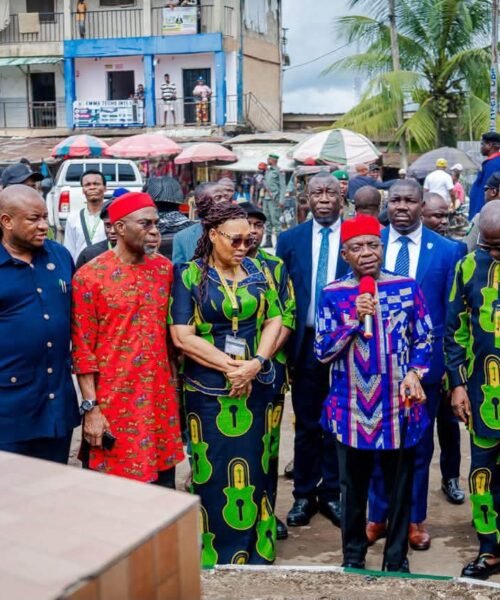



Ezutah: Our Policy Makers Don’t Seem To Appreciate The Importance Of Physical Devt Plans
Lekwa Ezutah, a former President, Nigerian Institute of Town Planners (NITP), in this interaction with journalists, speaks on Nigeria’s environmental hazards, majority of which have been blamed on lack of a sound and efficient development/master plans. Sunday Ojeme reports
There’s been much negative talk about the non-liveability of most of our towns and cities. Is that not an indictment on an institute such as the Nigerian Institute of Town Planners (NITP), with a membership of over 6,000?
Thank you for that question. First, it is important to appreciate that physical planning is the foundation upon which liveable, functional, safe and sustainable human settlements are built. The quality of our cities and towns is directly related to the quality of planning that guides their development.
However, it would be unfair to place the responsibility solely on the Nigerian Institute of Town Planners. Physical planning is primarily a government responsibility.
The role of the NITP is largely advisory, advocacy-oriented and professional, while the responsibility for policy formulation, implementation, funding and enforcement rests with governments at the Federal, State and Local Government levels.
One of the major challenges in Nigeria is that physical planning has not received the level of attention it deserves. Planning is often viewed as a regulatory activity rather than a strategic investment in economic growth, environmental sustainability and social well-being.
Consequently, planning agencies are poorly funded, understaffed and unable to effectively prepare, implement and monitor development plans. Another critical challenge is the shortage of professional town planners.
While countries such as the United Kingdom have approximately one planner for every 2,500–3,000 people and Australia about one for every 2,700 people, Nigeria has approximately one planner for every 40,000–45,000 people. This huge gap limits our ability to prepare and manage physical development frameworks for our settlements.
Many of our cities have grown faster than the plans guiding them. Urbanization in Nigeria is occurring at one of the fastest rates in the world. Cities such as Abuja, Lagos, Kano, Port Harcourt and Ibadan continue to attract thousands of people every day.
When growth occurs without corresponding planning, infrastructure provision and development control, the result is traffic congestion, slums, flooding, environmental degradation and declining quality of life.
The NITP has consistently advocated for the preparation and implementation of master plans, regional plans, urban renewal programmes and development control mechanisms. The Institute has also continued to advise governments that planning is not a cost but an investment.
Well-planned cities attract investors, create jobs, improve property values, reduce infrastructure costs and enhance economic productivity. Therefore, the challenge is not the absence of professional knowledge but the inadequate application of planning principles in governance and development decisions.
There are ongoing discussions about the disruption of the Abuja Master Plan by both government and private developers. Can you educate us on this?
The Abuja Master Plan is internationally recognised as one of the most comprehensive city development plans in Africa. It was designed to create a city that is orderly, efficient, environmentally sustainable and capable of accommodating future growth.
The Master Plan was based on important planning principles such as compatibility of land uses, accessibility, environmental protection, social equity and balanced urban development. Every land use allocation within the city was carefully determined after extensive technical studies and projections.
One of the most important provisions of the Master Plan is the allocation of approximately one-third of the city’s land area to green spaces, parks, open spaces and ecological conservation areas. These spaces were not included merely for beautification.
They serve critical functions such as flood control, climate regulation, air purification, recreation and biodiversity conservation.
Unfortunately, over the years, there have been increasing cases of land use conversions where areas originally designated for green spaces, public institutions, recreational facilities and other public purposes have been converted to residential and commercial developments. Such alterations may generate shortterm financial gains but often create long-term planning problems.
For example, when a green area is converted into a housing estate, the city loses part of its natural flood-control mechanism.
Similarly, when land reserved for schools, hospitals or public facilities is converted to other uses, future generations suffer shortages of essential services. The concern of the planning profession is not that changes should never occur. Cities are dynamic and must evolve.
However, changes must follow due process through proper technical studies, environmental assessments, stakeholder consultations and statutory approval procedures.
The Abuja Master Plan itself provides for periodic reviews approximately every five years. Such reviews ensure that emerging realities are accommodated without undermining the original planning concepts. What planners oppose are arbitrary changes driven by individual interests rather than the collective
One of the major challenges in Nigeria is that physical planning has not received the level of attention it deserves. Planning is often viewed as a regulatory activity rather than a strategic investment in economic growth, environmental sustainability and social well-being
public good. The long-term success of Abuja depends on preserving the integrity of its planning framework while adapting responsibly to changing circumstances.
Isn’t the disruption of the Master Plan caused by housing demand pressure?
Not necessarily. Housing demand is indeed increasing, but the Abuja Master Plan made extensive provisions for residential development. The city was designed with multiple development phases, satellite towns and future expansion areas. specifically to accommodate population growth.
The challenge is less about a shortage of land and more about the tendency to seek immediate financial gains through land use conversions. There are still substantial undeveloped areas within the Federal Capital Territory where residential developments can occur in accordance with approved plans.
A properly planned city balances housing with transportation, schools, hospitals, recreational facilities, commercial activities and environmental protection. Sacrificing one component to satisfy another ultimately reduces the quality of life for everyone.
Isn’t greenery a luxury only for people who are already comfortably settled?
Absolutely not. Green spaces are not luxuries; they are essential urban infrastructure. Modern research demonstrates that urban greenery contributes significantly to public health, environmental sustainability and climate resilience.
Trees and vegetation absorb carbon dioxide, release oxygen, moderate urban temperatures, reduce noise pollution and improve mental health. Green areas also play a crucial role in flood management.
During heavy rainfall, vegetated surfaces absorb and enable slow runoff, reducing the risk of flooding. This is particularly important as cities face increasing climate change impacts. Many of the world’s most successful cities deliberately preserve substantial green space.
Canberra, Wellington, Ottawa and Singapore are examples of cities that recognize the economic, environmental and social value of urban greenery. In Abuja, preserving green areas is even more important because they were intentionally integrated into the city’s original design to achieve harmony between development and nature.
You are an advocate of Site-and-Service. How does it work?
The Site-and-Service approach involves the government acquiring land, preparing a layout, providing basic infrastructure such as roads, water supply, drainage, electricity and sewage systems; and then allocating serviced plots to individuals or developers.
The beneficiaries construct their buildings according to approved specifications and development guidelines. This approach reduces the cost burden on citizens because infrastructure provision is one of the most expensive components of housing development.
It also allows the government to guide urban growth in an orderly manner. Countries such as Botswana, Kenya and Tanzania have successfully used Site-and-Service schemes to improve housing delivery.
Won’t investors hijack the scheme and exclude genuine home seekers from accessing housing?
That risk exists, but it can be managed through transparent allocation procedures and effective regulations. More importantly, housing policy should focus not only on home ownership but also on increasing housing availability. When more houses are built, supply increases and pressure on rents decreases.
A healthy housing market requires a combination of owner-occupied housing, rental housing, public housing and private investment. Investors are therefore not necessarily the enemy. Their investments can increase housing stock and improve affordability if properly regulated.
How can Nigeria’s mortgage sector become more effective?
The mortgage sector faces several structural challenges. High inflation, high interest rates, low-income levels and rising construction costs make mortgages unaffordable for many Nigerians. For the mortgage system to function effectively, several reforms are necessary.
These include: Reduction in mortgage interest rates; Longer repayment periods of 20–30 years; Increased government support for affordable housing; Expansion of the National Housing Fund; Strengthening of primary mortgage institutions; Improved land titling systems; Lower building material costs through local production.
In countries where mortgage systems work effectively, housing finance is supported by stable economic conditions and predictable incomes.
Nigeria must address these broader economic issues if mortgage financing is to become a realistic option for the majority of citizens. Until then, alternative housing delivery approaches such as Site-and-Service schemes, cooperative housing and public-private partnerships will remain important tools for addressing the housing deficit.
How can you explain to the common man on the street what master plan is all about?
It is a blueprint for guiding the physical growth of settlements – towns and cities. It is a comprehensive long term, 20- 25 years, policy guide of how the town or city shall grow over time.
The various land uses (residential, commercial, industrial, recreational, agricultural, transportation) are deliberately arranged taking into consideration physical planning principles such as compatibility, complementarity etc the aim being to ensure the settlement is functional, beautiful and economically viable. Physical development plans remain one of the most effective instruments for orderly development and creation of livable settlement.
How does it impact positively or negatively on the common man?
Physical Development Plans, master plans inclusive, prioritize public good over private/individual interest. It therefore negatively impacts anyone whose interest does not align with the public interest.
The positive impact of the master plan far outweighs the negative impact – the Physical Development Plan lays the foundation for livable settlements – orderly, functional, viable and beautiful cities and towns.
Livable towns and cities attract investors, investors generate employment and employment generates income which enhances the people’s wellbeing.
Why do people not strictly adhere to plans and easily get away with flaunting it?
Like I said earlier, Physical Development Plans prioritize the public interest over private interest. This generates resistance. For example a developer may want to erect a commercial building on a land designated for public use due to increase in land values.
The developer may apply any means available to him to achieve his goal. Of course, there is also the general indiscipline in our society.
How true is it that some cities in Nigeria have no master plans?
The truth is that only few cities have master plans in Nigeria. It is mostly the state capitals that have master plans. Unfortunately, most of these are not being religiously implemented.
Our policy makers don’t seem to appreciate the importance of physical development plans; provisions are therefore not made for the preparation and implementation of master plans in the budget We must appreciate that physical development plans and economic development plans as two sides of the same coin.
Physical Development Plans ensures facilities & services are equitably distributed thereby promoting social equity and inclusiveness. It also ensures the assignment of the right location at the right time for the right activity thereby enhancing functionality and aesthetics.
Countries that have realised the nexus between economic and physical planning have progressed much faster; the Asian Tigers provide good examples of the result of paying adequate attention to both economic and physical planning.
Does non-adherence to the provisions of a master plan cause flooding?
Non-adherence to the provisions of the master plan doesn’t automatically cause flooding but it is one of the biggest planning related causes . Heavy rainfall , blocked drains ( both natural and man made) , inadequate man made drainage channels , etc can cause flooding .
A master plan is basically a guide to the physical development of a settlement taking into consideration the natural attributes of the area – terrain , slope , absorptive capacity of the soil , vegetation , rainfall etc . It deals with the physical development components of a city – land use , environment , infrastructure including transportation routes , environment , drainage channels etc .
It provides where to build , how much to build , where water should go . Ignore these provisions and build at the wrong places , pave too much , block drainage channels , flood management breaks down and flooding becomes inevitable .
Credit: New Telegraph