
Eke O Ako’s Debt Arithmetic: When Liabilities, Loans and Debt Stock Are Thrown Into One Pot
Eke O Ako has produced what looks, at first glance, like an intimidating collection of figures against the Abia State Government. Unfortunately, once the figures are separated into their proper accounting categories, much of the dramatic conclusion begins to wobble. 😂 Numbers may be stubborn, but numbers placed in the wrong columns can also become very obedient servants of propaganda.
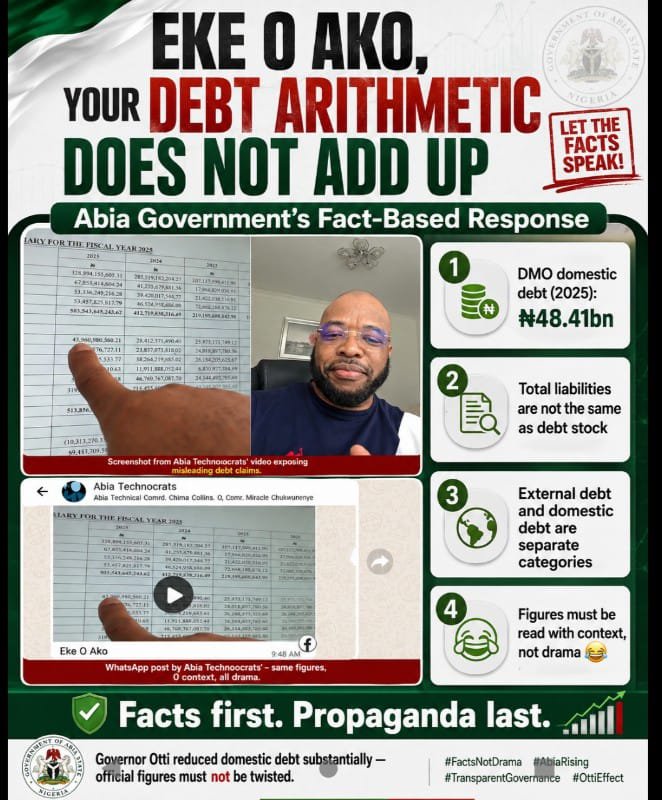
The first problem with Eke O Ako’s argument is elementary: total liabilities in a government financial statement are not automatically synonymous with DMO public-debt stock. A statement of liabilities can contain obligations such as payables, contractors’ liabilities and other recognised commitments, depending on the accounting framework being used. DMO debt statistics, on the other hand, specifically report public debt stock. Governor Alex Otti himself had earlier explained that the DMO figure did not necessarily capture inherited salary, pension and contractor obligations when discussing the debt inherited by his administration.
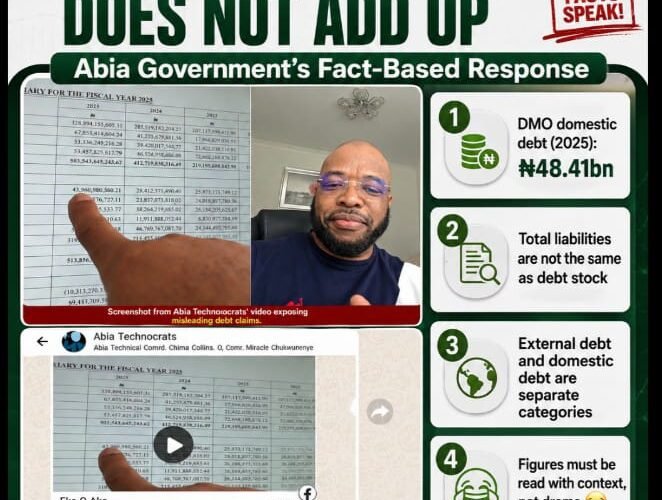
So, when Eke O Ako takes a purported “total liabilities” figure of about ₦203 billion and places it directly against the DMO domestic-debt figure of approximately ₦48.41 billion, he is comparing different accounting aggregates and then shouting, “Gotcha!” 😂 That is not forensic accounting. It is category confusion.
What does the DMO actually say? As at 31 December 2025, Abia State’s domestic debt stock stood at ₦48,410,403,758.61. That is an official DMO number. Independent analysis of the DMO series also shows that Abia’s domestic debt declined sharply from roughly ₦138 billion in 2023 to about ₦48.5 billion by the end of 2025. Whatever political language anybody wishes to use, that is a very substantial reduction.
Therefore, when Governor Otti speaks about bringing a major component of Abia’s debt burden down to below ₦50 billion, the ₦48.41 billion DMO domestic-debt figure is not a number manufactured inside Government House. It is published by Nigeria’s Debt Management Office.
Now to the external debt. Yes, the DMO reports Abia State’s external debt at US$107,163,236.46 at the end of 2025. Nobody serious should hide it. But Eke O Ako’s presentation creates another problem: foreign-currency debt cannot simply be converted at whichever naira exchange rate produces the most frightening social-media headline and then casually added to another accounting figure without specifying the valuation basis, reporting date and accounting treatment.
Indeed, available analysis of the DMO data acknowledges both sides of the story: Abia’s domestic debt fell dramatically while external debt rose moderately over the period. One analysis estimates the domestic decline at about 66 per cent between 2023 and 2025 while external debt increased by roughly 14 per cent in dollar terms. That is the balanced way to report it. One does not erase the domestic-debt achievement merely because external obligations exist.
Then comes the “Otti borrowed” argument. Here again, Eke O Ako needs to separate approval of a facility, drawdown of an inherited or previously negotiated facility, disbursement of an external programme loan and the contracting of a brand-new commercial debt by the current administration. Those are not automatically the same event.
In 2024, the Abia Government publicly maintained that certain AfDB and Islamic Development Bank facilities had been approved but had not at that point been drawn. In April 2025, Governor Otti also stated, while discussing DMO figures, that his administration had reduced the inherited domestic debt without borrowing a new dime. By July 2025, his publicly stated policy was that any borrowing considered necessary would be tied to productive investment rather than consumption.
If Eke O Ako wishes to establish that a specific 2024 or 2025 drawdown constitutes a new loan originated, negotiated, approved and contracted entirely by the Otti administration, then he should publish the facility agreement, approval date, lender, project, tenor, disbursement schedule and date of execution. Merely pointing at a line called “loan proceeds” does not settle all those questions.
This is where the laughter enters again. 😂 You cannot take an inherited multilateral facility, a fresh drawdown, domestic debt, external debt, contractors’ obligations and every other liability, throw them into one accounting soup and then announce that the Governor has been caught. Accounting has classifications for a reason.
There is also a mathematical problem in repeatedly describing Governor Otti’s statement as simply “₦191 billion reduced to ₦48 billion.” Public reports of his May 2026 media interaction indeed quote him as saying that the state’s debt profile had fallen significantly, from about ₦191 billion in 2023 to below ₦50 billion at the end of 2025. But an intellectually serious criticism should first establish precisely what constituted the ₦191 billion opening stock and ensure that the closing figure being compared uses exactly the same classification. Otherwise, the critic himself commits the very statistical offence he accuses the Governor of committing.
Eke O Ako also asks: “Where are Governor Otti’s ₦700 billion projects?”
That line sounds dramatic, but capital expenditure is not synonymous with “money spent only on roads.” Capital budgets and capital expenditure encompass infrastructure across transportation, education, health, public buildings, water, security-support infrastructure and other development assets. For example, Abia’s 2026 budget presentation allocated substantial capital resources not merely to roads but also education, health and other sectors.
So demanding that every naira classified as capital expenditure must appear physically as one giant pile of roads worth ₦700 billion is another accounting misunderstanding.
On roads specifically, Governor Otti publicly reported in May 2026 that 414 roads measuring approximately 864.12 kilometres had been reconstructed within three years, with another 82 roads measuring about 212 kilometres under construction. It is perfectly legitimate to demand a comprehensive road-by-road schedule showing location, length, contractor, contract sum and status. Transparency benefits government itself. But demanding documentation is different from declaring, without establishing contrary evidence, that the projects do not exist.
And that “Abia should now look like Dubai” joke? 😂 Governance is not an Instagram beauty filter. Capital expenditure is evaluated against actual public assets, service improvements and measurable outcomes—not whether Umuahia suddenly acquires the Burj Khalifa.
The intellectually responsible conclusion is therefore straightforward.
Eke O Ako has correctly identified some individual DMO numbers, particularly the ₦48.41 billion domestic debt and the US$107.16 million external debt. But his larger argument becomes defective when he mixes DMO debt stock with financial-statement liabilities, treats every loan-related entry as necessarily a fresh Otti-originated borrowing, converts foreign debt without carefully stating the valuation methodology, and treats capital expenditure as if it must equal road expenditure alone.
That is the problem.
The real fiscal story is not that Abia miraculously has no obligations. No responsible government makes such a claim. The significant story is that the state’s domestic debt burden has fallen dramatically—from roughly ₦138 billion in 2023 to about ₦48.41 billion by December 2025 according to DMO data.
That deserves acknowledgement even from critics.
So, Eke O Ako, next time you bring the calculator, please bring the accounting classifications with it. 😂
Because figures can be correct individually and still produce a spectacularly wrong argument when the analyst mixes apples, oranges, liabilities, debt stock, foreign exchange and capital expenditure inside the same political basket.
Criticise Governor Otti where the evidence warrants it. Demand project schedules. Demand audited accounts. Demand transparency. But please—do not prosecute an accountant with arithmetic that ignores accounting.
That case collapses before cross-examination.